
What happened
This podcast explores how Xi Jinping countered Donald Trump's trade war. Despite a temporary truce, China leveraged its rare earth dominance, a strategic choke point for modern technology. The discussion highlights China's long-term strategy, the US response, and the escalating economic warfare between the superpowers.
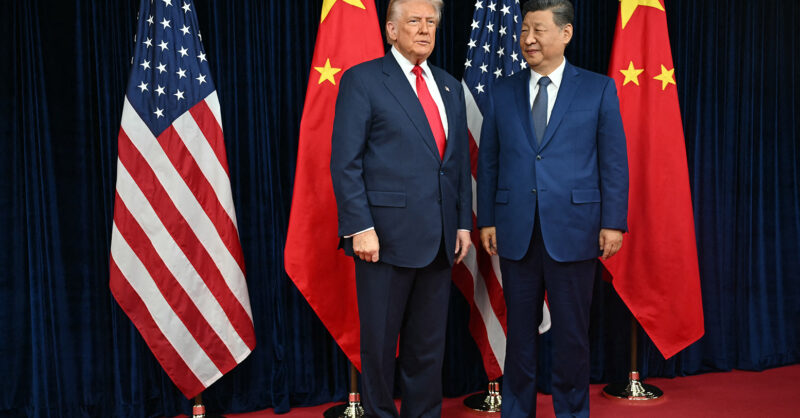
Photo by Andrew Caballero-Reynolds / AFP Ahead of meeting with China’s leader Xi Jinping in South Korea yesterday (30 October), Donald Trump was confidently predicting a major deal. “We’ll make a deal on, I think, everything,” Trump told reporters at the White House last week. “I think we’re going to make a deal on maybe even nuclear,” he said.
But it didn’t work out quite like that. After 90 minutes of talks at a South Korean air force base in Busan, Trump inevitably pronounced the meeting “amazing” and rated it “a 12” out of ten, lavishing praise on Xi. “He’s a great leader, great leader of a very powerful, very strong country, China, and we, what can I say?
We have, it was an outstanding group of decisions, I think that was made.” Those decisions amount to an agreement by China to “immediately” resume buying American soybeans, which Beijing had halted in response to Trump’s “Liberation Day” tariffs in April, hurting US farmers. Trump wrote on social media that Xi had agreed to “begin the process of purchasing American Energy,” suggesting that a “very large scale transaction may take place concerning the purchase of Oil and Gas from the Great State of Alaska.
” Crucially, Beijing also agreed to a year-long pause in the export controls it had announced on rare earths on 9 October, which had prompted Trump to threaten to impose an additional 100 per cent tariff on all Chinese goods, amounting to a virtual trade embargo. In return, Trump cut the tariffs he had imposed on China over its alleged role in fentanyl production – the US says chemicals used to make the drug originate in China – from 20 per cent to 10 per cent on the expectation that Beijing will “work very hard” to curtail those chemical exports.
This will reduce the overall tariff rate on Chinese exports to the US from 57 per cent to 47 per cent. Trump also discussed semiconductors with Xi, agreeing that US chipmaker Nvidia could negotiate its own deals with Beijing, while suggesting that the US would retain a role in any future talks. “I said that’s really between you and Nvidia, but we’re sort of the arbitrator,” Trump recounted on the long flight back to Washington.
It was unclear what this would mean in practical terms. He insisted they had not talked about Nvidia’s most advanced chips, which China has long sought to acquire and Washington has equally long sought to block. Nor did they broach the fraught issue of Taiwan, which has been subjected to a concerted Chinese military pressure campaign in recent months.
“Taiwan never came up,” Trump said. “It was not discussed.” The final reciprocal measures included the US agreeing to suspend for one year the port fees it had recently begun charging Chinese ships, with China doing the same for US vessels. Washington will also pause the export controls it announced in September on subsidiaries of Chinese companies that are already on a US blacklist, preventing them from being able to access some US-made products and advanced technology.
“We have a deal,” Trump concluded after the talks, before adding an important qualification. “Now, every year we’ll renegotiate the deal, but I think the deal will go on for a long time, long beyond the year. But all of the rare earth has been settled, and that’s for the world.” Subscribe to The New Statesman today from only £8.
99 per month Trump being Trump, of course all geopolitics must be rendered into the language of deals. But the more accurate term for what he has just agreed with Xi is a truce. And a decidedly uneasy one at that. The great victories he is claiming amount to little more than a return to the status quo before he launched his global trade war on “Liberation Day”.
In other words, Trump has largely succeeded in tamping down a fire that he started. That hardly qualifies as a triumph of dealmaking or statesmanship. Far from the issue of rare earths being “settled,” Xi has demonstrated just how much of a stranglehold China has established over this vital commodity – the country currently produces around 90 per cent of the world’s processed rare earths and associated magnets – and that he is absolutely prepared to leverage that dominance.
Renegotiating that deal on a continual basis means the global economy will never be more than a Truth Social post away from the resumption of hostilities between the world’s two largest economies, at least as long as Trump is in power. Perhaps that is why, despite his characteristic hyperbole, the global markets’ response to the news was notably flat.
In the short term, it is good news for both the US and China that their leaders have managed to agree a pause in the cycle of escalating brinkmanship and retaliatory measures that had threatened to derail both their own economies, and many others around the world. But the medium- and longer-term outlook is less rosy, particularly for Washington.
Both sides have succeeded in identifying the other’s pressure points and, in Xi’s case, to identify Trump’s pain threshold. The lesson he is likely to take from Trump’s first nine months back in power is that punching back against the US president’s trade threats is the best course of action, and that the associated market turmoil will cause his opponent to back down.
Xi will presumably emerge from the initial rounds of this contest only more determined to preserve China’s control over the supply of rare earths. It is far from certain that Trump will approach the issue of US pre-eminence over the most advanced semiconductors with the same degree of focus, particularly if he believes there is an impressive-sounding deal to be had.
The two leaders are expected to meet in China in April, followed by a meeting in the US later in the year, which could be “in Florida, Palm Beach or Washington DC,” according to Trump. That prospect, at least, gives them another incentive to keep the relationship more-or-less on the rails until then, although it is hardly the same as, say, the comprehensive trade deal that Trump had trailed in advance.
As for Trump’s prediction that he would reach a deal with Xi on “nuclear”, he blew that one up himself by announcing, minutes before their meeting, that the US would resume nuclear testing “on an equal basis” with other countries. Again, he did not specify what, exactly, this would mean. Trump’s remarks seemed to be directed towards Vladimir Putin, who has claimed that Russia successfully tested a nuclear-powered and nuclear capable cruise missile, along with a nuclear-powered torpedo, in recent days.
He later insisted his comments had not been aimed at China, which has been rapidly accelerating its own capabilities and is thought to possess the world’s third largest nuclear arsenal, but this is unlikely to reassure Beijing. So much for securing that promised deal on “everything”. Xi might be content to agree a truce with Trump for now, but he will be under no illusions about the broader strategic contest the two powers have now embarked upon, whether his US counterpart realises it, or not.
[Further reading: Our universities can save us from America’s political division] Content from our partners
Source coverage
Here is a comprehensive summary of the news article, interpreting its content and numerical data with appropriate context.
---
Deeper analysis
Full source content
Photo by Andrew Caballero-Reynolds / AFP Ahead of meeting with China’s leader Xi Jinping in South Korea yesterday (30 October), Donald Trump was confidently predicting a major deal. “We’ll make a deal on, I think, everything,” Trump told reporters at the White House last week. “I think we’re going to make a deal on maybe even nuclear,” he said.
But it didn’t work out quite like that. After 90 minutes of talks at a South Korean air force base in Busan, Trump inevitably pronounced the meeting “amazing” and rated it “a 12” out of ten, lavishing praise on Xi. “He’s a great leader, great leader of a very powerful, very strong country, China, and we, what can I say?
We have, it was an outstanding group of decisions, I think that was made.” Those decisions amount to an agreement by China to “immediately” resume buying American soybeans, which Beijing had halted in response to Trump’s “Liberation Day” tariffs in April, hurting US farmers. Trump wrote on social media that Xi had agreed to “begin the process of purchasing American Energy,” suggesting that a “very large scale transaction may take place concerning the purchase of Oil and Gas from the Great State of Alaska.
” Crucially, Beijing also agreed to a year-long pause in the export controls it had announced on rare earths on 9 October, which had prompted Trump to threaten to impose an additional 100 per cent tariff on all Chinese goods, amounting to a virtual trade embargo. In return, Trump cut the tariffs he had imposed on China over its alleged role in fentanyl production – the US says chemicals used to make the drug originate in China – from 20 per cent to 10 per cent on the expectation that Beijing will “work very hard” to curtail those chemical exports.
This will reduce the overall tariff rate on Chinese exports to the US from 57 per cent to 47 per cent. Trump also discussed semiconductors with Xi, agreeing that US chipmaker Nvidia could negotiate its own deals with Beijing, while suggesting that the US would retain a role in any future talks. “I said that’s really between you and Nvidia, but we’re sort of the arbitrator,” Trump recounted on the long flight back to Washington.
It was unclear what this would mean in practical terms. He insisted they had not talked about Nvidia’s most advanced chips, which China has long sought to acquire and Washington has equally long sought to block. Nor did they broach the fraught issue of Taiwan, which has been subjected to a concerted Chinese military pressure campaign in recent months.
“Taiwan never came up,” Trump said. “It was not discussed.” The final reciprocal measures included the US agreeing to suspend for one year the port fees it had recently begun charging Chinese ships, with China doing the same for US vessels. Washington will also pause the export controls it announced in September on subsidiaries of Chinese companies that are already on a US blacklist, preventing them from being able to access some US-made products and advanced technology.
“We have a deal,” Trump concluded after the talks, before adding an important qualification. “Now, every year we’ll renegotiate the deal, but I think the deal will go on for a long time, long beyond the year. But all of the rare earth has been settled, and that’s for the world.” Subscribe to The New Statesman today from only £8.
99 per month Trump being Trump, of course all geopolitics must be rendered into the language of deals. But the more accurate term for what he has just agreed with Xi is a truce. And a decidedly uneasy one at that. The great victories he is claiming amount to little more than a return to the status quo before he launched his global trade war on “Liberation Day”.
In other words, Trump has largely succeeded in tamping down a fire that he started. That hardly qualifies as a triumph of dealmaking or statesmanship. Far from the issue of rare earths being “settled,” Xi has demonstrated just how much of a stranglehold China has established over this vital commodity – the country currently produces around 90 per cent of the world’s processed rare earths and associated magnets – and that he is absolutely prepared to leverage that dominance.
Renegotiating that deal on a continual basis means the global economy will never be more than a Truth Social post away from the resumption of hostilities between the world’s two largest economies, at least as long as Trump is in power. Perhaps that is why, despite his characteristic hyperbole, the global markets’ response to the news was notably flat.
In the short term, it is good news for both the US and China that their leaders have managed to agree a pause in the cycle of escalating brinkmanship and retaliatory measures that had threatened to derail both their own economies, and many others around the world. But the medium- and longer-term outlook is less rosy, particularly for Washington.
Both sides have succeeded in identifying the other’s pressure points and, in Xi’s case, to identify Trump’s pain threshold. The lesson he is likely to take from Trump’s first nine months back in power is that punching back against the US president’s trade threats is the best course of action, and that the associated market turmoil will cause his opponent to back down.
Xi will presumably emerge from the initial rounds of this contest only more determined to preserve China’s control over the supply of rare earths. It is far from certain that Trump will approach the issue of US pre-eminence over the most advanced semiconductors with the same degree of focus, particularly if he believes there is an impressive-sounding deal to be had.
The two leaders are expected to meet in China in April, followed by a meeting in the US later in the year, which could be “in Florida, Palm Beach or Washington DC,” according to Trump. That prospect, at least, gives them another incentive to keep the relationship more-or-less on the rails until then, although it is hardly the same as, say, the comprehensive trade deal that Trump had trailed in advance.
As for Trump’s prediction that he would reach a deal with Xi on “nuclear”, he blew that one up himself by announcing, minutes before their meeting, that the US would resume nuclear testing “on an equal basis” with other countries. Again, he did not specify what, exactly, this would mean. Trump’s remarks seemed to be directed towards Vladimir Putin, who has claimed that Russia successfully tested a nuclear-powered and nuclear capable cruise missile, along with a nuclear-powered torpedo, in recent days.
He later insisted his comments had not been aimed at China, which has been rapidly accelerating its own capabilities and is thought to possess the world’s third largest nuclear arsenal, but this is unlikely to reassure Beijing. So much for securing that promised deal on “everything”. Xi might be content to agree a truce with Trump for now, but he will be under no illusions about the broader strategic contest the two powers have now embarked upon, whether his US counterpart realises it, or not.
[Further reading: Our universities can save us from America’s political division] Content from our partners
How this page is built
Goose Pod turns cited reporting into a public episode summary first, then pairs that summary with audio playback so listeners can check the source material before they decide how deeply to engage.
The goal is to make this page useful as a news landing page first, while still giving listeners transcript access, related episodes, and direct links back to the original publishers.