
Tom Bankswww
Good morning 跑了松鼠好嘛, I'm Tom Bankswww, and this is Goose Pod, specially for you. Today is Tuesday, November 04th. I'm excited to dive into some truly out-of-this-world predictions.
Mask
And I'm Mask, ready to explore the future with you, Tom. Today, we're discussing Jeff Bezos's bold vision: millions of people living in space by 2045, with robots commuting to the moon for us. It’s a future that demands our attention, demanding we push beyond current limits.
Tom Bankswww
That's quite a headline, Mask, it really makes you stop and think about where we're headed. But before we get too lost in Bezos's 2045 vision, our core event today actually brings us back to some immediate challenges in space exploration, particularly with NASA and its lunar landing contracts.
Mask
Indeed, Tom, it’s a stark reminder that even the grandest visions face earthly hurdles. We're seeing NASA opening up SpaceX's $4 billion moon landing contract to competition, a move driven by delays with Elon Musk's Starship spacecraft. Delays are unacceptable when the stakes are this high, especially with China vying for lunar dominance.
Tom Bankswww
It’s a real space race, isn’t it? Acting NASA Administrator Sean Duffy expressed significant concerns about the U.S. falling behind. It’s a bit like the Cold War era again, but with private companies leading the charge. You can almost feel the historical weight of it all.
Mask
Historical weight or not, Tom, the reality is that SpaceX needs to demonstrate crucial technologies, like orbital refueling and completing a full orbital mission, before that planned 2027 lunar landing. This isn't just about showing off; it's about proving capability and executing a mission critical to human expansion.
Tom Bankswww
And it seems Jeff Bezos's company, Blue Origin, is ready to step in, having secured a $3.4 billion contract in 2023 for its own lunar lander, aiming for human astronauts by 2029. It's fascinating to see these titans of industry, once competing in e-commerce, now battling it out for lunar supremacy.
Mask
Blue Origin is a viable alternative, and competition is always a catalyst for innovation and accelerated progress. Duffy even anticipates Blue Origin getting involved in this new competition, which is precisely what we need. We can't afford to be complacent, especially when the goal is to get humanity off-world.
Tom Bankswww
It’s a significant shift, considering NASA awarded SpaceX that initial contract back in 2021. The pressure is clearly on to make good on these ambitious timelines. The Artemis II mission, launching astronauts around the moon as early as next year, really sets the stage for these lunar landings.
Mask
The Artemis missions are critical, Tom, but a circumlunar flight is not a landing. The last time humans were on the moon was 1972, and that's far too long ago. We need to push harder, faster. The delay with Starship, while understandable from a technical perspective, means we lose precious time in this critical race.
Tom Bankswww
I agree the timeline is stretched, Mask. It's a testament to the immense engineering challenges involved. We're talking about putting humans back on the moon, a feat that still inspires awe. It's not just about the technology, but the human spirit of exploration.
Mask
It is about the technology, Tom, primarily. The human spirit requires the tools to manifest its ambition. If one tool isn't ready, we must develop another, or another company must step up. This is a critical juncture, and there's no room for sentimentality, only results.
Tom Bankswww
It truly highlights the high stakes, not just for the companies involved, but for national prestige and humanity's future in space. These contracts, these delays, they're all part of a much larger narrative unfolding before our eyes.
Tom Bankswww
Shifting gears a bit, Mask, to understand these futuristic visions, it helps to look at the historical context of AI development. It's been a long journey, really, starting much earlier than many people realize.
Mask
A long journey, perhaps, Tom, but the exponential acceleration is what truly matters. From simple concepts to complex systems, the foundational elements of AI, though rudimentary by today's standards, set the stage for our current disruptive capabilities.
Tom Bankswww
It’s fascinating to think back to 1965, when Herbert Simon boldly predicted that 'machines will be capable, within twenty years, of doing any work a man can do.' A grand statement, certainly, though perhaps a bit premature given the realities.
Mask
Premature, yes, but the ambition was there, the vision for a transformed future. And even in 1965, I.J. Good hypothesized that 'the first ultraintelligent machine is the last invention that man need ever make,' a testament to the ultimate power AI represents.
Tom Bankswww
Yet, even then, there were skeptics. Hubert Dreyfus published 'Alchemy and AI' in 1965, arguing against the idea of the mind as a computer and suggesting limitations to AI progress. It’s a debate that continues, in different forms, even today.
Mask
Skepticism is a natural byproduct of true innovation, Tom. While others debated, Terry Winograd developed SHRDLU in 1968, an early program for natural language understanding. These were the crucial, tangible steps, not just theoretical musings.
Tom Bankswww
And by 1968, we even had *2001: Space Odyssey* with Hal, a sentient computer, captivating audiences. It showed how much the public imagination was already grappling with these ideas, long before the technology truly caught up.
Mask
The public imagination, while important, doesn't build rockets or algorithms, Tom. It was the sustained, relentless effort that led to milestones like Richard Wallace's A.L.I.C.E. chatbot in 1995, building on Joseph Weizenbaum's ELIZA. These were functional, interactive systems.
Tom Bankswww
It's incredible to trace the lineage, from Alan Turing's Bombe machine in 1942, aiding in cracking Enigma codes, to his 1950 proposal for a test of machine intelligence. These were the very seeds of what we call AI today.
Mask
Seeds that blossomed, Tom. John McCarthy coined the term 'Artificial Intelligence' in 1955, solidifying the field. He even created the Lisp language, a fundamental tool for early AI development. This wasn't just theory; it was immediate, practical application.
Tom Bankswww
Then came the tangible applications, like Unimate, the first industrial robot, introduced in 1961 on a General Motors assembly line. Or Shakey, the first general-purpose mobile robot in 1969, capable of perceiving and planning. It’s like watching a child learn to walk, then run.
Mask
And run it did, Tom. IBM's DeepBlue defeating Garry Kasparov in 1997 wasn't just a chess match; it was a monumental demonstration of machine intelligence. Kismet, the robot capable of emotional interactions by 1998, pushed the boundaries of human-machine interface. This was a clear trajectory.
Tom Bankswww
Then, the 2000s brought AI into our homes. Roomba in 2002, Siri on the iPhone in 2008, Alexa in 2014. These weren't just novelties; they were practical tools, seamlessly integrating into daily life, making the abstract concept of AI very real for millions.
Mask
Integration is key, Tom, but the true leap was in generative capabilities. IBM Watson winning Jeopardy in 2011, Sophia the humanoid robot becoming a citizen, Amper composing music, and then GPT-3 in 2020. These weren't just following rules; they were creating, generating, disrupting.
Tom Bankswww
And now, here we are in 2025, where over 75% of enterprise companies have integrated some form of AI. It’s reshaping workflows, speeding up tasks, enhancing decision-making. It’s everywhere, like electricity, as some have said.
Mask
Precisely, Tom. Voice AI is nearly indistinguishable from humans, AI Co-Pilots are becoming common across all departments. This is the 'maturity and integration' phase. It's not just a cost center anymore; it's a revenue driver, creating new opportunities and efficiencies, and it’s only accelerating.
Tom Bankswww
It’s a powerful force, certainly. And with that power comes the need for regulation, as we're seeing with new frameworks in the EU, India, and the US, governing data use, transparency, and bias detection. It’s a responsible step, ensuring this incredible technology serves humanity, not the other way around.
Tom Bankswww
This leads us nicely into the conflict, Mask. With such rapid advancements, there's a strong debate about the future of humanity, especially concerning AI and space colonization. Some envision utopias, others, well, dystopias.
Mask
Dystopian narratives are a weakness, Tom. They reflect a lack of courage, a fear of the unknown. We are facing a 'dystopia overload,' as some call it, when we should be imagining better, more optimistic futures. Solarpunk, with its sustainable technologies, is a step in the right direction, a necessary counter to the pervasive gloom.
Tom Bankswww
I can see that perspective, Mask, but even cyberpunk, which started as a critical and pessimistic look at late capitalism and technology, eventually became aestheticized and commercialized. It seems even our critical visions can be co-opted, losing their initial bite.
Mask
That's a failure of execution, not vision, Tom. The commercialization simply proves the power of these narratives. Shows like *Black Mirror*, which are closer to 'nowpunk,' use subtle extrapolations of the present to highlight potential dangers. These serve a purpose, to wake people up, to show the precipice.
Tom Bankswww
But are they always accurate? AI specialists and roboticists often point out the unrealistic portrayal of AI and robots in Hollywood. If the warnings aren't grounded in reality, do they truly help us envision realistic futures, or are they just for entertainment?
Mask
Entertainment can be a powerful vehicle for ideas, Tom. And in response to 'Black Mirror,' futurists propose 'White Mirror,' to create more positive scenarios, or 'protopia,' acknowledging a complex reality with both positive and negative aspects. The point is to engage, to push the boundaries of what's imaginable, not to retreat into fear.
Tom Bankswww
And yet, the philosopher Hans Jonas advocated for 'warning futurology,' focusing on forecasting negative probabilities to identify what should be avoided. He emphasized prudence, a 'voluntary break' against excesses of power, rather than blindly rushing towards any future.
Mask
Prudence is valuable, Tom, but it can also be a handbrake on progress. Jonas criticized progressive Marxist utopias and even capitalist versions that envision happiness solely through automation and consumer goods. While resources are finite, human ingenuity is not, and we must not let caution paralyze us.
Tom Bankswww
But he also cautioned against technological determinism and over-reliance on technology, warning that 'the opposite of hope is not fear, but prudence.' It's about finding that balance, isn't it? Not just for the sake of progress, but for responsible progress.
Mask
Responsible progress means acknowledging the risks, Tom, and then mitigating them. It does not mean halting the inevitable march forward. The debate between utopian and dystopian narratives, or between unbridled ambition and cautious prudence, is vital. It forces us to define the future we truly want to build, and then we build it, despite the nay-sayers.
Tom Bankswww
Speaking of building the future, Mask, let's talk about the profound impact AI and automation are already having, particularly on the future of work and society. It's not just a distant prediction; it's happening now.
Mask
The impact is undeniable, Tom. AI and automation are fundamentally transforming businesses, driving unprecedented economic growth through sheer productivity gains. This isn't just about making things easier; it's about making them vastly more efficient, solving problems previously thought insurmountable.
Tom Bankswww
And it's addressing major societal challenges, too, like improving diagnostic times in healthcare or refining climate models. But there's also the human cost to consider, the transformation of jobs. Some occupations will decline, others will grow, and many more will change significantly.
Mask
Change is inevitable and necessary, Tom. We're looking at potential displacement of 15% to 30% of the global workforce by 2030, but equally, new jobs will be created, often in emerging economies, offsetting those losses. This isn't a jobs apocalypse; it's a re-skilling imperative.
Tom Bankswww
But that re-skilling, that transition, it's a huge undertaking. Workers will need new skills, from advanced technological proficiency to social-emotional intelligence and higher cognitive abilities. The demand for physical and manual skills will decline, which will be a seismic shift for many.
Mask
And a necessary one. This shift will accelerate, Tom. The old ways of working are simply not efficient enough for the future. We must adapt, embrace human-machine collaboration, and redesign work itself. Those who resist will be left behind.
Tom Bankswww
However, this transition also puts pressure on wages, potentially exacerbating income inequality. We need to rethink income support, perhaps through universal basic income or adapted social safety nets, to ensure no one is left behind in this rapid transformation.
Mask
While that's a societal concern, Tom, the focus for business leaders must be on safely embracing AI. Data security, privacy, mitigating bias—these are critical, not just ethical considerations, but foundational for successful widespread adoption. We must ensure the systems we build are robust and trustworthy.
Tom Bankswww
And it's a mixed picture, isn't it? Some research suggests AI complements human skills, augmenting productivity, especially for older, experienced workers. Yet, other studies show declines in employment for early-career workers in AI-exposed occupations, suggesting AI can automate rather than augment.
Mask
It simply means the nature of work is changing, Tom. Routine, repetitive tasks are being automated, allowing skilled workers like architects and engineers to leverage AI to augment their capabilities, increasing their value. This is about elevating human potential, not diminishing it.
Tom Bankswww
So, it’s about understanding where AI fits, where it truly adds value, and where human ingenuity remains irreplaceable. The future of work isn't just about machines; it's about how we, as humans, adapt and thrive alongside them.
Tom Bankswww
Looking ahead, Mask, to the future, both Jeff Bezos and Elon Musk paint incredibly ambitious pictures of humanity's destiny among the stars. It's a vision that truly captures the imagination.
Mask
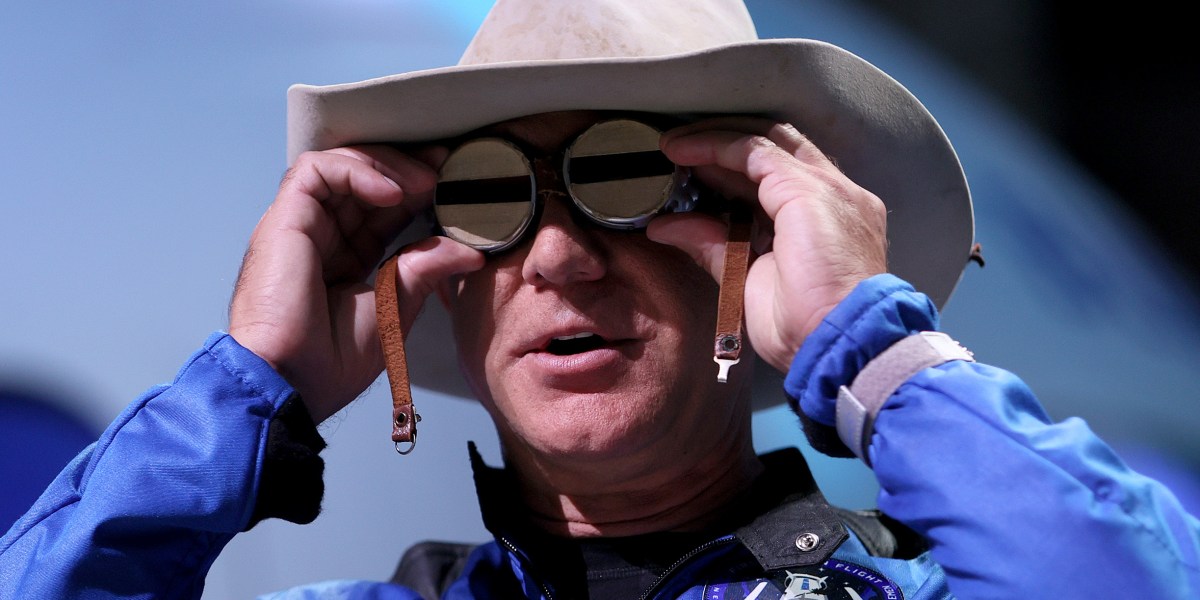
Imagination is merely the first step, Tom. Bezos predicts a future where people will be born in space, visiting Earth 'the way you visit, you know, Yellowstone National Park.' This isn't just space tourism; it's a fundamental shift in human existence, a new frontier for life itself.
Tom Bankswww
That's a profound thought, being born off-world and seeing Earth as a heritage site. It really makes you ponder our place in the universe, doesn't it? The sheer scale of that vision is breathtaking.
Mask
It's not just breathtaking, Tom; it's the inevitable next stage of human evolution. And Elon Musk, he's laid out a detailed plan at Starbase for turning humanity into an interplanetary species. This isn't a fantasy; it's an engineering challenge, and we are meeting it head-on.
Tom Bankswww
So, we're talking about not just living in space, but truly becoming a multi-planetary species. What does that mean for our identity, our connection to this planet we call home? It’s a future that asks deep questions of us.
Mask
It means expanding our identity, Tom. Our connection to Earth will be as a cradle, a historical origin. But our future, our survival, demands we become a spacefaring civilization. This is the ultimate insurance policy for humanity, ensuring our long-term existence beyond the confines of a single planet.
Tom Bankswww
It’s a bold and somewhat unsettling thought, to see Earth as merely a park to visit, but it also speaks to an incredible human drive to explore and conquer new frontiers. These visions are truly shaping where we might be headed.
Tom Bankswww
That's a lot to ponder, Mask, from lunar landing contracts to humanity's interplanetary future. Thank you for joining me, 跑了松鼠好嘛, on this journey through the ambitious predictions of tech giants.
Mask
It's been a privilege, Tom. The future isn't just coming; we are building it, piece by piece, challenge by challenge. Keep pushing the boundaries, 跑了松鼠好嘛. This is Goose Pod, and we'll see you next time.