

What happened
Report Provider: The Guardian
Author: Sid Lowe
Date/Time Period Covered: The article discusses Zubimendi's recent move to Arsenal and his preparations for World Cup qualifiers with the Spain team, which were scheduled for Saturday and Tuesday of the week of publication. The interview also references events from the past year, including Liverpool's interest and...
Mikel Arteta knew and so did Win. Dogs just do. “Well, of course,” Martín Zubimendi says, cracking up. The July day he walked through the doors at the Arsenal training centre, the club’s resident chocolate labrador – a therapy dog the head coach had brought in to bring the kind of calm wanted from the new signing too – was the first to welcome him.
“It was lovely. I arrived with my parents, my agent, a small group, and she came straight to me, sat by me, rolled on the floor at my feet; that was very nice.”It was also the way he would have wanted it, part of the plan. “She’s a bit like yours,” the sporting director, Andrea Berta, offered as Win lent against the midfielder’s legs.
Zubimendi’s dog, Lea, hadn’t made it to London – he’s hoping she will soon – but this was a good start. There was a letter from Mikel Merino and a video call from Martin Ødegaard, teammates at Real Sociedad, yet no friendlier face than this. That can help when you’re departing the city you were born in and the club where you have been since you were 12.
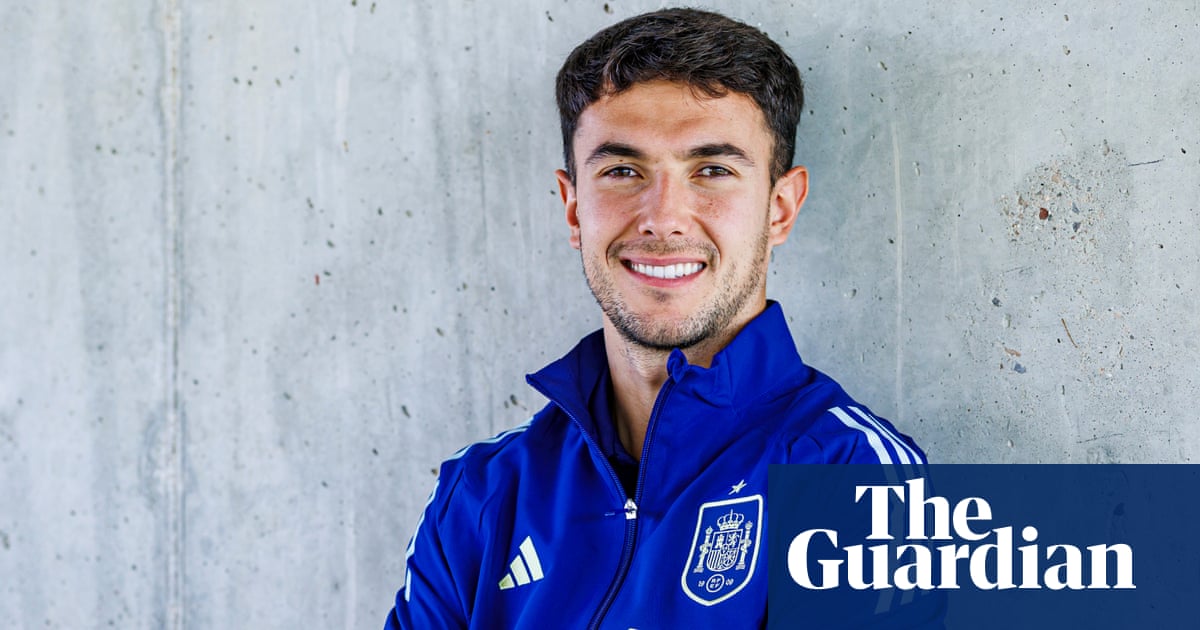
Zubimendi’s welcome at Arsenal included meeting Win, Arsenal’s therapy dog. Photograph: David Price/Arsenal FC/Getty Images“I hadn’t left home yet; going was a radical change,” Zubimendi says, and there is a glimpse of that here, at Las Rozas with the Spain team, preparing for World Cup qualifiers against Georgia in Elche on Saturday and Bulgaria in Valladolid on Tuesday.
When you’re away, he admits, you appreciate these moments even more. “The climate, the language, and above all it’s lovely being with these mates – the atmosphere is great,” Zubimendi says. “But the change was what I was looking for. I didn’t have too many doubts.”Not any more, not by this summer. A year earlier, Zubimendi had chosen not to leave home, where he has had the same mates since he was three or four.
Arne Slot admitted that Liverpool had tried everything to sign him and he had listened but, unlike his teammates, friends and fellow European champions Robin Le Normand and Merino, he didn’t take the final step. Twelve months on, he did. Why wait? What changed?There is a pause. “When any proposal comes, the first question has to be whether to stay at la Real,” he says.
“And it wasn’t the right moment [to go]. I stayed and it was a hard season but I learned a lot. I wanted to step forward, take that weight after others went.” Fans appreciated his staying. “Well, until you do decide to go,” he says, smiling. “But I’ve always tried to choose the right time and I’m happy with how it happened in the end.
“I had watched Arsenal and I liked everything I saw, in terms of passion, youth, the feeling you got watching them. And when Mikel Arteta called me … Well, if you’ve ever spoken to him you’ll know that he can be very convincing. He’s mad about football, crazy about having everything under control, trying to get something from every little detail.
He’s very clear on everything and the proposal he had was the best for me.”The leap wasn’t so great, not once he got the initiation out the way. “The worst thing in football,” he calls it; by his own admission, he is quite reserved, after all. “I had to sing: I did La Bachata, by Manuel Turizo.” And how was it?
“Horrible, horrible.”Otherwise, it has gone well, although he misses Lea. Merino and Ødegaard are there. A footballer’s life is similar anywhere, Zubimendi believes, adaptation not so hard. He lives less than 10 minutes from the training ground, north of the city but with London only a train ride away.
And he had studied English, even if it’s one thing to think you understand the language and another to turn up and test that. On the pitch, the proposal fit perfectly, going to a different league good for him.Zubimendi holds off Manchester City’s Erling Haaland during September’s 1-1 draw. Photograph: Stuart MacFarlane/Arsenal FC/Getty ImagesThere is a confidence about him too, born of continuity at the highest level: a stability, a maturity, recognition now too.
He will be at the heart of the Spain team this week. He came on at half-time in the final of Euro 2024, with everyone fearing that Rodri’s injury was a disaster – in the directors’ box, one Basque member of the delegation rounded on Spanish colleagues unable to believe that they didn’t have more faith – and ran the game.
He scored the champions’ first goal back on Spanish soil. And he has started 10 of Spain’s past 11 games.“I always felt that Luis [de la Fuente, the Spain coach] trusted me but when you’re on the pitch [regularly], when you can contribute, you feel more involved in everything. And I do feel that. At half-time, there were nerves for sure.
But doubts? None. It also happened so fast, and was so unexpected that I didn’t have time to think. Often the issue is [mental]. There are players who have the level but the hardest thing is taking that step, finding a way to be yourself.”Zubimendi may be the best in the world in a position where even what it is called says something about how it is conceptualised: the defensive or deep midfielder is a pivot in Spain, the piece upon which it all hinges.
When Rodri got injured, De la Fuente said the City midfielder was the best in the world but, not to worry, he had the second best too. If few followed him then, the debate now may be only about the order. Inside the game, it had already been seen. Slot had little doubt; Arteta had even less. Arsenal’s manager, after all, is from the same city and played for the same team as his new signing: not just Real Sociedad but their local club Antiguoko.
Zubimendi (left) poses with Rodri after Spain’s Euro 2024 final victory over England – his international coach believes the pair are the two best midfielders in the world. Photograph: Pablo GarcíaArsenal, Premier League runners-up three years in a row, a feeling growing that this year has to be their year, were determined to build strength in depth.
“From what teammates have said to me, the problem was the injuries, that when someone got injured, the team came undone,” Zubimendi says.“This year the club has invested a lot in having two players in every position.” In having different types of solutions, too. As for the 26-year-old, he was the central piece, a qualitative leap towards a title challenge, his profile one they didn’t have.
“Actually, I don’t agree with that,” he says. “Because the midfield there was already very strong.”As for the demands of his position, he says: “The pivot has to be someone who is very complete; he has to have the best qualities with the ball and without it, plus the physical capability. He has to be able to do everything.
It completes you [to move]. It would be easy to stay in my comfort zone. But I wanted to leave that environment where I was with Real Sociedad and grow in a personal sense, to see another culture, another football. The more you come out of that, the more you develop.skip past newsletter promotionafter newsletter promotionIt’s in those situations where you are pushed to the limit that you get the best out of yourself.
I think I have a lot to learn in the Premier League, a lot to improve, but I think I can do that.”Well, if he can learn to belt volleys in from 20 yards, as he did against Nottingham Forest last month … Zubimendi laughs. “Just my thing,” he says.Is it as brutal as it looks? “Yes. The mentality is: be a man.
Go into clashes hard. It’s more direct. In Spain when you get the ball, it’s more about keeping it; [in England], whenever you win it, it’s straight on to the attack. Transitions are unavoidable, it’s harder to control. But [handling] that is not about ability as such, it’s getting your mind used to it.
That’s different to La Liga but the thing that has most struck me is the dead ball, how important it is. I’m seeing loads of goals from that and they’re often what opens up the game. We have a set-play coach and we work on that practically daily.Martín Zubimendi jumps for joy after his stunning volley opens the scoring in Arsenal’s 3-0 win over Nottingham Forest in September.
Photograph: Andy Rain/EPA“But I choose a team on the basis of my qualities too: what they wanted from me. I have to adapt my play a bit in terms of playing faster, more direct. I’m a pivot, but in this structure I have the chance to take that step forward and Arteta insists a lot that I can play that final pass and make the difference.
But I think my profile doesn’t change much.If they have signed me it is because they like what I do. They know this is what I can contribute to the team. If I changed my profile it would be an error.”Brought, like Win, to make everyone else feel better, putting them at ease. “Totally reliable,” in De la Fuente’s words, someone who “thinks more about his teammates than himself,” according to Xabi Alonso, his idol first and his coach later.
It’s in the person, and the player. The son of teachers, a little less timid as time passes, he is engaging, warm company but there is no show, no desire to be noticed, just to help.As Spain’s coach put it: “Martín doesn’t get nervous, even if he’s walking along a high-wire without ropes. He’s always so calm, so in control.
”“Well, I look like it, at least,” Zubimendi replies, laughing again. Inside, you’re terrified?“No, I try to be calm because I think in that emotional state I’m going to make better decisions. When it comes to the ‘caffeine’ level I’m cautious.Overstimulation isn’t good. I’m naturally calm. Away from football, too, it’s unlikely you’ll ever see me out of control or overexcited.
But it’s also the confidence and trust I have in my teammates that gives me the tranquillity to know we’ll be fine.”
Source coverage
Report Provider: The Guardian
Author: Sid Lowe
Deeper analysis
Full source content
Mikel Arteta knew and so did Win. Dogs just do. “Well, of course,” Martín Zubimendi says, cracking up. The July day he walked through the doors at the Arsenal training centre, the club’s resident chocolate labrador – a therapy dog the head coach had brought in to bring the kind of calm wanted from the new signing too – was the first to welcome him.
“It was lovely. I arrived with my parents, my agent, a small group, and she came straight to me, sat by me, rolled on the floor at my feet; that was very nice.”It was also the way he would have wanted it, part of the plan. “She’s a bit like yours,” the sporting director, Andrea Berta, offered as Win lent against the midfielder’s legs.
Zubimendi’s dog, Lea, hadn’t made it to London – he’s hoping she will soon – but this was a good start. There was a letter from Mikel Merino and a video call from Martin Ødegaard, teammates at Real Sociedad, yet no friendlier face than this. That can help when you’re departing the city you were born in and the club where you have been since you were 12.
Zubimendi’s welcome at Arsenal included meeting Win, Arsenal’s therapy dog. Photograph: David Price/Arsenal FC/Getty Images“I hadn’t left home yet; going was a radical change,” Zubimendi says, and there is a glimpse of that here, at Las Rozas with the Spain team, preparing for World Cup qualifiers against Georgia in Elche on Saturday and Bulgaria in Valladolid on Tuesday.
When you’re away, he admits, you appreciate these moments even more. “The climate, the language, and above all it’s lovely being with these mates – the atmosphere is great,” Zubimendi says. “But the change was what I was looking for. I didn’t have too many doubts.”Not any more, not by this summer. A year earlier, Zubimendi had chosen not to leave home, where he has had the same mates since he was three or four.
Arne Slot admitted that Liverpool had tried everything to sign him and he had listened but, unlike his teammates, friends and fellow European champions Robin Le Normand and Merino, he didn’t take the final step. Twelve months on, he did. Why wait? What changed?There is a pause. “When any proposal comes, the first question has to be whether to stay at la Real,” he says.
“And it wasn’t the right moment [to go]. I stayed and it was a hard season but I learned a lot. I wanted to step forward, take that weight after others went.” Fans appreciated his staying. “Well, until you do decide to go,” he says, smiling. “But I’ve always tried to choose the right time and I’m happy with how it happened in the end.
“I had watched Arsenal and I liked everything I saw, in terms of passion, youth, the feeling you got watching them. And when Mikel Arteta called me … Well, if you’ve ever spoken to him you’ll know that he can be very convincing. He’s mad about football, crazy about having everything under control, trying to get something from every little detail.
He’s very clear on everything and the proposal he had was the best for me.”The leap wasn’t so great, not once he got the initiation out the way. “The worst thing in football,” he calls it; by his own admission, he is quite reserved, after all. “I had to sing: I did La Bachata, by Manuel Turizo.” And how was it?
“Horrible, horrible.”Otherwise, it has gone well, although he misses Lea. Merino and Ødegaard are there. A footballer’s life is similar anywhere, Zubimendi believes, adaptation not so hard. He lives less than 10 minutes from the training ground, north of the city but with London only a train ride away.
And he had studied English, even if it’s one thing to think you understand the language and another to turn up and test that. On the pitch, the proposal fit perfectly, going to a different league good for him.Zubimendi holds off Manchester City’s Erling Haaland during September’s 1-1 draw. Photograph: Stuart MacFarlane/Arsenal FC/Getty ImagesThere is a confidence about him too, born of continuity at the highest level: a stability, a maturity, recognition now too.
He will be at the heart of the Spain team this week. He came on at half-time in the final of Euro 2024, with everyone fearing that Rodri’s injury was a disaster – in the directors’ box, one Basque member of the delegation rounded on Spanish colleagues unable to believe that they didn’t have more faith – and ran the game.
He scored the champions’ first goal back on Spanish soil. And he has started 10 of Spain’s past 11 games.“I always felt that Luis [de la Fuente, the Spain coach] trusted me but when you’re on the pitch [regularly], when you can contribute, you feel more involved in everything. And I do feel that. At half-time, there were nerves for sure.
But doubts? None. It also happened so fast, and was so unexpected that I didn’t have time to think. Often the issue is [mental]. There are players who have the level but the hardest thing is taking that step, finding a way to be yourself.”Zubimendi may be the best in the world in a position where even what it is called says something about how it is conceptualised: the defensive or deep midfielder is a pivot in Spain, the piece upon which it all hinges.
When Rodri got injured, De la Fuente said the City midfielder was the best in the world but, not to worry, he had the second best too. If few followed him then, the debate now may be only about the order. Inside the game, it had already been seen. Slot had little doubt; Arteta had even less. Arsenal’s manager, after all, is from the same city and played for the same team as his new signing: not just Real Sociedad but their local club Antiguoko.
Zubimendi (left) poses with Rodri after Spain’s Euro 2024 final victory over England – his international coach believes the pair are the two best midfielders in the world. Photograph: Pablo GarcíaArsenal, Premier League runners-up three years in a row, a feeling growing that this year has to be their year, were determined to build strength in depth.
“From what teammates have said to me, the problem was the injuries, that when someone got injured, the team came undone,” Zubimendi says.“This year the club has invested a lot in having two players in every position.” In having different types of solutions, too. As for the 26-year-old, he was the central piece, a qualitative leap towards a title challenge, his profile one they didn’t have.
“Actually, I don’t agree with that,” he says. “Because the midfield there was already very strong.”As for the demands of his position, he says: “The pivot has to be someone who is very complete; he has to have the best qualities with the ball and without it, plus the physical capability. He has to be able to do everything.
It completes you [to move]. It would be easy to stay in my comfort zone. But I wanted to leave that environment where I was with Real Sociedad and grow in a personal sense, to see another culture, another football. The more you come out of that, the more you develop.skip past newsletter promotionafter newsletter promotionIt’s in those situations where you are pushed to the limit that you get the best out of yourself.
I think I have a lot to learn in the Premier League, a lot to improve, but I think I can do that.”Well, if he can learn to belt volleys in from 20 yards, as he did against Nottingham Forest last month … Zubimendi laughs. “Just my thing,” he says.Is it as brutal as it looks? “Yes. The mentality is: be a man.
Go into clashes hard. It’s more direct. In Spain when you get the ball, it’s more about keeping it; [in England], whenever you win it, it’s straight on to the attack. Transitions are unavoidable, it’s harder to control. But [handling] that is not about ability as such, it’s getting your mind used to it.
That’s different to La Liga but the thing that has most struck me is the dead ball, how important it is. I’m seeing loads of goals from that and they’re often what opens up the game. We have a set-play coach and we work on that practically daily.Martín Zubimendi jumps for joy after his stunning volley opens the scoring in Arsenal’s 3-0 win over Nottingham Forest in September.
Photograph: Andy Rain/EPA“But I choose a team on the basis of my qualities too: what they wanted from me. I have to adapt my play a bit in terms of playing faster, more direct. I’m a pivot, but in this structure I have the chance to take that step forward and Arteta insists a lot that I can play that final pass and make the difference.
But I think my profile doesn’t change much.If they have signed me it is because they like what I do. They know this is what I can contribute to the team. If I changed my profile it would be an error.”Brought, like Win, to make everyone else feel better, putting them at ease. “Totally reliable,” in De la Fuente’s words, someone who “thinks more about his teammates than himself,” according to Xabi Alonso, his idol first and his coach later.
It’s in the person, and the player. The son of teachers, a little less timid as time passes, he is engaging, warm company but there is no show, no desire to be noticed, just to help.As Spain’s coach put it: “Martín doesn’t get nervous, even if he’s walking along a high-wire without ropes. He’s always so calm, so in control.
”“Well, I look like it, at least,” Zubimendi replies, laughing again. Inside, you’re terrified?“No, I try to be calm because I think in that emotional state I’m going to make better decisions. When it comes to the ‘caffeine’ level I’m cautious.Overstimulation isn’t good. I’m naturally calm. Away from football, too, it’s unlikely you’ll ever see me out of control or overexcited.
But it’s also the confidence and trust I have in my teammates that gives me the tranquillity to know we’ll be fine.”
How this page is built
Goose Pod turns cited reporting into a public episode summary first, then pairs that summary with audio playback so listeners can check the source material before they decide how deeply to engage.
The goal is to make this page useful as a news landing page first, while still giving listeners transcript access, related episodes, and direct links back to the original publishers.