What happened
Cyberpunk 2077's remarkable comeback is highlighted, having sold over 35 million copies, surpassing The Witcher 3's post-launch sales. This success, fueled by the Phantom Liberty expansion and strategic platform deals, signifies a complete turnaround from its disastrous launch. CD Projekt Red's commitment to fixing...
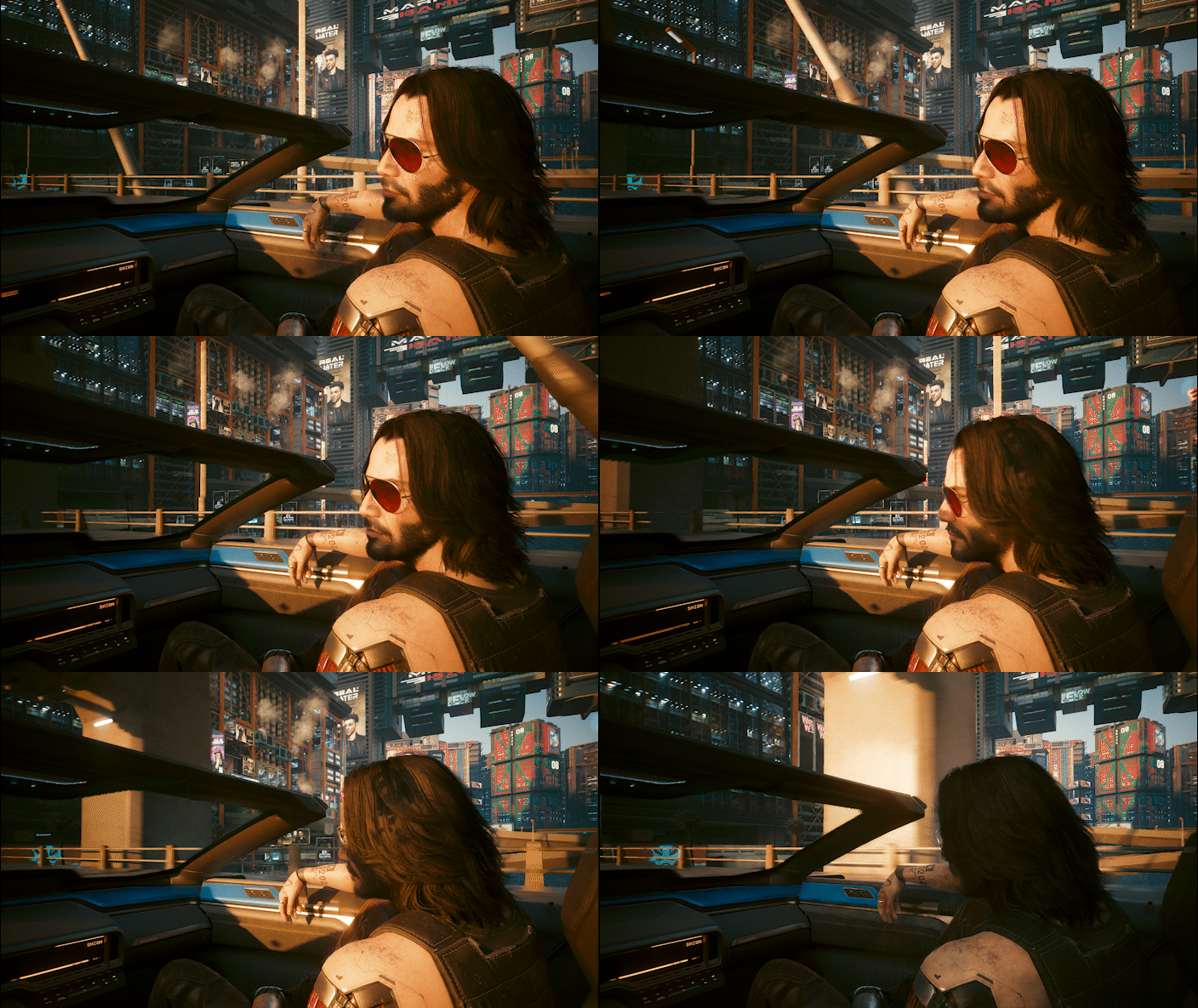
(Image credit: CD Projekt) Remember when Cyberpunk 2077 launched in late 2020, and it was basically the worst videogame ever? That's obviously a gross overstatement made for comedic effect, but it was really bad—which is why the subsequent turnaround on it is so damn remarkable. We've said at least a couple times in the past that Cyberpunk's redemption arc is complete, but here I am to say it again, because yet another big milestone is now in the rear-view.
Cyberpunk 2077 has now sold more than 35 million copies, and that's a hell of an accomplishment for any videogame, but it's still way off the 60 million mark set by The Witcher 3 back in May. As CD Projekt CFO Piotr Nielubowicz explained, however, Cyberpunk has actually surpassed The Witcher 3 in one important measure: It got there faster.
(Image credit: CD Projekt (Twitter))"Gamers have now purchased over 35 million copies of Cyberpunk 2077," Nielubowicz said in comments released as part of today's financial report. "That's a better result than The Witcher 3 was able to achieve in the same post-release time frame."Nielubowicz added that Cyberpunk 2077 is now CD Projekt's "main source of income," having recently received a boost from releases on the Nintendo Switch 2, Macs, and PlayStation Plus, which helped juice sales of the very excellent Phantom Liberty expansion (and really, you should play it if you haven't, it's like a whole separate game) on PlayStation consoles.
[PL/EN] Grupa CD PROJEKT - wyniki finansowe za III kwartał 2025 r. | KOMENTARZ - YouTube Watch On That in turn has powered a big bump in CD Projekt's revenues and profits: Nielubowicz said CD Projekt turned a net profit of 193 million zloty ($53 million), "near two and a half times more than in the past year, and nearly as much as in 2023, which is when the Phantom Liberty expansion was released."
Phantom Liberty, you'll recall, was a big moneymaker for CD Projekt in its own right.So there you have it: Geralt is still out in front, but V is catching up. For a game that once triggered lawsuits, a regulatory investigation, and a multi-billion-dollar kick in the ass that saw its valuation tank by more than 75%, that's quite a turnaround indeed.
Keep up to date with the most important stories and the best deals, as picked by the PC Gamer team. Andy has been gaming on PCs from the very beginning, starting as a youngster with text adventures and primitive action games on a cassette-based TRS80. From there he graduated to the glory days of Sierra Online adventures and Microprose sims, ran a local BBS, learned how to build PCs, and developed a longstanding love of RPGs, immersive sims, and shooters.
He began writing videogame news in 2007 for The Escapist and somehow managed to avoid getting fired until 2014, when he joined the storied ranks of PC Gamer. He covers all aspects of the industry, from new game announcements and patch notes to legal disputes, Twitch beefs, esports, and Henry Cavill.
Lots of Henry Cavill. You must confirm your public display name before commenting Please logout and then login again, you will then be prompted to enter your display name.
Source coverage
This article from pcgamer, written by Andy Chalk, is reporting on CD Projekt's (CDPR) Q3 2025 financial results. It's a huge deal because Cyberpunk 2077 has not only sold over 35 million copies, but it's now actually CD Projekt's biggest money-maker, surpassing even The Witcher 3. The really impressive part? It...
The financials are solid: a net profit of 193 million zloty (about $53 million). That's nearly two and a half times more than the same quarter last year and almost as much as they made in 2023, the year "Phantom Liberty" came out. This proves what a turnaround it is. The game's sales got a big boost from the...
Deeper analysis
Full source content
(Image credit: CD Projekt) Remember when Cyberpunk 2077 launched in late 2020, and it was basically the worst videogame ever? That's obviously a gross overstatement made for comedic effect, but it was really bad—which is why the subsequent turnaround on it is so damn remarkable. We've said at least a couple times in the past that Cyberpunk's redemption arc is complete, but here I am to say it again, because yet another big milestone is now in the rear-view.
Cyberpunk 2077 has now sold more than 35 million copies, and that's a hell of an accomplishment for any videogame, but it's still way off the 60 million mark set by The Witcher 3 back in May. As CD Projekt CFO Piotr Nielubowicz explained, however, Cyberpunk has actually surpassed The Witcher 3 in one important measure: It got there faster.
(Image credit: CD Projekt (Twitter))"Gamers have now purchased over 35 million copies of Cyberpunk 2077," Nielubowicz said in comments released as part of today's financial report. "That's a better result than The Witcher 3 was able to achieve in the same post-release time frame."Nielubowicz added that Cyberpunk 2077 is now CD Projekt's "main source of income," having recently received a boost from releases on the Nintendo Switch 2, Macs, and PlayStation Plus, which helped juice sales of the very excellent Phantom Liberty expansion (and really, you should play it if you haven't, it's like a whole separate game) on PlayStation consoles.
[PL/EN] Grupa CD PROJEKT - wyniki finansowe za III kwartał 2025 r. | KOMENTARZ - YouTube Watch On That in turn has powered a big bump in CD Projekt's revenues and profits: Nielubowicz said CD Projekt turned a net profit of 193 million zloty ($53 million), "near two and a half times more than in the past year, and nearly as much as in 2023, which is when the Phantom Liberty expansion was released."
Phantom Liberty, you'll recall, was a big moneymaker for CD Projekt in its own right.So there you have it: Geralt is still out in front, but V is catching up. For a game that once triggered lawsuits, a regulatory investigation, and a multi-billion-dollar kick in the ass that saw its valuation tank by more than 75%, that's quite a turnaround indeed.
Keep up to date with the most important stories and the best deals, as picked by the PC Gamer team. Andy has been gaming on PCs from the very beginning, starting as a youngster with text adventures and primitive action games on a cassette-based TRS80. From there he graduated to the glory days of Sierra Online adventures and Microprose sims, ran a local BBS, learned how to build PCs, and developed a longstanding love of RPGs, immersive sims, and shooters.
He began writing videogame news in 2007 for The Escapist and somehow managed to avoid getting fired until 2014, when he joined the storied ranks of PC Gamer. He covers all aspects of the industry, from new game announcements and patch notes to legal disputes, Twitch beefs, esports, and Henry Cavill.
Lots of Henry Cavill. You must confirm your public display name before commenting Please logout and then login again, you will then be prompted to enter your display name.
How this page is built
Goose Pod turns cited reporting into a public episode summary first, then pairs that summary with audio playback so listeners can check the source material before they decide how deeply to engage.
The goal is to make this page useful as a news landing page first, while still giving listeners transcript access, related episodes, and direct links back to the original publishers.