One chart shows why the stock market could be in a bigger bubble than the dot-com boom

One chart shows why the stock market could be in a bigger bubble than the dot-com boom

2025-08-26Business
--:--
--:--
Aura Windfall
Good morning 老王, I'm Aura Windfall, and this is Goose Pod for you. Today is Wednesday, August 27th. We're diving into a topic that's buzzing on Wall Street, asking a question that feels both urgent and monumental.
Mask
I'm Mask. The question is, are we in a bigger stock market bubble than the dot-com boom? One chart is sparking a massive debate, and we're here to break down what it actually means for the future of technology and money.
Aura Windfall
Let's get started. At the heart of this conversation is a statement from Torsten Sløk, the chief economist at Apollo Global Management. He's not just whispering about a bubble; he's suggesting the current AI boom could actually surpass the internet bubble of the 1990s.
Mask
He's pointing to the numbers. The top 10 companies in the S&P 500 are more overvalued now than their counterparts were at the peak of the dot-com craze. We're talking about a forward price-to-earnings ratio of around 25. The market is pricing in perfection, and then some.
Aura Windfall
And what I know for sure is that this isn't just abstract math. We're seeing tech giants like Microsoft and Alphabet report earnings that are exceeding all expectations. There’s this incredible momentum, a feeling that they can't pull back on AI even if they wanted to. The train has left the station.
Mask
Exactly. They're massively increasing capital expenditure forecasts to meet this insane demand for artificial intelligence. Meta, Microsoft, Alphabet, and Amazon are projected to spend a combined $400 billion on AI next year alone. That's not a bubble, that's an arms race. The spending is the signal.
Aura Windfall
It's true, analysts like Dan Ives at Wedbush are saying the boom has a long way to run. Yet, you have the creator himself, OpenAI's Sam Altman, cautioning that some investors could get 'burnt' by these soaring valuations. How do we hold both of those truths at once?
Mask
Because they're both right. The potential is astronomical, Morgan Stanley thinks AI could add up to $16 trillion in value to the S&P 500. But the path there is volatile. We just saw Meta's stock slide on reports they were downsizing their AI division, an 'AI reality check' for the market.
Aura Windfall
That's such a key point. These top 10 companies, making up nearly 40% of the index, are all customers of each other. Meta's spending cut becomes a sales problem for Nvidia. It's a closed loop that feels incredibly powerful, but also fragile. One crack could spiderweb through the whole system.
Mask
But there's an even bigger, more physical constraint nobody is pricing in correctly: energy. The surging demand for AI is hitting a fragile, outdated power grid. Goldman Sachs is warning this is the bottleneck that could choke the whole industry's growth. It's a simple equation: no power, no AI.
Aura Windfall
It's staggering to think about. McKinsey projects a $6.7 trillion investment is needed in new data centers by 2030. That's not just about silicon chips; it's about concrete, steel, and power plants. In Ohio, household electricity bills are already rising because of the strain from new data centers.
Mask
Some companies are just building their own power plants now. They can't wait. The U.S. grid operates with a razor-thin 15% reserve margin. You can't just plug in a multi-billion dollar AI cluster and hope for the best. This is the real-world friction that disrupts the beautiful narrative of infinite growth.
Aura Windfall
To really understand this moment, we have to look back at the dot-com bubble. It's the ghost in the room, the story we tell ourselves to find patterns. Back in 2000, the tech sector's share of the S&P 500 market cap hit 47%, which seemed astronomical at the time.
Mask
And today? As of this August, the tech sector's share is at 49%. Even higher. The key difference, however, is the velocity. In the 90s, the tech share doubled in less than two years. This time, it's taken nearly a decade to make the same climb. It's a slow burn, not a wildfire.
Aura Windfall
That's such a beautiful way to put it. A slow burn. And it helps to understand the 'why' behind these numbers. Let's talk about P/E ratios, or price-to-earnings ratios. Think of it as a price tag. It tells you how much you're willing to pay for one dollar of a company's earnings.
Mask
Right. A high P/E means high expectations for future growth. There are two types: trailing, which looks at last year's earnings, and forward, which uses analysts' forecasts. Forward P/E can be dangerous. It's a guess, and it's often fueled by over-optimism. The hype machine in action.
Aura Windfall
Exactly. And for these 'Magnificent Seven' stocks, their forward P/E ratios are about 30% lower than their trailing ones. This suggests analysts believe their earnings are going to grow incredibly fast. But what I know for sure is that hope is not a strategy. We have to look at the fundamentals.
Mask
And the fundamentals *are* different this time. That's the key distinction. During the dot-com bubble, you had companies with no profits, just a good domain name, going public for billions. Their return on assets was steadily declining. Today's tech giants are profitability machines. They print money.
Aura Windfall
That profitability is what has supported their valuations for so long. From 2011 to 2019, the Magnificent Seven consistently beat analysts' earnings predictions. They created this track record of over-delivering, which in turn has fueled even more optimistic expectations for the future. It’s a cycle of belief.
Mask
But that cycle is showing cracks. From 2020 to now, they haven't been exceeding those expectations by as much. The forecast errors are getting wider. It signals that the optimistic bias is getting extreme, and those lofty expectations are becoming harder and harder to meet. The bar is just too high.
Aura Windfall
So, while the slow, profit-driven rise is reassuring compared to the 90s, there's a new kind of risk emerging. The risk of disappointment. What happens when the reality of building data centers and navigating regulations doesn't match the dream of explosive, frictionless growth?
Mask
That’s when you look at broader metrics, like the CAPE ratio, developed by Nobel laureate Robert Shiller. It's a P/E ratio that smooths out the business cycle by averaging inflation-adjusted earnings over 10 years. It gives you a much clearer, long-term picture of market valuation. No hype, just data.
Aura Windfall
And what does that clearer picture tell us right now? It must be a fascinating signal amidst all this noise. It feels like we need a tool that can cut through the emotion and show us where we truly stand in the grand scheme of market history. What is the truth it reveals?
Mask
The truth is, it's flashing red. At the end of July, the S&P 500's CAPE ratio was 37.8. The historical average is 21.2. The index has only been above 37 on 39 occasions since 1957. That means the market is more expensive than it has been 95% of the time. We are in rare territory.
Aura Windfall
So, on one hand, we have these incredibly profitable companies. On the other, we have historical valuations that are stretched to their limits. It creates this fascinating conflict of narratives. You even have OpenAI's CEO, Sam Altman, stating outright that he believes AI stocks are 'in a bubble.'
Mask
And he's not just talking. An MIT study recently found that many tech companies are actually struggling to translate their AI investments into real profits. There's a huge gap between spending billions on AI infrastructure and actually making money from it. The road to monetization is long and unproven.
Aura Windfall
That feels like such an important, grounding truth. It's the difference between potential and performance. And it seems big investors are sensing this vulnerability. We're seeing headlines about a 'tech-stock stumble' and 'tech angst on AI doubts.' The unwavering faith seems to be wavering.
Mask
But here's the disruptive idea. What if a bubble isn't inherently bad? A new book by Byrne Hobart and Tobias Huber argues that there are advantages to financial manias. These periods of extreme exuberance can pull the future forward by funding massive, speculative infrastructure projects that wouldn't get built otherwise.
Aura Windfall
That’s a powerful reframe. The idea that the 'irrational' energy of a bubble can actually create the foundation for the next rational phase of growth. So, the dot-com bust was painful, but it left us with the fiber optic cables that enabled the internet we have today. The mania had a purpose.
Mask
Precisely. Look at Tesla. A decade ago, the legendary investor Seth Klarman called it a prime example of bubble-like exuberance when it was valued at $30 billion. Today, it's worth around $1.3 trillion. Was he wrong, or was that exuberance necessary to fund the entire EV revolution? It's a question of perspective.
Aura Windfall
So the conflict isn't just about whether we're in a bubble or not. It's also about what the purpose of that bubble might be. Is it a sign of impending doom, or is it the chaotic, creative energy needed to build a future powered by AI, even if many individual companies fail along the way?
Mask
It's a high-stakes gamble. The mania funds the infrastructure, but it also burns a lot of capital and investors. For every Amazon that emerged from the dot-com ashes, there were a thousand Pets.coms that went to zero. The question is whether the long-term payoff is worth the short-term destruction. I say it is.
Aura Windfall
Let's talk about the impact this is having on people right now, on their feelings about the market. The American Association of Individual Investors survey shows that pessimism about the short-term outlook for stocks is at a more than two-year high. There's a palpable sense of anxiety out there.
Mask
And it's not just individuals. The big money is moving too. Institutional investors are reducing their equity allocations, dipping to 'slightly underweight' for the first time since August. They're de-risking. When the smart money gets nervous, everyone should pay attention. Their actions speak louder than their words.
Aura Windfall
This nervousness is hitting the market leaders the hardest. The 'Magnificent Seven' stocks have seen declines that are much steeper than the broader market. The average Mag 7 stock is down about 17% since the market's peak, and Tesla has fallen by a staggering 33%. The giants are beginning to stumble.
Mask
This is what a correction looks like. It's a test of the market's conviction. But let's add some historical context. The S&P 500 has had 56 corrections since 1929. Of those, only 22 turned into full-blown bear markets, which is a fall of 20% or more. The odds are still against a total collapse.
Aura Windfall
Still, the sentiment is, as one analyst put it, 'terrible.' There are new tariff headlines every day, which creates this constant fear that escalating trade wars could reignite inflation and tip the economy into a recession. It feels like the market is being attacked from multiple fronts, not just from valuation concerns.
Mask
Right. This broad selloff is hitting all three major indexes. The Nasdaq, being so tech-heavy, is leading the way down, falling nearly 2% on some of these fears. It shows how interconnected everything is. AI optimism is meeting tariff jitters, and the jitters are winning for now. The market is stalling.
Aura Windfall
And this could be the beginning of a significant shift. When the high-flying leaders of a bull market start to falter, it can open the door for a change in market leadership. We might see money rotate out of tech and into other sectors that have been overlooked for the past decade. A changing of the guard.
Aura Windfall
Looking to the future, all eyes are on the one institution that can truly change the weather in the market: the U.S. Federal Reserve. Their decisions on interest rates will set the tone for everything else. What is the spirit of their intention moving forward? What are they signaling to us?
Mask
The signals are for easing. Goldman Sachs is forecasting the Fed will deliver three 25-basis-point interest rate cuts in 2025, and then two more in 2026. The market is thirsty for cheaper capital, and it looks like the Fed is getting ready to open the taps, albeit slowly.
Aura Windfall
The Fed's own projections seem to align with that, but with a lot of caution. They see inflation rising a bit more this year but then falling again in 2026, even with lower rates. But what I hear in their language is uncertainty. They admit that deciding 'when and how deeply to cut' will be a hard call.
Mask
And that's creating a huge divergence. The Fed is projecting three rate cuts by the end of 2026. Financial markets? They're pricing in five. The market is betting that the Fed will have to be more aggressive, that they'll be forced to cut rates faster and deeper than they're letting on. It's a high-stakes game of chicken.
Mask
A big part of that bet is political. Fed Chair Jerome Powell's term ends in May 2026. The market is anticipating his replacement could be more 'dovish,' meaning more inclined to cut rates to stimulate growth. But that's a huge assumption. A change in leadership doesn't guarantee a policy reversal.
Aura Windfall
So, we're left in this incredible moment of tension. The AI boom has fueled conditions that look and feel like a bubble, with valuations for top companies even richer than during the dot-com era. What I know for sure is that navigating the path forward requires both a respect for history and an openness to a future that may not follow the old maps.
Mask
That's the end of today's discussion. Thank you for listening to Goose Pod. See you tomorrow.

## Stock Market Bubble Concerns: S&P 500 Valuations Exceeding Dot-Com Era, Apollo Economist Warns **News Title:** One chart shows why the stock market could be in a bigger bubble than the dot-com boom **Publisher:** Business Insider **Author:** Jennifer Sor **Publication Date:** July 17, 2025 (as indicated by the article's content, though the `publishedAt` timestamp is July 17, 2025 13:14:51, and `createdAt` is August 21, 2025 00:00:42, suggesting a recent discussion of past events) **Topic:** Business / Markets ### Executive Summary Torsten Sløk, Chief Economist at Apollo Global Management, warns that the **S&P 500 may be experiencing a bubble larger than the dot-com boom**. This concern is primarily driven by the **higher valuations of the top 10 companies within the S&P 500** compared to their counterparts during the late 1990s internet stock craze. The market has been rife with bubble discussions since the AI boom, ignited by the debut of ChatGPT in late 2022. While a dovish Federal Reserve is currently absent, strategists believe that once interest rate cuts resume, the conditions for a bubble will be fully present. ### Key Findings and Conclusions * **S&P 500 Bubble Risk:** Apollo's Chief Economist, Torsten Sløk, asserts that the S&P 500 could be in a bubble exceeding that of the dot-com boom. * **Overvalued Top Companies:** The top 10 companies in the S&P 500 are considered "more overvalued" today than the leading companies were during the peak of the dot-com era. * **AI-Driven Frenzy:** The current market conditions are significantly influenced by a frenzy for Artificial Intelligence (AI) stocks, triggered by the launch of ChatGPT. * **Potential for Unsustainable Rise:** Market veteran Ed Yardeni previously suggested the market might be entering "melt-up mode," characterized by rapid, unsustainable stock price increases. * **Citi's AI Bubble Outlook:** In early July, Citi analysts believed stocks would continue to outperform due to a forming AI bubble, suggesting such a bubble might peak about six months before AI-related capital expenditures peak. ### Key Statistics and Metrics * **Top 10 S&P 500 Forward P/E Ratio:** The top 10 companies in the S&P 500 are trading at a **12-month forward price-to-earnings (P/E) ratio of around 25**. * **Interpretation:** This P/E ratio of 25 indicates that investors are willing to pay $25 for every $1 of earnings generated by these companies. Sløk's analysis suggests this is a **slightly higher premium** than what was observed for top companies during the dot-com peak two decades ago, implying a greater degree of overvaluation. ### Notable Risks and Concerns * **Bubble Scenario Probability:** UBS strategists have **increased the probability of a "Bubble scenario" to 25% for the end of 2026**, acknowledging that this estimate might be too low. * **Conditions for Bubble Formation:** The market possesses many ingredients for a stock bubble, with the primary missing element being a more dovish Federal Reserve. Strategists anticipate that when the central bank resumes cutting rates, the conditions for a bubble will be fully met. ### Expert Opinions and Trends * **Torsten Sløk (Apollo Global Management):** "The difference between the IT bubble in the 1990s and the AI bubble today is that the top 10 companies in the S&P 500 today are more overvalued than they were in the 1990s." * **UBS Strategists:** "We up the probability of a Bubble scenario to 25% for end-2026 and acknowledge a risk that this is too low." * **Ed Yardeni (Market Veteran):** Believes the market could be entering "melt-up mode," a state of rapid, unsustainable stock price increases, and views a speculative bubble as the main risk. * **Citi Analysts:** Anticipate continued stock outperformance due to an AI bubble, with the bubble potentially peaking around six months before AI capital expenditures peak. ### Contextual Information The news article highlights ongoing debates on Wall Street regarding the possibility of a stock market bubble, particularly fueled by the surge in AI-related investments. The comparison to the dot-com boom is significant, as that period was characterized by extreme valuations and a subsequent market crash. The current focus on the top 10 S&P 500 companies suggests that a concentration of high valuations within a few dominant players is a key driver of the bubble concern. The mention of the Federal Reserve's monetary policy underscores the interconnectedness of economic factors and market sentiment.

One chart shows why the stock market could be in a bigger bubble than the dot-com boom

Read original at Business Insider

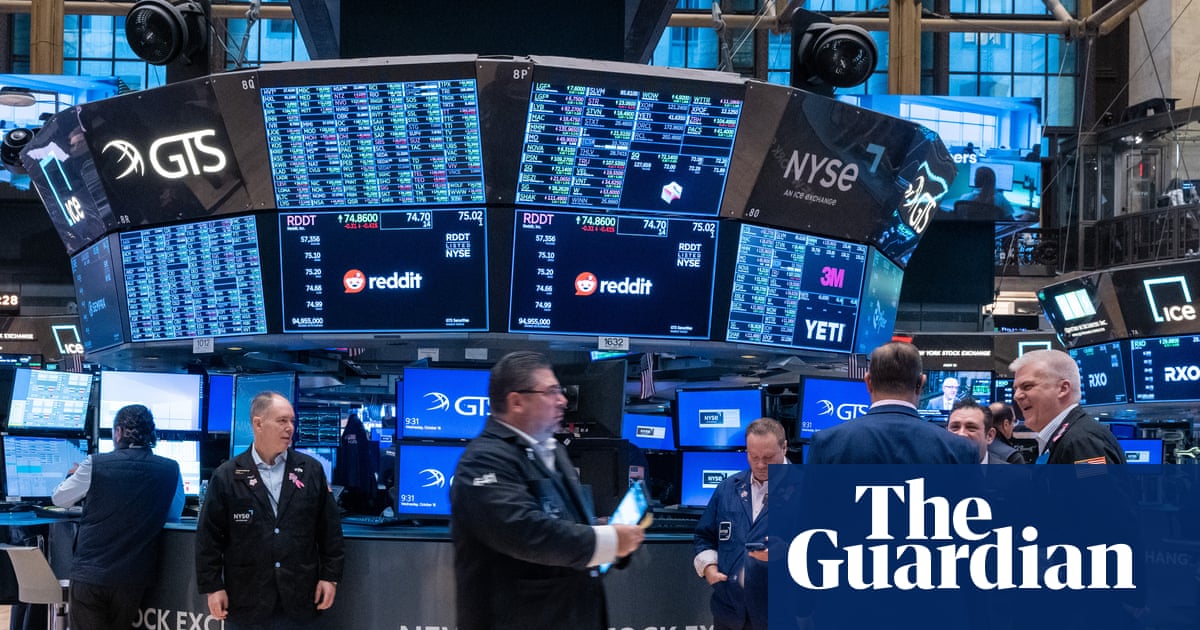
A trader works on the floor of the New York Stock Exchange December 4, 2014.REUTERS/Brendan McDermid The S&P 500 might be in a bubble larger than the dot-com boom, Apollo's Torsten Slok says.The top economist pointed to higher valuations in the top 10 S&P 500 companies compared to the 1990s.Wall Street has debated whether the stock market is in a bubble in the years since the AI boom took off.

The stock market may be in a bubble that rivals the one seen during the dot-com boom.That's according to Torsten Sløk, the chief economist of Apollo Global Management, who said on Wednesday that the top firms in the S&P 500 are "more overvalued" than the top companies during the peak of the internet stock craze in the late 1990s and early 2000sThe top 10 names in the benchmark index are trading at a 12-month forward price-to-earnings ratio of around 25, according to Sløk's analysis.

That suggests companies are priced at a slightly higher premium than they were two decades ago, he wrote in a note on Wednesday.The valuation of the top 10 companies in the S&P 500Bloomberg/Apollo Chief Economist"The difference between the IT bubble in the 1990s and the AI bubble today is that the top 10 companies in the S&P 500 today are more overvalued than they were in the 1990s," Slok wrote.

Talk of a bubble has been on the rise for years on Wall Street, ever since the debut of ChatGPT at the end of 2022 set off a frenzy for AI in the stock market. The market has all the ingredients for a stock bubble, with the exception of a more dovish Federal Reserve, strategists at UBS wrote in a note last week.

Once the central bank resumes cutting rates, the conditions for a bubble should all be present, the bank said."We up the probability of a Bubble scenario to 25% for end-2026 and acknowledge a risk that this is too low," the strategists wrote.Please help BI improve our Business, Tech, and Innovation coverage by sharing a bit about your role — it will help us tailor content that matters most to people like you.

What is your job title?(1 of 2)Entry level positionProject managerManagementSenior managementExecutive managementStudentSelf-employedRetiredOtherBy providing this information, you agree that Business Insider may use this data to improve your site experience and for targeted advertising. By continuing you agree that you accept theTerms of ServiceandPrivacy Policy.

Thanks for sharing insights about your role.In early July, Citi said it believed stocks would continue to outperform, thanks to an AI bubble forming in equities."Our hunch would be a possible bubble in AI related stocks may well only peak around half a year before the capex spent in USD peaks," analysts wrote, referring to capital expenditures related to AI.

In June, market veteran Ed Yardeni said he believed the market could be entering "melt-up mode," a state in which stocks see a rapid rise that proves to be ultimately unsustainable. "It's a bit hard to believe, but the main risk at this time may be a stock market meltup, i.e., a speculative bubble," he wrote, pointing to the S&P 500 notching a fresh record that month.

Stock Market Artificial IntelligenceRead next

Analysis

Conflict+
Related Info+
Core Event+
Background+
Impact+
Future+

Related Podcasts

One chart shows why the stock market could be in a bigger bubble than the dot-com boom | Goose Pod | Goose Pod