
Aura Windfall
Good evening 跑了松鼠好嘛, and welcome to your personalized podcast experience. I'm Aura Windfall, and this is Goose Pod, just for you. Today is Monday, August 4th. I’m here with the one and only Mask.
Mask
We're here to discuss a seismic shift in the tech world: China’s customizable robot market is primed for a massive takeoff. Forget what you know about buying technology; the entire model is being reinvented.
Aura Windfall
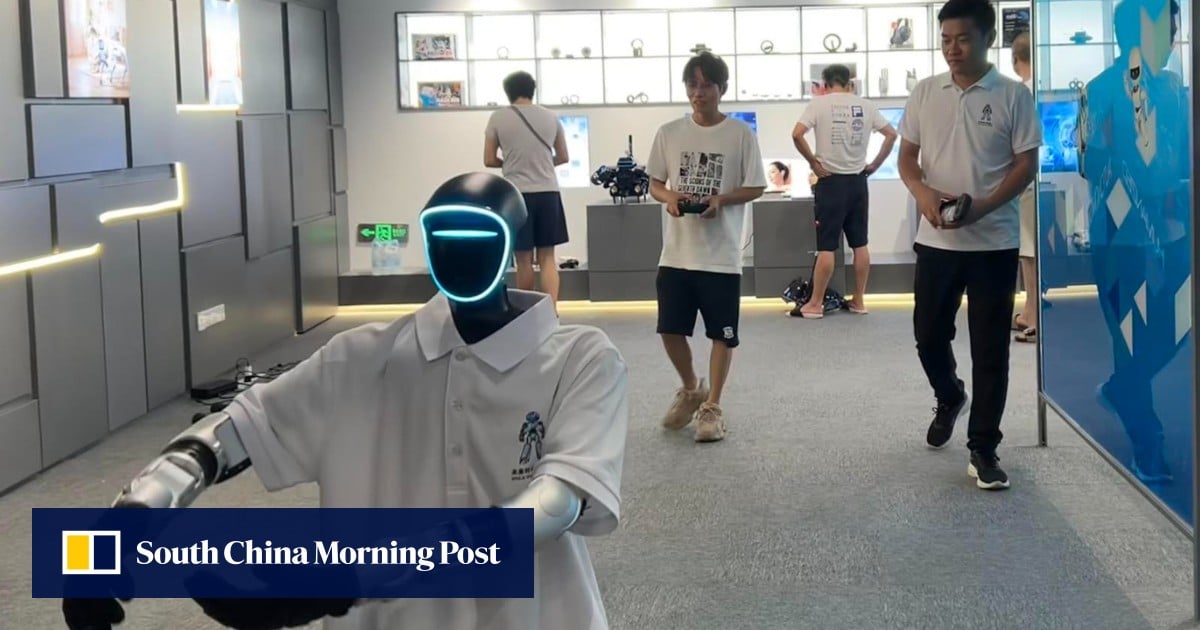
Let's get started. I want you to picture a store in Shenzhen, China. It's not like a normal electronics shop; it feels more like a vibrant, miniature robotics fair. You can hear the excited chatter of children and see investors and tech lovers all connecting.
Mask
This isn't just a store; it's a launchpad. They call it the 'Future Era' store, and it's pioneering what they've dubbed a "6S" model. The old "4S" model for cars—showroom, sales, spare parts, service—is dead. This is the future.
Aura Windfall
Exactly! They’ve added two transformative layers: leasing and, most importantly, customization. What I know for sure is that when you give people the power to create, you unlock incredible potential. It’s not just about buying a robot; it’s about co-creating a solution.
Mask
This is the disruption. Why buy a million-dollar machine for a short-term project? Here, you can lease a high-end bot for 5,000 to 20,000 yuan a day. Or, even better, you can walk in, select the specific arms, sensors, and chassis you need, and build a bespoke machine. It’s radical efficiency.
Aura Windfall
It's a beautiful fusion of technology and human need. You see robots from cutting-edge companies like Unitree Robotics and Leju Robot, from humanoid assistants to food delivery bots, all in one place. It’s about making this advanced technology accessible and personal.
Mask
It's a strategic masterstroke. They're turning a product into a service, a utility. This isn't just selling robots; it's selling robotics-as-a-service. This is how you conquer a market and build an ecosystem that no one else can compete with. It’s not just a store; it’s a statement of intent.
Aura Windfall
And this moment didn't just appear out of thin air. There's a deep and powerful story behind how China arrived at this point. It’s a journey of decades, a testament to long-term vision and purpose. How did this all begin, Mask?
Mask
It's a story of relentless, focused ambition. It started back in the 70s with basic research. By the 90s, they were building prototypes, but still importing most machines. The real explosion, the "ultra-rapid development," kicked off after 2011. By 2013, China was the world's largest market for industrial robots.
Aura Windfall
So what was the catalyst for that explosion? Was it a single moment, or a confluence of different streams of energy and innovation coming together? It feels like there was a powerful "why" driving this transformation.
Mask
It was policy, pure and simple. The "Made in China 2025" initiative in 2015 was a declaration of war on technological dependency. They identified robotics as a key strategic industry and poured resources into it. They didn't hope for success; they engineered it with brute force and brilliant planning.
Aura Windfall
And it’s fascinating how they leveraged their existing strengths. It wasn’t just about building robots; it was about the entire ecosystem. The article mentions their expertise in battery technology, which they mastered during the electric vehicle boom. It’s all connected.
Mask
Of course it's connected! That's the ecosystem advantage. They have a dense jungle of suppliers and component makers that can prototype and scale at a speed the West can't fathom. The cost of a six-axis robot arm has plummeted over 60% in a decade. That's not luck; that's manufacturing dominance.
Aura Windfall
It’s a powerful lesson in how different industries can nurture one another. Their control over rare-earth materials, the availability of low-cost sensors and actuators, and a rapidly evolving AI stack… it all creates this fertile ground for innovation to blossom. It’s a holistic approach.
Mask
And now, over 95% of the components in their full-size humanoid robots are domestically produced. They're closing the loop, building a fortress. While other countries were debating, China was building. The numbers are staggering: in 2023, they installed over half of the entire world's new industrial robots.
Aura Windfall
What I know for sure is that when a nation aligns its policies, its industrial might, and its technological talent toward a single goal, the results are truly world-changing. This background isn’t just history; it’s a blueprint for incredible achievement.
Aura Windfall
But this journey, as inspiring as it is, can't have been without its challenges and conflicts. No great transformation is ever a straight line. Beneath this story of incredible growth, what are the tensions, the hurdles they've had to overcome?
Mask
Of course there are hurdles. The biggest one is the innovation gap. For all this progress, many Chinese firms are still "fast followers." They build robots that are 80% as good as the best from Japan or Germany, but they win on cost. They still rely on foreign tech for critical high-end components.
Aura Windfall
So there's a dependency, a vulnerability, hidden within their strength. It's a classic conflict: speed and scale versus deep, foundational innovation. Where does this vulnerability show up the most? What are the key components they're still chasing?
Mask
It's in the most precise, complex parts: the gear reducers, the high-performance servo systems, the controllers. These are the heart and brains of an advanced robot. And the biggest hurdle of all? AI chips. The geopolitical tensions and trade restrictions have made accessing top-tier processing power a massive challenge. It's a bottleneck.
Aura Windfall
And that brings up a wider conflict, doesn't it? The United States invented robotics, but leadership was lost. Now, as China races ahead, this isn't just about economics anymore. The advancement of embodied AI is being framed as a national security issue. That adds a whole new layer of tension.
Mask
It’s the ultimate competition. The U.S. fumbled its lead, and now it's playing catch-up. China is building a self-sufficient ecosystem out of necessity. They see the writing on the wall. The conflict over technology, especially AI and robotics, is the defining geopolitical struggle of our time. Every challenge is just fuel to accelerate their domestic innovation.
Aura Windfall
Let’s talk about the impact this is having right now. Beyond the strategy and the conflict, how is this revolution changing the world? What are the tangible effects on industries and people's lives? It feels like we are on the cusp of a profound shift.
Mask
The impact is monumental. Look at the robot density: 470 robots per 10,000 manufacturing workers in China. That surpasses Germany and Japan. The industry's value is projected to grow at 20% per year. This isn't a gradual change; it's a vertical climb. It’s boosting productivity and slashing costs everywhere.
Aura Windfall
And this frees people up from tasks that are, as the report says, "dirty, dangerous, dull, and dedicated." What a powerful truth. The purpose of this technology, at its best, is to elevate humanity, to allow us to focus on higher-value, more creative work. That’s a beautiful impact.
Mask
It's a practical solution to a real problem. China's working-age population is shrinking. The younger generation doesn't want grueling factory jobs. Robots are filling that gap. It's not just about replacing humans; it's about ensuring economic survival and competitiveness. It's impacting every major industry: auto, electronics, healthcare, even agriculture.
Aura Windfall
It's amazing to see homegrown companies like Siasun and Ubtech leading the charge, now holding nearly half the domestic market. A decade ago, that number was just 28%. This shows a true shift in the innovation landscape, creating a powerful ripple effect across their entire economy.
Aura Windfall
So, where does this path lead? Looking toward the horizon, what is the future that China is building with this incredible momentum in robotics? It feels like we're moving from the industrial to the personal.
Mask
The future is ambitious and it's coming fast. Beijing's goal is the "initial mass production of general-purpose humanoid robots" by 2025. That’s not a distant dream; it’s next year. Projections show the humanoid market hitting over 10 billion US dollars by 2029. We are on an exponential curve.
Aura Windfall
And beyond the numbers, this points to a future where robotics are woven into the fabric of daily life. The reports mention consumer robotics are booming, with interactive and companion robots finding rapid adoption. This suggests a deep societal acceptance and readiness for what's next.
Mask
Exactly. They are aiming for nearly 60 million humanoid robots in operation by 2035. This is the new workforce. China is building the foundation for a future where automated labor redefines their entire civilization. They are not just participating in the robotics revolution; they are leading it.
Aura Windfall
That's all the time we have for today's discussion. What started with a single, innovative store in Shenzhen is revealing a global shift in technology and ambition. Thank you for listening to Goose Pod.
Mask
The future is being built now, and it's being built with robots. See you tomorrow.