
What happened
Công ty khởi nghiệp Venture Creations, thông qua công nghệ BiRed Imaging, đang cách mạng hóa việc phát hiện ung thư vú. Sử dụng camera hồng ngoại và AI, phương pháp này không đau đớn, không bức xạ, và giảm đáng kể dương tính giả, mang lại hy vọng mới cho phụ nữ và hệ thống y tế.
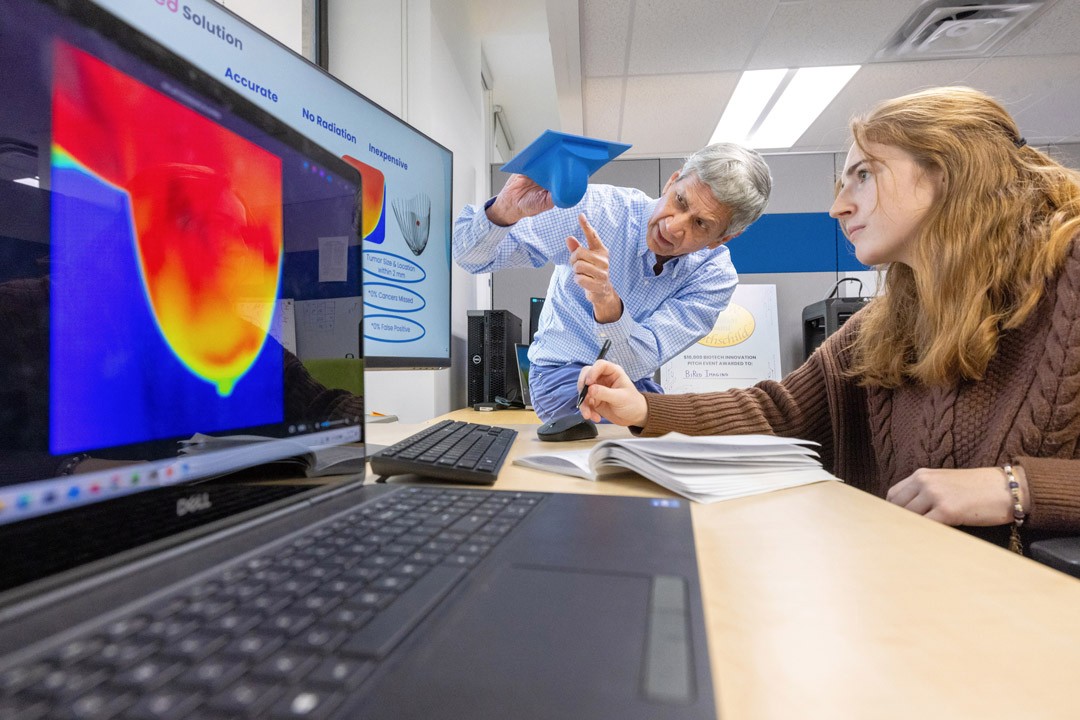
A small Venture Creations startup company is making big waves in the area of breast cancer detection.BiRed Imaging, co-founded in 2020 by RIT mechanical engineering professor Satish Kandlikar, blends infrared camera capture, numerical simulation, and artificial intelligence-driven algorithms to accurately detect the presence, size, and location of tumors.
The process is revolutionary based on the fact that it spares patients painful breast compression, radiation exposure, false alarm, and unnecessary anxiety.CREDIT">Carlos Ortiz/RITThe BiRed Imaging research team includes, from left to right, biomedical engineering student Sarah Fink; Atharva Sundge ’25 MS (artificial intelligence); Carlos Guitierrez ’24 Ph.
D. (engineering); Professor Satish Kandlikar; and Abhinav Kalsi ’25 MS (artificial intelligence).In early studies, this adjunctive technology has accurately predicted the presence or absence of a tumor in 41 patients. And, according to Kandlikar, RIT’s Gleason Professor of Mechanical Engineering, the impact is fewer false positives, fewer biopsies, fewer follow-up scans, lower costs, and more confidence in screening outcomes.
“It is safe to assume that just about everyone has been touched in some way by cancer, whether personally or with a loved one or friend,” said Kandlikar. “The research that our team is doing has meaning—for us, for patients, for breast cancer clinics and hospitals. Our technology, which is non-radiative and contactless, promises an improved patient experience, fewer unnecessary invasive procedures, and cost-savings for an overburdened healthcare system.
”Kandlikar explained that while mammography remains the standard for breast cancer detection, it has limitations, especially for patients with dense breast tissue. Supplemental methods such as ultrasound and MRI add cost, operator dependence, and radiation in some cases, and still generate high false-positive rates.
In fact, a major study reported by Health Affairs found that in the U.S., the cost for false-positive mammograms and breast-cancer overdiagnoses is roughly $4 billion a year.BiRed’s imaging process involves a woman lying on an open imaging table, with no compression of the breast, no radiation exposure, and no need for an expert operator.
Because a malignant tumor typically produces more metabolic heat than surrounding healthy tissue, this thermal signature becomes a synthetic marker when processed using the physics-based artificial intelligence (AI) algorithm.Sarah Fink, a second-year RIT biomedical engineering student from Syracuse, N.
Y., joined the BiRed team as a biomedical research assistant on co-op assignment. Her role is indicative of BiRed’s commitment to making a difference in women’s health while teaching and training the next generation of researchers. Fink assists with patient imaging and has been trained on both the clinical and technical sides of the research.
“I’m working with AI, software, and mechanical engineers on a biological topic, so by having some expertise as a biomedical engineering undergrad, I’m able to help bridge the biomedical aspects withthe technical process as a whole,” said Fink.In addition, three RIT alumni have been hired full time. Carlos Gutierrez ’24 Ph.
D. (engineering) is chief technical officer, Atharva Sundge ’25 MS (artificial intelligence) is an AI engineer, and Abhinav Kalsi ’25 MS (artificial intelligence) serves as software engineer.BiRed’s progress has been bolstered by several rounds of funding from the National Science Foundation, bringing the total federal investment in the company to nearly $556,000.
These funds support prototype development, clinical studies, algorithm refinement, and a pathway to commercialization. BiRed recently received $100,000 from New York state’s innovation grant program, accelerating its next stages of development, and an investment from RIT’s Venture Fund. The company is now conducting clinical studies to screen patients for breast cancer, in collaboration with Rochester Regional Health.
“I’m so incredibly lucky and grateful to be a part of this team and to see how my work is directly impacting our next steps as a small company,” added Fink. “I get chills thinking and talking about BiRed’s future knowing that I’m working toward making a difference in the field of breast cancer detection.
It’s truly a unique experience.”
Source coverage
Okay, so I've just read this article about BiRed Imaging, a startup company coming out of Rochester Institute of Technology (RIT), and it's pretty fascinating. They're working on something that could really change the game in breast cancer detection. Here's what I've gathered:
Key News Metadata:
Deeper analysis
Full source content
A small Venture Creations startup company is making big waves in the area of breast cancer detection.BiRed Imaging, co-founded in 2020 by RIT mechanical engineering professor Satish Kandlikar, blends infrared camera capture, numerical simulation, and artificial intelligence-driven algorithms to accurately detect the presence, size, and location of tumors.
The process is revolutionary based on the fact that it spares patients painful breast compression, radiation exposure, false alarm, and unnecessary anxiety.CREDIT">Carlos Ortiz/RITThe BiRed Imaging research team includes, from left to right, biomedical engineering student Sarah Fink; Atharva Sundge ’25 MS (artificial intelligence); Carlos Guitierrez ’24 Ph.
D. (engineering); Professor Satish Kandlikar; and Abhinav Kalsi ’25 MS (artificial intelligence).In early studies, this adjunctive technology has accurately predicted the presence or absence of a tumor in 41 patients. And, according to Kandlikar, RIT’s Gleason Professor of Mechanical Engineering, the impact is fewer false positives, fewer biopsies, fewer follow-up scans, lower costs, and more confidence in screening outcomes.
“It is safe to assume that just about everyone has been touched in some way by cancer, whether personally or with a loved one or friend,” said Kandlikar. “The research that our team is doing has meaning—for us, for patients, for breast cancer clinics and hospitals. Our technology, which is non-radiative and contactless, promises an improved patient experience, fewer unnecessary invasive procedures, and cost-savings for an overburdened healthcare system.
”Kandlikar explained that while mammography remains the standard for breast cancer detection, it has limitations, especially for patients with dense breast tissue. Supplemental methods such as ultrasound and MRI add cost, operator dependence, and radiation in some cases, and still generate high false-positive rates.
In fact, a major study reported by Health Affairs found that in the U.S., the cost for false-positive mammograms and breast-cancer overdiagnoses is roughly $4 billion a year.BiRed’s imaging process involves a woman lying on an open imaging table, with no compression of the breast, no radiation exposure, and no need for an expert operator.
Because a malignant tumor typically produces more metabolic heat than surrounding healthy tissue, this thermal signature becomes a synthetic marker when processed using the physics-based artificial intelligence (AI) algorithm.Sarah Fink, a second-year RIT biomedical engineering student from Syracuse, N.
Y., joined the BiRed team as a biomedical research assistant on co-op assignment. Her role is indicative of BiRed’s commitment to making a difference in women’s health while teaching and training the next generation of researchers. Fink assists with patient imaging and has been trained on both the clinical and technical sides of the research.
“I’m working with AI, software, and mechanical engineers on a biological topic, so by having some expertise as a biomedical engineering undergrad, I’m able to help bridge the biomedical aspects withthe technical process as a whole,” said Fink.In addition, three RIT alumni have been hired full time. Carlos Gutierrez ’24 Ph.
D. (engineering) is chief technical officer, Atharva Sundge ’25 MS (artificial intelligence) is an AI engineer, and Abhinav Kalsi ’25 MS (artificial intelligence) serves as software engineer.BiRed’s progress has been bolstered by several rounds of funding from the National Science Foundation, bringing the total federal investment in the company to nearly $556,000.
These funds support prototype development, clinical studies, algorithm refinement, and a pathway to commercialization. BiRed recently received $100,000 from New York state’s innovation grant program, accelerating its next stages of development, and an investment from RIT’s Venture Fund. The company is now conducting clinical studies to screen patients for breast cancer, in collaboration with Rochester Regional Health.
“I’m so incredibly lucky and grateful to be a part of this team and to see how my work is directly impacting our next steps as a small company,” added Fink. “I get chills thinking and talking about BiRed’s future knowing that I’m working toward making a difference in the field of breast cancer detection.
It’s truly a unique experience.”
How this page is built
Goose Pod turns cited reporting into a public episode summary first, then pairs that summary with audio playback so listeners can check the source material before they decide how deeply to engage.
The goal is to make this page useful as a news landing page first, while still giving listeners transcript access, related episodes, and direct links back to the original publishers.