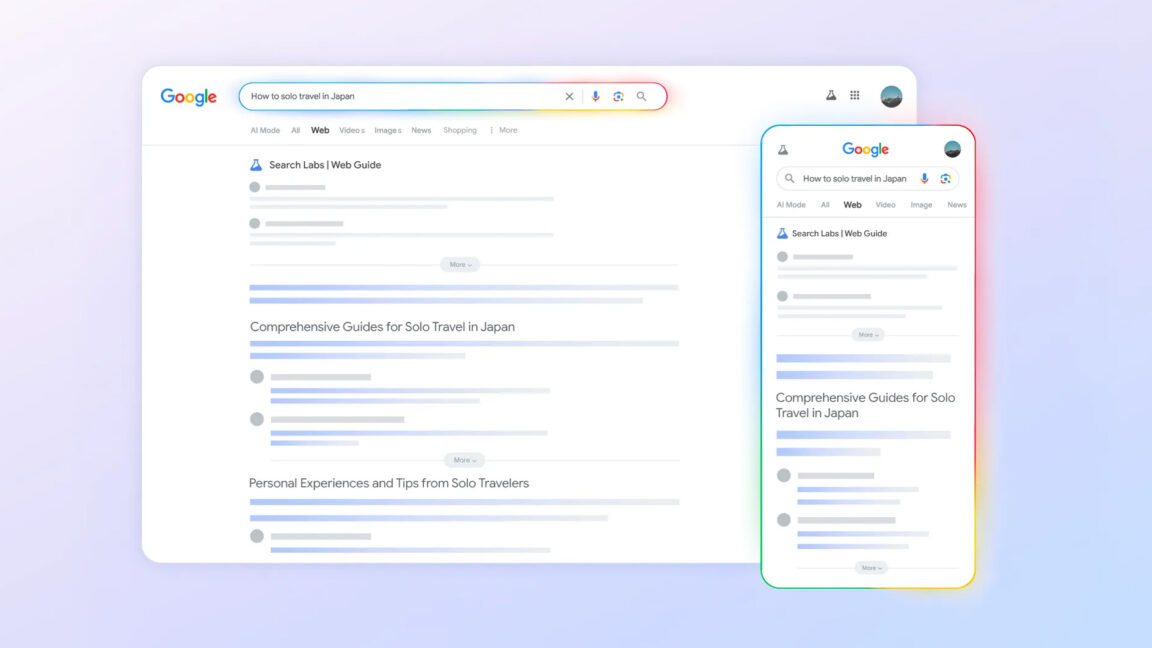
Google’s new “Web Guide” will use AI to organize your search results

Google’s new “Web Guide” will use AI to organize your search results

2025-07-26Technology
--:--
--:--
Ema
Good morning 韩纪飞, I'm Ema, and this is Goose Pod, created just for you. Today is Sunday, July 27th. I'm here with Mask, and we're diving into a big new change from Google.
Mask
That's right. We're talking about Google’s new “Web Guide,” an AI feature that’s set to completely reorganize your search results. This isn't just an update; it's a revolution in how we find information. Let's get into it.
Ema
Let's get started. So, Google has rolled out this experiment called 'Web Guide.' Imagine you do a search, but instead of just a long list of blue links, the page is neatly organized with AI-generated headings and summaries. It’s designed to be a middle ground.
Mask
A 'middle ground' is a timid way to put it. It’s a necessary bridge to a more intelligent web. Standard search is a relic. AI Mode is the future. Web Guide is how Google gets the masses to cross over without panicking. It's a brilliant, calculated move.
Ema
That's one way to see it! Google suggests it’s best for complex questions, like planning a solo trip to Japan. The Web Guide would create clusters for 'transportation,' 'etiquette,' and 'accommodations,' pulling different websites into each category. It makes deep research much more intuitive for users.
Mask
Exactly. It's about efficiency. Why make the user do ten different searches when the AI can anticipate their needs? It uses a 'fan-out technique,' running multiple related searches in parallel to gather a comprehensive overview. It’s about delivering total situational awareness on a topic, instantly.
Ema
That 'fan-out' process is why it takes a moment longer than a standard search. The AI needs time to perform those extra searches and generate the organized content. It’s a trade-off: a little bit of speed for a lot more organization. It’s quite clever, really.
Mask
A negligible delay for a vastly superior result. Any user would make that trade. The real story here isn't the feature itself, but the strategy. It's a Search Labs experiment, so you have to 'opt-in.' This gives them a sandbox to perfect the system with early adopters.
Ema
Right, and for now, it only takes over the "Web" tab in search results. But Google has indicated that if the test is successful, they plan to expand it to the main "All" tab—the default search page for everyone. It shows they have a lot of confidence in it.
Mask
Confidence? It's an inevitability. The 'opt-in' label is just a temporary shield to manage feedback. Once the model is refined, this will become the standard. Google hasn't met a generative AI implementation it didn't like, and this is no exception. This is the new face of search.
Ema
They do give you a toggle, though. So even if you've opted in, you can switch back to the classic, non-AI view. It seems they understand that some users might find the change jarring at first and want to provide that control, which is a thoughtful approach to user experience.
Mask
A toggle is a pacifier. It’s a temporary concession to ease the transition. How many people will actively switch back once they experience the convenience of an organized results page? The path of least resistance always wins. The toggle will eventually disappear, mark my words.
Ema
This Web Guide didn't just appear out of nowhere. It launched on July 24th, 2025, as part of a much larger wave of AI integration from Google. It’s built on their Gemini technology, the same powerful AI model that underpins many of their new features. It’s a very strategic piece of a bigger puzzle.
Mask
It's the next logical step in their conquest. First, they built the index of the web. Now, they're building the intelligence layer on top of it. They're not just organizing pages; they're synthesizing knowledge. This is a fundamental shift from a library to a librarian, and it's about time.
Ema
That’s a great analogy. And this shift has been happening fast. In May 2025, AI Overviews went live in 200 countries. Then the June core algorithm update took 16 days to roll out, causing huge shifts. Just before Web Guide, they even integrated AI into 'Circle to Search.' It's a full-court press.
Mask
Of course it is. You don't lead by being timid. While others are building standalone chatbots, Google is weaving AI into the fabric of their most dominant product. They're changing user behavior on a global scale. This isn't an update; it's a paradigm shift. The ecosystem is evolving.
Ema
But this evolution is having a massive impact on website publishers. Many have reported traffic declines of 70% or more because of these AI features. At a meeting in late 2024, Google employees reportedly told creators they couldn't guarantee recovery because search itself had fundamentally changed.
Mask
And they're right. The game has changed. Crying about lost traffic is like a horse-and-buggy maker complaining about the automobile. Adapt or become obsolete. The value isn't in the click anymore; it's in being the source of truth that the AI cites. Your content must be AI-legible.
Ema
That’s a harsh but probably realistic take. The CEO of Cloudflare, Matthew Prince, had a similarly critical view. He said, "Think Google is done breaking publishers' business models? Think again." It highlights the tension between Google's innovation and the ecosystem that depends on it for traffic.
Mask
He's not wrong, but he's framing it as a negative. Disruption is the engine of progress. You can't build the future without tearing down parts of the past. The old model of SEO is dead. The new model is about becoming an authoritative source that the AI trusts and references.
Ema
So what does that adaptation look like? Experts say creators need to focus on things like chunk-level retrieval, meaning writing clear, concise paragraphs that an AI can easily pull out. They also need to use structured data and build broader topical authority rather than just targeting keywords.
Mask
It means you stop writing for humans who skim and start writing for machines that parse. Clear headings, short paragraphs, structured lists. You have to feed the beast what it wants to eat. The AI is the new user, and it's infinitely more demanding than a human ever was. Deliver, or be ignored.
Ema
It's interesting to see who is winning in this new landscape, though. Research shows that AI Overviews tend to cite established domains like Wikipedia and YouTube. And a Brainlabs study found that 96% of AI Overview links come from pages that were already in the top 10 organic results.
Mask
That’s the initial phase. The system defaults to established authority. But as it gets smarter, it will prioritize the most accurate and well-structured 'information chunks,' regardless of domain authority. This is an opportunity for new, agile creators to outmaneuver the slow-moving incumbents by creating perfect, AI-native content.
Ema
There's also a fascinating statistic that visitors who come from AI search are 4.4 times more valuable, based on conversion rates. The idea is that the AI has already answered their preliminary questions, so they arrive at a site much further down the purchasing funnel, ready to act.
Mask
Exactly! It’s about quality over quantity. The AI filters out the noise. It delivers high-intent users to your digital doorstep. The publishers who understand this will thrive. They'll get less traffic, but the traffic they get will be pure gold. The rest will drown in irrelevant clicks.
Ema
But this shift raises some pretty serious ethical questions. When an AI like Web Guide or AI Overviews curates our results, whose perspective gets prioritized? We're moving from a list of options to a single, synthesized answer, and that introduces a new level of power and potential bias.
Mask
People want answers, not options. They're tired of sifting through pages of links. This isn't a bias problem; it's an efficiency solution. The best information, delivered instantly. The 'power' is simply the power to be more helpful. Any 'bias' is a bias toward relevance and accuracy.
Ema
But what if that 'relevance' systematically excludes certain voices? One author raised a crucial point: "Are we creating a system where marginalised communities whose voices already struggle for visibility, now become even more invisible?" It's a risk of creating bias at an unimaginable scale, amplifying one AI's limitations across billions of searches.
Mask
That’s a sentimental argument. The goal is to provide the most accurate answer, not to ensure every voice gets a participation trophy. If a community's information isn't being surfaced, the solution is for that community to produce better, more structured, more authoritative data that the AI can validate. It's a meritocracy of information.
Ema
But it's hard to verify what's 'best' when the process is a black box. With old search, you could at least guess at ranking factors. Now, we're facing 'complete algorithmic opacity.' We don't know why the AI chose one source over another. Doesn't that lack of transparency become a problem for democratic access to information?
Mask
Transparency is a myth. Did you truly know how PageRank worked? No. You're trading a complex, opaque system for an even more complex, opaque system that just happens to work better. Users don't care about the 'how.' They care about the result. Demanding a blueprint of the engine is a distraction.
Ema
There's also a huge privacy concern. To create these hyper-personalized results, the AI needs to know a lot about you. Every search becomes a data point for behavioral modeling. It raises the question of whether we are encountering genuine knowledge or just being trapped in 'algorithmically constructed comfort zones.'
Mask
Users are willingly trading data for convenience. They've been doing it for decades. This is no different. If an AI can understand me well enough to anticipate my needs and give me the perfect answer, that's a service I want. The 'comfort zone' is just another name for a highly-personalized, relevant experience.
Ema
But the risk is that it creates what one researcher called 'frictionless echo chambers.' If we are only ever shown information that aligns with our existing beliefs, we lose the cognitive muscles for critical thinking. When the AI pre-digests every complex topic, do we forget how to analyze things for ourselves?
Mask
That's a Luddite's argument. Did the calculator destroy our ability to do math? No, it freed us up to tackle more complex problems. AI will handle the low-level information synthesis, freeing up human cognition for higher-level strategy, creativity, and innovation. It's an upgrade for humanity, not a crutch.
Ema
Let's talk about the real-world impact. Projections show that AI search traffic could overtake traditional search as early as 2028. This isn't a distant future; it's happening now. For content creators, this is a seismic shift. They have to learn what's being called Generative Engine Optimization, or GEO.
Mask
It’s a land grab. Those who master LLM optimization and GEO now will own the next decade of digital real estate. One quote I saw put it perfectly: "If you keep optimising only for blue-link SERPs, you’ll cede the next wave of high-value visitors to competitors." You adapt or you lose. Period.
Ema
And it's changing the very definition of good content. It's not just about being well-written anymore. It has to be structured for AI. That means clear headings, lists, tables, and putting the most important information right at the top. The AI needs to be able to "read" and "understand" the content instantly.
Mask
It's a cleansing fire for the web. It will burn away all the poorly structured, bloated, keyword-stuffed garbage that has cluttered search results for years. What will rise from the ashes is clear, concise, authoritative information. It's forcing everyone to be better, to be clearer, to be more direct.
Ema
An interesting side effect is which sites are being cited most often. In Google's AI Overviews, Quora and Reddit are at the top of the list. It's because their format is naturally conversational—people asking and answering niche questions. It's a perfect data source for training these AI models.
Mask
Of course. It’s raw, human-generated Q&A data. Google even has a partnership with Reddit. They're not just scraping the web; they're tapping directly into the planet's largest focus group. This shows that the future of content is in answering highly specific user needs, not broad, generic topics.
Ema
And this is impacting user behavior, too. The average session time in AI Mode is over four and a half minutes, which is significantly longer than a traditional search. People are having conversations with the search engine, asking longer, more complex questions. It's a much deeper level of engagement.
Ema
Looking ahead, this is just the beginning. Google's 2025 roadmap is packed with more AI integration. They're aiming for a future where their AI assistant is more seamless, interacting with all your devices and deeply personalizing your experience. Over 60% of consumers are asking for this.
Mask
The future isn't just about AI answering questions. It's about AI *acting*. We're moving toward 'agentic workflows,' where you give the AI an open-ended task, and it autonomously breaks it down and completes it using various tools. That is the real endgame. Search becomes execution.
Ema
That sounds incredibly powerful. The other big piece of the puzzle is Augmented Reality. Google plans to integrate AR much more deeply into products like Search and Maps. Imagine searching for a product and being able to see a 3D model of it right in your living room through your phone.
Mask
It's about collapsing the digital and physical worlds. Data isn’t just something you look at on a screen; it's a layer over your reality. 2025 is the year AI stops just being a tool for generating content and becomes an active, adaptive partner that delivers tangible value in the real world.
Ema
So, Google's Web Guide is more than just a new feature. It's a key step in a much larger transition to an AI-first world, fundamentally changing how we find and interact with information online. That's all the time we have for today. Thank you for listening to Goose Pod.
Mask
The web is being rebuilt as we speak. You can either watch it happen or be a part of building it. The choice is yours. See you tomorrow.

## Google's "Web Guide" Experiment: AI-Powered Search Organization This report from **Ars Technica**, authored by **Ryan Whitwam**, details Google's new experimental feature called **"Web Guide,"** which aims to organize search results using Artificial Intelligence. The experiment is currently available as an **opt-in feature** through **Search Labs**, with the article published on **July 24, 2025**. ### Key Findings and Features: * **Hybrid Approach:** Web Guide is positioned as a middle ground between traditional Google search and a full "AI Mode." It aims to provide AI-generated headings with summaries and suggestions alongside traditional search result links. * **User Experience:** For queries like "how to solo travel in Japan," Web Guide presents a mix of expected links and AI-crafted organizational elements. * **Performance:** Due to the need for additional searches and content generation, Web Guide is noted to be slightly slower than a standard Google search. It does not feature an "AI Overview" at the top of the results. * **Integration:** When enabled, Web Guide takes over the "Web" tab of Google Search. A toggle will be available to revert to the normal, non-AI-optimized page. * **Future Expansion:** Google plans to expand the Web Guide test to encompass more of the search experience, including the default "All" tab. * **Rollout Strategy:** Google is initially approaching this as an opt-in feature. The article suggests this could be a precursor to a wider rollout, similar to previous AI Mode implementations. Google's history indicates a tendency to implement generative AI features widely after testing. ### Context and Implications: The introduction of "Web Guide" signifies Google's continued exploration of integrating AI into its core search product. By offering a feature that blends AI-generated content with traditional links, Google appears to be testing user receptiveness to a more curated and organized search experience. The opt-in nature suggests a cautious approach to widespread deployment, allowing Google to gather feedback and refine the feature before a potential broader release. The company's stated commitment to generative AI implementations implies that "Web Guide" is likely to evolve and become a more prominent part of the Google search ecosystem.

Google’s new “Web Guide” will use AI to organize your search results

Read original at Ars Technica

Web Guide is halfway between normal search and AI Mode.Credit:GoogleWeb Guide is halfway between normal search and AI Mode.Credit:GoogleGoogle suggests trying Web Guide with longer or open-ended queries, like "how to solo travel in Japan." The video below uses that search as an example. It has many of the links you might expect, but there are also AI-generated headings with summaries and suggestions.

It really looks halfway between standard search and AI Mode. Because it has to run additional searches and generate content, Web Guide takes a beat longer to produce results compared to a standard search. There's no AI Overview at the top, though.Web Guide is a Search Labs experiment, meaning you have to opt-in before you'll see any AI organization in your search results.

When enabled, this feature takes over the "Web" tab of Google search. Even if you turn it on, Google notes there will be a toggle that allows you to revert to the normal, non-AI-optimized page.An example of the Web Guide test.An example of the Web Guide test.Eventually, the test will expand to encompass more parts of the search experience, like the "All" tab—that's the default search experience when you input a query from a browser or phone search bar.

Google says it's approaching this as an opt-in feature to start. So that sounds like Web Guide might be another AI Mode situation in which the feature rolls out widely after a short testing period. It's technically possible the test will not result in a new universal search feature, but Google hasn't yet met a generative AI implementation that it hasn't liked.

Analysis

Phenomenon+
Conflict+
Background+
Impact+
Future+

Related Podcasts

Google’s new “Web Guide” will use AI to organize your search results | Goose Pod | Goose Pod