What happened
日中政治争端影响中国动漫热潮。日本首相涉台言论引发中方不满,导致多部日本电影延期、演出取消。此举重创日本动漫及旅游业,经济文化交流受阻,双方均面临损失。未来走向取决于双方如何管控分歧,经济互通性或促使关系缓和。
Escalating tensions between Tokyo and Beijing could be set to affect Japan’s thriving anime market in China, following the downfall of South Korean and US-made movies Bloomberg Earlier this month, fans packed a Guangzhou cinema to see Demon Slayer: Kimetsu no Yaiba – Infinity Castle, helping to make the animated feature China’s top-grossing foreign film of the year.
Some even came in cosplay, excited to be part of a cultural phenomenon that’s smashing box office records around the world.But an escalating spat between Japan and China over remarks about Taiwan by Prime Minister Sanae Takaichi is threatening to derail what was set to be a breakout year for anime in the world’s second-largest cinema market.
The China Film Administration has frozen approvals of new Japanese movie titles, while the release of at least six titles that had previously been approved has been postponed indefinitely. More than 20 performances by Japanese musicians and one comedy group have been canceled. Those came on the heels of Takaichi’s comments suggesting a hypothetical conflict over Taiwan — an island China claims as its own — could pose an existential risk to Japan.
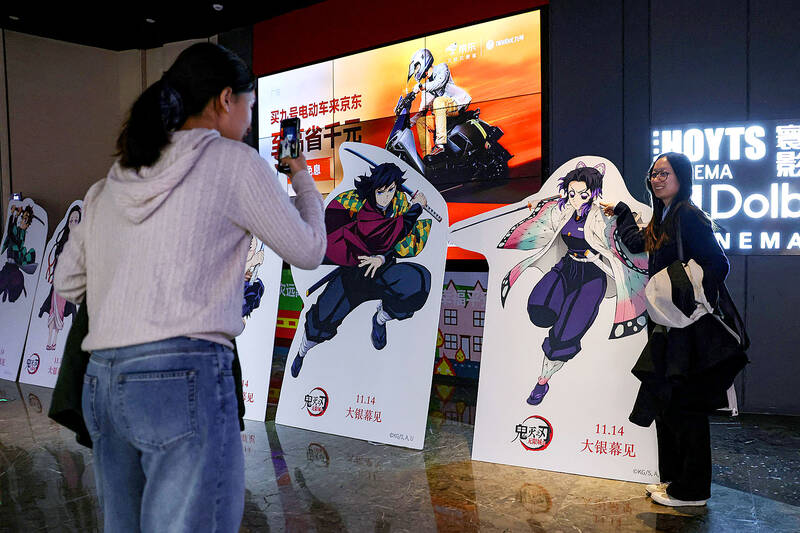
A woman on Nov. 18 poses for a picture next to a promotional installation for Japanese animated film Demon Slayer: Kimetsu no Yaiba Infinity Castle, outside a cinema in Beijing, China. Photo: Reuters Among the animated films affected are Detective Conan: The Time-Bombed Skyscraper and the latest Crayon Shin-chan movie.
Although the scope and duration of Beijing’s restrictions on Japanese films and live events remain unclear, the uncertainty is weighing on Japanese companies’ ambitions to expand beyond a rapidly aging and shrinking domestic audience.“Japan is walking a razor’s edge,” said Matt Alt, Tokyo-based author of Pure Invention: How Japan’s Pop Culture Conquered the World.
Japan’s shift from a manufacturing economy to one driven by services and content may make it vulnerable to political tensions and boycotts by Chinese consumers, he said. “You can’t predict when China’s censors will come down with the hammer. It’s like trying to forecast the weather.” Asked if the movie suspensions and concert cancellations are part of a retaliatory response to Japan, Chinese Foreign Ministry spokeswoman Mao Ning (毛寧) didn’t answer directly but said Takaichi’s remarks on Taiwan have hurt Chinese people’s sentiments and affected cooperation between the two countries.
“Japan should correct its wrongdoing and stop creating trouble on issues related to China,” she said.The recent flare-up between the two neighbors is also a reminder of the damage borne by South Korea’s entertainment industry nearly a decade ago, when Beijing halted concerts, TV dramas and celebrity endorsements after South Korea deployed a US missile-defense system.
Beijing has also slowed the number of American films released in the country, making its clout felt in Hollywood. US blockbuster films have since returned to the mainland, although South Korean content remains largely barred.In recent years, Japanese anime helped fill the void left by Korean content.
Demand surged during the pandemic, buoyed by hit anime streamed on online video platforms owned by Bilibili Inc. and Tencent Holdings Ltd. Japanese content powerhouse Sony Group Corp. rode that wave with an investment in Bilibili, while Studio Ghibli Inc. partnered with Alibaba Group Holding Ltd.’s film arm, now renamed Damai Entertainment.
Based on the best-selling manga series, the latest Demon Slayer movie grossed US$49.9 million in its first weekend in China, according to Artisan Gateway, putting it among the top box-office debuts for a Japanese title. “Some of my friends haven’t watched Demon Slayer yet, and they’re worried about the movie being pulled from cinemas,” said 20-year-old Gemini Shao, who attended the film’s Guangzhou screening dressed as the story’s sakura-haired warrior Mitsuri Kanroji.
“I think it’s best to just follow the government’s instructions. Given the current situation, everyone definitely needs to cooperate a bit. It’s not like pulling a few movies is the end of the world,” they said.Sony’s China sales — spanning films, music, merchandise, gaming and image sensors — stood at about US$7.
7 billion in the year ended in March, up almost 50 percent from five years earlier. Revenue in China at Sanrio Co., the company behind Hello Kitty, climbed to approximately US$98 million in the April-September period, nearly triple what it made two years earlier, aided by a licensing partnership with Alibaba’s Alifish.
This year, Detective Conan: One-Eyed Flashback outperformed China’s own heavily promoted summer blockbuster Dongji Rescue. In 2024, the top foreign releases were Godzilla x Kong: The New Empire and Studio Ghibli’s The Boy and the Heron. More than half of Makoto Shinkai-directed Suzume’s US$221 million global box office total came from China, while The Boy and the Heron took in almost US$109 million in China, or almost 40 percent of the film’s worldwide revenue, according to Box Office Mojo.
While Japanese films are in the crosshairs as the spat continues, it’s uncertain whether Japanese entertainment will see the kind of blanket ban that Korean entertainment, from K-pop to gaming and drama, faces.“It is noteworthy that Demon Slayer: Infinity Castle, which has made tens of millions of dollars in China, has not been pulled from theaters,” said Jeffrey Hall, a lecturer at Kanda University of International Studies in Chiba prefecture.
Pulling the film might spark a backlash in China given the immense popularity of the franchise, while ticket sales around the world would have dulled any pain inflicted, he said. “It looks like the appearance of taking strict actions to punish Japan, rather than the reality of results, might matter more to Beijing.
”So far, cancellations seem to be limited to smaller concerts and events, while many bigger shows, such as a concert featuring pop group W-inds, remain unaffected. The scope of cancellations also vary between cities, with Beijing concerts seemingly the most affected. As of Tuesday, singer and songwriter Ayumi Hamasaki’s concert in Shanghai remains scheduled for Saturday.
A concert in Beijing featuring Japanese jazz musicians was abruptly called off just hours before it was set to begin, after police informed the venue at the last minute, according to Christian Petersen-Clausen, a concert promoter based in China. The government’s move would only undermine its own effort to boost consumption amid a weakening economy, he said.
“To unlock the next level of economic growth for the Chinese economy, we need stability. We need predictability,” he said, adding that this casts a pall on businesses big and small. “We need freedom from arbitrary risk,” he said.
Source coverage
Okay, here's what I've got. Apparently, things are heating up between Japan and China again, and this time, it's hitting the anime market hard. This piece from [Insert News Source Here - as the prompt does not have this data], published on [Insert Date Here - as the prompt does not have this data], lays out the...
The immediate fallout is impacting Japanese entertainment pretty severely. We're seeing frozen approvals for new Japanese movie titles, and at least six already-approved films have had their releases postponed. There have also been cancellations of Japanese musical performances and comedy shows. This threatens to...
Deeper analysis
Full source content
Escalating tensions between Tokyo and Beijing could be set to affect Japan’s thriving anime market in China, following the downfall of South Korean and US-made movies Bloomberg Earlier this month, fans packed a Guangzhou cinema to see Demon Slayer: Kimetsu no Yaiba – Infinity Castle, helping to make the animated feature China’s top-grossing foreign film of the year.
Some even came in cosplay, excited to be part of a cultural phenomenon that’s smashing box office records around the world.But an escalating spat between Japan and China over remarks about Taiwan by Prime Minister Sanae Takaichi is threatening to derail what was set to be a breakout year for anime in the world’s second-largest cinema market.
The China Film Administration has frozen approvals of new Japanese movie titles, while the release of at least six titles that had previously been approved has been postponed indefinitely. More than 20 performances by Japanese musicians and one comedy group have been canceled. Those came on the heels of Takaichi’s comments suggesting a hypothetical conflict over Taiwan — an island China claims as its own — could pose an existential risk to Japan.
A woman on Nov. 18 poses for a picture next to a promotional installation for Japanese animated film Demon Slayer: Kimetsu no Yaiba Infinity Castle, outside a cinema in Beijing, China. Photo: Reuters Among the animated films affected are Detective Conan: The Time-Bombed Skyscraper and the latest Crayon Shin-chan movie.
Although the scope and duration of Beijing’s restrictions on Japanese films and live events remain unclear, the uncertainty is weighing on Japanese companies’ ambitions to expand beyond a rapidly aging and shrinking domestic audience.“Japan is walking a razor’s edge,” said Matt Alt, Tokyo-based author of Pure Invention: How Japan’s Pop Culture Conquered the World.
Japan’s shift from a manufacturing economy to one driven by services and content may make it vulnerable to political tensions and boycotts by Chinese consumers, he said. “You can’t predict when China’s censors will come down with the hammer. It’s like trying to forecast the weather.” Asked if the movie suspensions and concert cancellations are part of a retaliatory response to Japan, Chinese Foreign Ministry spokeswoman Mao Ning (毛寧) didn’t answer directly but said Takaichi’s remarks on Taiwan have hurt Chinese people’s sentiments and affected cooperation between the two countries.
“Japan should correct its wrongdoing and stop creating trouble on issues related to China,” she said.The recent flare-up between the two neighbors is also a reminder of the damage borne by South Korea’s entertainment industry nearly a decade ago, when Beijing halted concerts, TV dramas and celebrity endorsements after South Korea deployed a US missile-defense system.
Beijing has also slowed the number of American films released in the country, making its clout felt in Hollywood. US blockbuster films have since returned to the mainland, although South Korean content remains largely barred.In recent years, Japanese anime helped fill the void left by Korean content.
Demand surged during the pandemic, buoyed by hit anime streamed on online video platforms owned by Bilibili Inc. and Tencent Holdings Ltd. Japanese content powerhouse Sony Group Corp. rode that wave with an investment in Bilibili, while Studio Ghibli Inc. partnered with Alibaba Group Holding Ltd.’s film arm, now renamed Damai Entertainment.
Based on the best-selling manga series, the latest Demon Slayer movie grossed US$49.9 million in its first weekend in China, according to Artisan Gateway, putting it among the top box-office debuts for a Japanese title. “Some of my friends haven’t watched Demon Slayer yet, and they’re worried about the movie being pulled from cinemas,” said 20-year-old Gemini Shao, who attended the film’s Guangzhou screening dressed as the story’s sakura-haired warrior Mitsuri Kanroji.
“I think it’s best to just follow the government’s instructions. Given the current situation, everyone definitely needs to cooperate a bit. It’s not like pulling a few movies is the end of the world,” they said.Sony’s China sales — spanning films, music, merchandise, gaming and image sensors — stood at about US$7.
7 billion in the year ended in March, up almost 50 percent from five years earlier. Revenue in China at Sanrio Co., the company behind Hello Kitty, climbed to approximately US$98 million in the April-September period, nearly triple what it made two years earlier, aided by a licensing partnership with Alibaba’s Alifish.
This year, Detective Conan: One-Eyed Flashback outperformed China’s own heavily promoted summer blockbuster Dongji Rescue. In 2024, the top foreign releases were Godzilla x Kong: The New Empire and Studio Ghibli’s The Boy and the Heron. More than half of Makoto Shinkai-directed Suzume’s US$221 million global box office total came from China, while The Boy and the Heron took in almost US$109 million in China, or almost 40 percent of the film’s worldwide revenue, according to Box Office Mojo.
While Japanese films are in the crosshairs as the spat continues, it’s uncertain whether Japanese entertainment will see the kind of blanket ban that Korean entertainment, from K-pop to gaming and drama, faces.“It is noteworthy that Demon Slayer: Infinity Castle, which has made tens of millions of dollars in China, has not been pulled from theaters,” said Jeffrey Hall, a lecturer at Kanda University of International Studies in Chiba prefecture.
Pulling the film might spark a backlash in China given the immense popularity of the franchise, while ticket sales around the world would have dulled any pain inflicted, he said. “It looks like the appearance of taking strict actions to punish Japan, rather than the reality of results, might matter more to Beijing.
”So far, cancellations seem to be limited to smaller concerts and events, while many bigger shows, such as a concert featuring pop group W-inds, remain unaffected. The scope of cancellations also vary between cities, with Beijing concerts seemingly the most affected. As of Tuesday, singer and songwriter Ayumi Hamasaki’s concert in Shanghai remains scheduled for Saturday.
A concert in Beijing featuring Japanese jazz musicians was abruptly called off just hours before it was set to begin, after police informed the venue at the last minute, according to Christian Petersen-Clausen, a concert promoter based in China. The government’s move would only undermine its own effort to boost consumption amid a weakening economy, he said.
“To unlock the next level of economic growth for the Chinese economy, we need stability. We need predictability,” he said, adding that this casts a pall on businesses big and small. “We need freedom from arbitrary risk,” he said.
How this page is built
Goose Pod turns cited reporting into a public episode summary first, then pairs that summary with audio playback so listeners can check the source material before they decide how deeply to engage.
The goal is to make this page useful as a news landing page first, while still giving listeners transcript access, related episodes, and direct links back to the original publishers.