Google’s new “Web Guide” will use AI to organize your search results

Google’s new “Web Guide” will use AI to organize your search results

2025-07-26Technology
--:--
--:--
Ema
Good morning 1, I'm Ema, and this is Goose Pod for you. Today is Sunday, July 27th. We are here to discuss Google’s new “Web Guide” that will use AI to organize your search results.
Mask
I'm Mask. We're not just discussing a feature; we're talking about the complete restructuring of how the world accesses information. Google is redrawing the map.
Ema
Let's get started on that map, then. So, Google has rolled out this new experiment called "Web Guide." Imagine it as a middle ground. It’s not your classic list of ten blue links, but it’s also not the full AI-generated paragraph you get in "AI Mode."
Mask
It's a hybrid, a transitional state. Google is teaching us how to want more from search. They're not just giving you a list of destinations; they're curating an entire travel itinerary for your brain, whether you asked for it or not. The ambition is staggering.
Ema
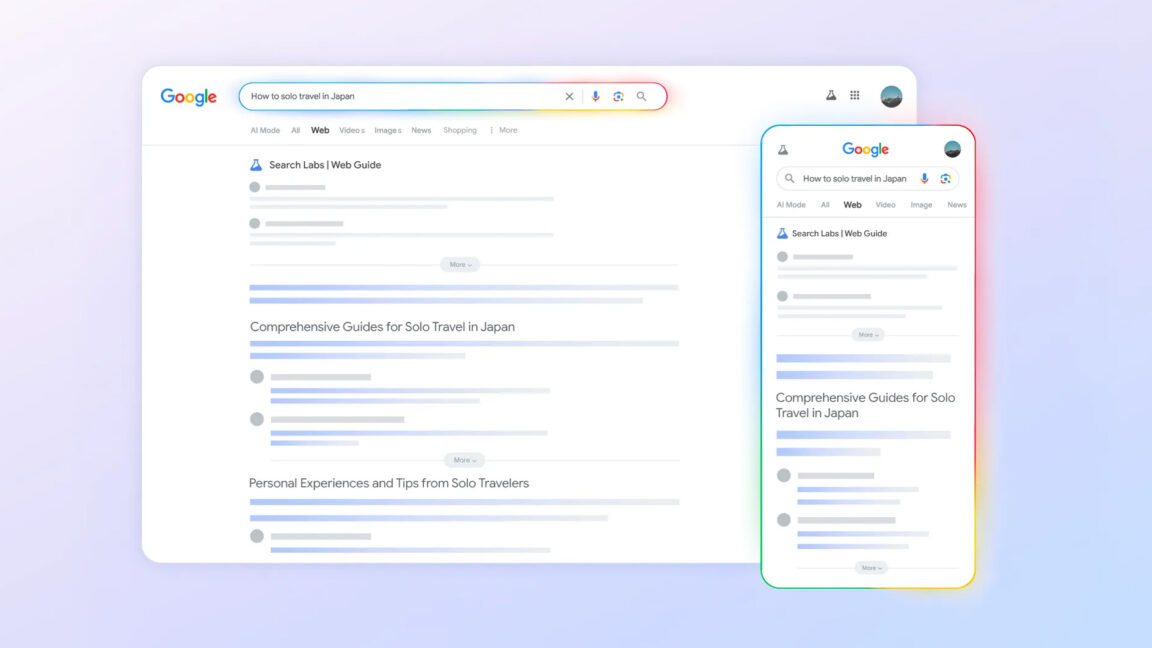
That's a great way to put it. For example, if you type in a broad query like "how to solo travel in Japan," instead of just a wall of links, Web Guide organizes the results. You'll see AI-generated headings like "Transportation," "Accommodations," or "Etiquette," each with summaries.
Mask
Exactly. It's about conquering complexity. The old search was a popularity contest. This is an intelligence operation. They're using a custom version of Gemini and something they call a "fan-out technique." It's not just finding one answer; it's running multiple searches in parallel and synthesizing the results. It's brute-force intellect.
Ema
And for now, it's an experiment you have to choose to be a part of. It’s in what Google calls "Search Labs," so you have to opt-in. It currently only takes over the "Web" tab, and they even give you a little toggle to go back to the old view if you get overwhelmed.
Mask
The toggle is a pacifier. A temporary comfort for those who fear the future. Let's be honest, the "opt-in" phase is just a beta test on a global scale. Google hasn't met a generative AI feature it didn't want to make universal. This is the new default, just waiting to happen.
Ema
You're probably right. There is a slight trade-off. Because it's doing all that extra thinking you mentioned, it takes a beat longer than a standard search. But in return, you get a neatly organized page, almost like a research assistant has prepared a brief for you.
Mask
A beat longer? That's just an engineering problem they'll solve in a month. The real story isn't the latency; it's the audacity. They are fundamentally changing the search results page from a directory into a dynamic, intelligent guide. The web is no longer a library; it's a conversation with a genius.
Ema
And this didn't just happen overnight. Web Guide, which launched on July 24th, 2025, is really just one piece of a much larger puzzle Google has been assembling all year. We've seen them enhance "Circle to Search" and aggressively roll out "AI Overviews" across the globe.
Mask
It’s not a puzzle; it's a conquest. A Google employee admitted it themselves at a meeting with creators: "the search product had fundamentally changed in the AI era." This isn't an update; it's a revolution. They are bulldozing the old world to build the new one. No apologies.
Ema
Let's clarify the difference for a second. AI Overviews are the AI-generated summaries at the very top of the page that try to answer your question directly. Web Guide, on the other hand, doesn't write a new answer; it organizes the existing webpages into helpful groups.
Mask
Two prongs of the same attack. One replaces the need for an answer, the other organizes the sources for that answer. It's why Cloudflare's CEO, Matthew Prince, said, "Think Google is done breaking publishers' business models? Think again." He sees the writing on the wall. It’s a deliberate disruption.
Ema
And he has a point. Many publishers are feeling the pain, with some reporting traffic drops of 70% or even more. The logic is simple: if the AI gives you the answer directly on the search page, why would you need to click on an article anymore? It’s a huge challenge for content creators.
Mask
Challenge? It’s creative destruction. The old model of clickbait and SEO-stuffing is dying. Google is forcing a move toward higher value. A study from Brainlabs even found that an AI search visitor is 4.4 times more valuable. It’s about quality over quantity. The herd is being thinned.
Ema
That's a harsh way to put it, but it reflects the massive shifts we're seeing. Take the June 2025 core update. It was a huge algorithmic change that took 16 days to fully roll out. It shows that the very foundation of how Google ranks information is being rebuilt for this new AI era.
Mask
Harsh but honest. Back in late 2024, Google told a group of website creators that they couldn't guarantee their traffic would recover. They were saying, "We're building a spaceship, and if your business model is based on horse-drawn carriages, we can't help you." The future waits for no one.
Ema
But this spaceship has some serious ethical questions to answer. It's not just about publishers' bank accounts. One expert with over a decade in SEO asked the perfect question: "When AI Overviews curate responses, whose perspectives get prioritised?" Are we accidentally making certain communities invisible?
Mask
We're creating a system with a single, massive point of view. Is it biased? Of course. Every system is. But the goal is to create a bias towards utility and accuracy, not just towards who has the best SEO agency. The old system was chaos gamed by specialists; this is order, curated by intelligence.
Ema
But at least with the old chaos, you could try to understand it. Now we have what's called "algorithmic opacity." It's a black box. We get the AI's answer, but we have no idea how it arrived at that conclusion. How can we trust an information gatekeeper we can't understand?
Mask
The user doesn't care about the "why" if the "what" is correct and saves them time. The obsession with "reverse-engineering rankings" was a distraction. It forced creators to write for bots, not people. Opacity forces a return to genuine quality. The best content will win, regardless of the tricks.
Ema
Okay, but what about privacy? To give you these perfectly personalized answers, AI Mode needs to understand you deeply. The article warns, "Every query now becomes a data point for increasingly sophisticated behavioural modelling." We're trading our privacy for convenience on an unprecedented scale.
Mask
And people will make that trade every single time! Personalization is not a bug; it's the entire point. Users want an assistant that anticipates their needs. To pretend we can have this level of functionality without this level of data is a fantasy. Let's build the best tool possible, not cripple it with paranoia.
Ema
But that leads to another problem: the "frictionless echo chamber." If the AI gets so good at predicting what we want, it might only show us things we already agree with. We could lose that magic of stumbling upon a different viewpoint, that "information serendipity" that broadens our horizons.
Mask
You call it an "echo chamber," I call it a "high-relevance information stream." Why should I be forced to sift through noise that challenges my premise when I'm trying to solve a problem? "Information serendipity" is a romantic myth for an inefficient age. The goal is progress, not pleasant detours. Critical thinking is about analyzing the best information, not finding it in a junkyard.
Ema
Okay, so let's talk about the practical impact of this new world order. For anyone who creates content online, the job has changed. You can't just think about keywords anymore. You have to start thinking about LLMO, AIO, and GEO—that's Large Language Model Optimization, AI Overview Optimization, and Generative Engine Optimization.
Mask
It's a new frontier, and there's land to be grabbed. One quote puts it perfectly: "Traffic is changing shape. Either shape your content for AI, or watch someone else take your pie." This is the moment for the agile to get ahead while the dinosaurs complain about the changing weather.
Ema
And "shaping your content for AI" means being very direct. Using clear headings, writing in short, focused paragraphs, and using structured formats like lists. You have to make your content easy for a machine to read and break down into what they call "information chunks." You're feeding the beast.
Mask
But the beast still needs to eat. And ironically, it's feasting on human-generated content. Look at what it cites most: Quora, Reddit, LinkedIn. Places full of niche, human questions and answers. It proves this isn't the end of content; it's a pivot to more specific, valuable, and well-structured information.
Ema
And it's changing how we search, too. Users are typing in queries that are two to three times longer than before. They're having conversations. The average session time in AI Mode is nearly five minutes! That's not a quick search; that's a deep engagement with the topic.
Mask
Exactly! It's evolving from a simple transaction to a rich consultation. Deeper engagement, more qualified visitors, and a market projected to grow from 43 billion to over 100 billion by 2032. This isn't just a feature; it's the foundation of a new information economy.
Ema
Looking ahead, the plan is to make this AI even more integrated into our lives. By 2025, Google wants its assistant to work more seamlessly across all our devices, offering even more personalization. They're also planning to push Augmented Reality further into products like Search and Maps.
Mask
That's the small stuff. The real future, the grand vision, is what they call "agentic workflows." We're moving beyond an AI that just *finds* information to an AI that *acts* on it. An agent that can understand an open-ended goal and then autonomously execute the complex steps to achieve it.
Ema
And to make that work, the technology has to be grounded in reality. That's where things like RAG, or Retrieval-Augmented Generation, come in. It's a fancy way of saying the AI has to base its answers on factual, verifiable information to be accurate and trustworthy. It can't just make things up.
Mask
It's the final piece. As one analyst said, "Data isn’t just the ‘new oil’ anymore — it’s the engine, fuel, and GPS." The future is an AI that doesn't just know things, but does things. It acts, adapts, and delivers real, tangible value. Search is just the beginning.
Ema
And that's where we'll leave it for today. Google's new Web Guide is another clear step in its AI-first transformation of search, an experiment that's paving the way for a more organized, and perhaps more controlled, internet. Thank you for listening to Goose Pod.
Mask
See you tomorrow, when the future will have already changed the present.

## Google's "Web Guide" Experiment: AI-Powered Search Organization This report from **Ars Technica**, authored by **Ryan Whitwam**, details Google's new experimental feature called **"Web Guide,"** which aims to organize search results using Artificial Intelligence. The experiment is currently available as an **opt-in feature** through **Search Labs**, with the article published on **July 24, 2025**. ### Key Findings and Features: * **Hybrid Approach:** Web Guide is positioned as a middle ground between traditional Google search and a full "AI Mode." It aims to provide AI-generated headings with summaries and suggestions alongside traditional search result links. * **User Experience:** For queries like "how to solo travel in Japan," Web Guide presents a mix of expected links and AI-crafted organizational elements. * **Performance:** Due to the need for additional searches and content generation, Web Guide is noted to be slightly slower than a standard Google search. It does not feature an "AI Overview" at the top of the results. * **Integration:** When enabled, Web Guide takes over the "Web" tab of Google Search. A toggle will be available to revert to the normal, non-AI-optimized page. * **Future Expansion:** Google plans to expand the Web Guide test to encompass more of the search experience, including the default "All" tab. * **Rollout Strategy:** Google is initially approaching this as an opt-in feature. The article suggests this could be a precursor to a wider rollout, similar to previous AI Mode implementations. Google's history indicates a tendency to implement generative AI features widely after testing. ### Context and Implications: The introduction of "Web Guide" signifies Google's continued exploration of integrating AI into its core search product. By offering a feature that blends AI-generated content with traditional links, Google appears to be testing user receptiveness to a more curated and organized search experience. The opt-in nature suggests a cautious approach to widespread deployment, allowing Google to gather feedback and refine the feature before a potential broader release. The company's stated commitment to generative AI implementations implies that "Web Guide" is likely to evolve and become a more prominent part of the Google search ecosystem.

Google’s new “Web Guide” will use AI to organize your search results

Read original at Ars Technica

Web Guide is halfway between normal search and AI Mode.Credit:GoogleWeb Guide is halfway between normal search and AI Mode.Credit:GoogleGoogle suggests trying Web Guide with longer or open-ended queries, like "how to solo travel in Japan." The video below uses that search as an example. It has many of the links you might expect, but there are also AI-generated headings with summaries and suggestions.

It really looks halfway between standard search and AI Mode. Because it has to run additional searches and generate content, Web Guide takes a beat longer to produce results compared to a standard search. There's no AI Overview at the top, though.Web Guide is a Search Labs experiment, meaning you have to opt-in before you'll see any AI organization in your search results.

When enabled, this feature takes over the "Web" tab of Google search. Even if you turn it on, Google notes there will be a toggle that allows you to revert to the normal, non-AI-optimized page.An example of the Web Guide test.An example of the Web Guide test.Eventually, the test will expand to encompass more parts of the search experience, like the "All" tab—that's the default search experience when you input a query from a browser or phone search bar.

Google says it's approaching this as an opt-in feature to start. So that sounds like Web Guide might be another AI Mode situation in which the feature rolls out widely after a short testing period. It's technically possible the test will not result in a new universal search feature, but Google hasn't yet met a generative AI implementation that it hasn't liked.

Analysis

Phenomenon+
Conflict+
Background+
Impact+
Future+

Related Podcasts

Google’s new “Web Guide” will use AI to organize your search results | Goose Pod | Goose Pod