
What happened
Report Provider: ESPN
Author: Nate Taylor
Date: September 13, 2025, 06:00 AM ET
Nate TaylorSep 13, 2025, 06:00 AM ETKANSAS CITY, Mo. -- During last week's game, Kansas City Chiefs quarterback Patrick Mahomes was intentional in wanting to deliver a message -- both to his teammates and the opponent, the Los Angeles Chargers.The Chiefs' first play on offense in the second half began with Mahomes executing a play-action fake and then rolling to his right.
Mahomes knew that most quarterbacks, including himself, would've been content with gaining seven or eight yards before running out of bounds to ensure they didn't get hit by a defender. This time, however, Mahomes was the one who wanted contact. He turned upfield to lower his left shoulder into linebacker Troy Dye for an 11-yard gain.
Following the play, even as a few Chargers from the sideline chirped at him, Mahomes smiled when he entered the Chiefs' huddle.In Mahomes' mind, he accomplished his side mission: He grabbed everyone's attention."More than anything, sometimes you've got to do something to jump-start the team," Mahomes said after the Chiefs' 27-21 loss.
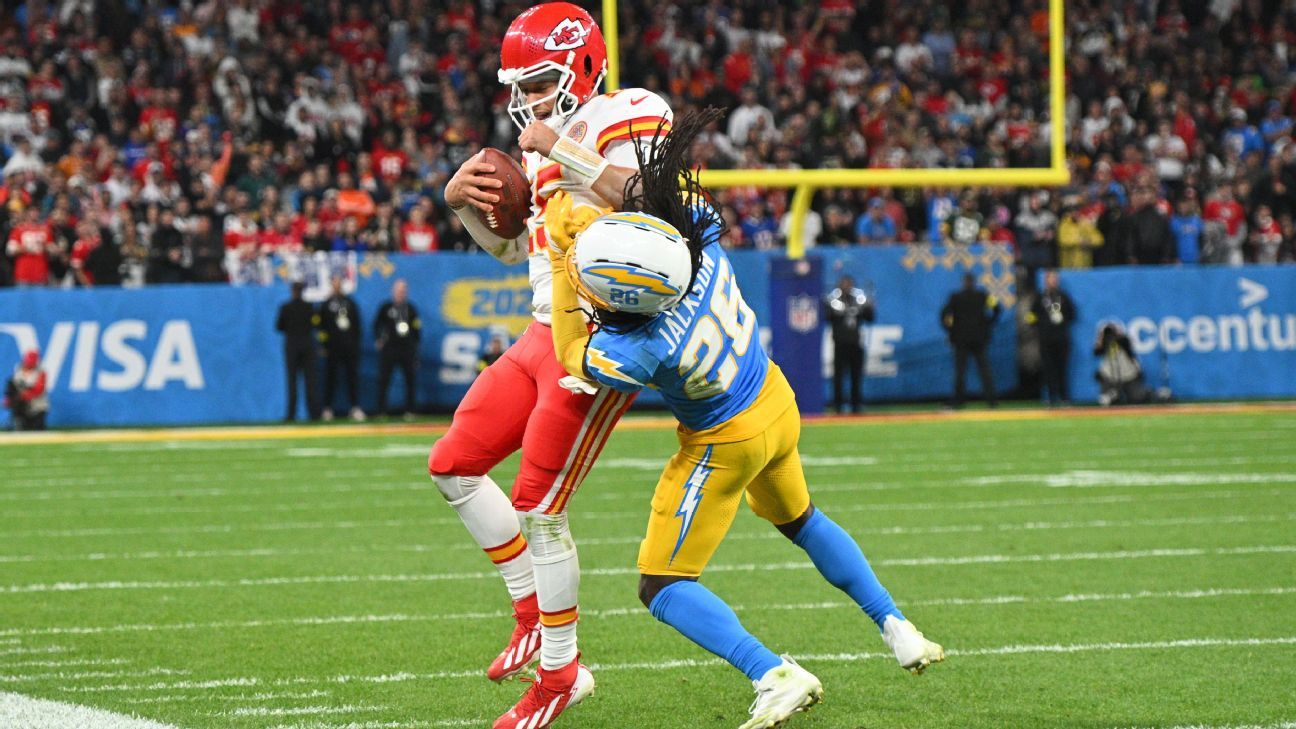
"I was not in the mood to be running out of bounds."Later in the same drive, Mahomes doubled his efforts. While scrambling for another first down, Mahomes wowed the crowd in São Paulo when he trucked cornerback Donte Jackson before going out of bounds, a decision he made because he noticed -- after a lackluster first half -- that his teammates needed to be inspired by his physicality."
He's always going to do anything to give us a better chance at winning," right guard Trey Smith said Friday of Mahomes. "He's looking to make a play, and it fires me up. It makes me want to fight harder and protect him harder."The Chiefs scored a few plays later on Mahomes' 11-yard touchdown run that was a byproduct of a broken run-pass option play in which he faked out Chargers edge rusher Khalil Mack with a pump fake before going around him to reach the front pylon."
It's who he is, his natural leadership," offensive coordinator Matt Nagy said Thursday of Mahomes. "He's a fiery competitor. I loved what he did. That's who he is and he made plays."The most surprising part of Mahomes' Week 1 performance -- finishing with 258 passing yards, 57 rushing yards and two touchdowns -- is that he punished defenders when near the sideline instead of just going out of bounds."
We kind of got going on offense in the second half, but it takes everybody," Mahomes said. "We've got to start faster."Mahomes' increased aggression has added another layer to what he has done in the past when near the sideline, which is use it to his advantage against defenders leery of committing a personal foul or unnecessary roughness penalty.
The biggest such example occurred last year in a win over the San Francisco 49ers. Mahomes used the sideline, and a block from running back Kareem Hunt, to run for an additional 20 yards along the sideline on his 33-yard highlight, the longest run of his career.Based on his actions, Mahomes is aware of what he could encounter next, perhaps as soon as Sunday's Super Bowl rematch against the Philadelphia Eagles (4:25 p.
m. ET on FOX). The next time Mahomes has the ball and is near the sideline, he'll likely have a quick decision to make.Will the approaching defender not expect him to go out of bounds? Does the defender look like he's ready to hit him harder than usual, even if it results in a penalty? Will the defender try to energize and impress his teammates by trucking him?"
I always brace for impact," Mahomes said. "I mean, you have to protect yourself. In this last game, I think we just needed the yards. We needed ways to score, especially at that time of the game. That's why I think people highlighted the one I got hit on the side. I really wasn't running out of bounds really the whole second half."
It's a long season, so I try to get back to running out of bounds as much as possible. But that's stuff that I usually do in the playoffs. I'm just going to try to manage that throughout the season so I can be there for the playoffs."Nagy knows a best-case scenario for Chiefs' offense in Sunday's game.
Instead of trailing by 10 points in the second quarter, Nagy and coach Andy Reid challenged the Chiefs to build their own lead against the Eagles early in the game. If that happens, Mahomes might not have to scramble as much, which means he might not have to get so aggressive when he sees a defender chasing him near the sideline."
I thought in that game, when you look back at how he played in some moments, it was pretty special," Nagy said of Mahomes' Week 1 performance. "The guys saw that, we as coaches saw that, so now (we all) have to do it, too. If we do that, it can get really good. But we've got to do it earlier."
Source coverage
Report Provider: ESPN
Author: Nate Taylor
Deeper analysis
Full source content
Nate TaylorSep 13, 2025, 06:00 AM ETKANSAS CITY, Mo. -- During last week's game, Kansas City Chiefs quarterback Patrick Mahomes was intentional in wanting to deliver a message -- both to his teammates and the opponent, the Los Angeles Chargers.The Chiefs' first play on offense in the second half began with Mahomes executing a play-action fake and then rolling to his right.
Mahomes knew that most quarterbacks, including himself, would've been content with gaining seven or eight yards before running out of bounds to ensure they didn't get hit by a defender. This time, however, Mahomes was the one who wanted contact. He turned upfield to lower his left shoulder into linebacker Troy Dye for an 11-yard gain.
Following the play, even as a few Chargers from the sideline chirped at him, Mahomes smiled when he entered the Chiefs' huddle.In Mahomes' mind, he accomplished his side mission: He grabbed everyone's attention."More than anything, sometimes you've got to do something to jump-start the team," Mahomes said after the Chiefs' 27-21 loss.
"I was not in the mood to be running out of bounds."Later in the same drive, Mahomes doubled his efforts. While scrambling for another first down, Mahomes wowed the crowd in São Paulo when he trucked cornerback Donte Jackson before going out of bounds, a decision he made because he noticed -- after a lackluster first half -- that his teammates needed to be inspired by his physicality."
He's always going to do anything to give us a better chance at winning," right guard Trey Smith said Friday of Mahomes. "He's looking to make a play, and it fires me up. It makes me want to fight harder and protect him harder."The Chiefs scored a few plays later on Mahomes' 11-yard touchdown run that was a byproduct of a broken run-pass option play in which he faked out Chargers edge rusher Khalil Mack with a pump fake before going around him to reach the front pylon."
It's who he is, his natural leadership," offensive coordinator Matt Nagy said Thursday of Mahomes. "He's a fiery competitor. I loved what he did. That's who he is and he made plays."The most surprising part of Mahomes' Week 1 performance -- finishing with 258 passing yards, 57 rushing yards and two touchdowns -- is that he punished defenders when near the sideline instead of just going out of bounds."
We kind of got going on offense in the second half, but it takes everybody," Mahomes said. "We've got to start faster."Mahomes' increased aggression has added another layer to what he has done in the past when near the sideline, which is use it to his advantage against defenders leery of committing a personal foul or unnecessary roughness penalty.
The biggest such example occurred last year in a win over the San Francisco 49ers. Mahomes used the sideline, and a block from running back Kareem Hunt, to run for an additional 20 yards along the sideline on his 33-yard highlight, the longest run of his career.Based on his actions, Mahomes is aware of what he could encounter next, perhaps as soon as Sunday's Super Bowl rematch against the Philadelphia Eagles (4:25 p.
m. ET on FOX). The next time Mahomes has the ball and is near the sideline, he'll likely have a quick decision to make.Will the approaching defender not expect him to go out of bounds? Does the defender look like he's ready to hit him harder than usual, even if it results in a penalty? Will the defender try to energize and impress his teammates by trucking him?"
I always brace for impact," Mahomes said. "I mean, you have to protect yourself. In this last game, I think we just needed the yards. We needed ways to score, especially at that time of the game. That's why I think people highlighted the one I got hit on the side. I really wasn't running out of bounds really the whole second half."
It's a long season, so I try to get back to running out of bounds as much as possible. But that's stuff that I usually do in the playoffs. I'm just going to try to manage that throughout the season so I can be there for the playoffs."Nagy knows a best-case scenario for Chiefs' offense in Sunday's game.
Instead of trailing by 10 points in the second quarter, Nagy and coach Andy Reid challenged the Chiefs to build their own lead against the Eagles early in the game. If that happens, Mahomes might not have to scramble as much, which means he might not have to get so aggressive when he sees a defender chasing him near the sideline."
I thought in that game, when you look back at how he played in some moments, it was pretty special," Nagy said of Mahomes' Week 1 performance. "The guys saw that, we as coaches saw that, so now (we all) have to do it, too. If we do that, it can get really good. But we've got to do it earlier."
How this page is built
Goose Pod turns cited reporting into a public episode summary first, then pairs that summary with audio playback so listeners can check the source material before they decide how deeply to engage.
The goal is to make this page useful as a news landing page first, while still giving listeners transcript access, related episodes, and direct links back to the original publishers.