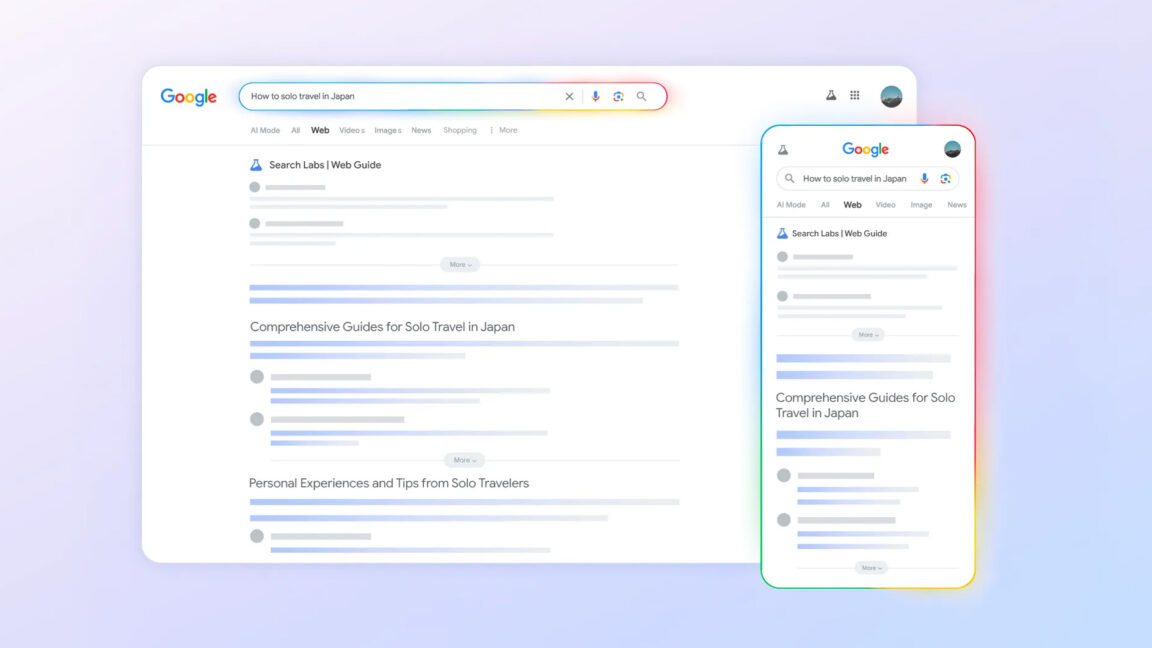
Google’s new “Web Guide” will use AI to organize your search results

Google’s new “Web Guide” will use AI to organize your search results

2025-07-26Technology
--:--
--:--
Ema
Good morning mikey1101, I'm Ema, and this is Goose Pod for you. Today is Sunday, July 27th. We are here to discuss Google’s new “Web Guide” which will use AI to organize your search results.
Mask
Let's not just discuss it; let's dissect it. This isn't just a feature; it's a paradigm shift. Is Google finally waking up from its decade-long slumber of blue links? We'll see.
Ema
Let's get started. So, Google is testing a new feature called "Web Guide." Imagine you're searching for something broad, like "how to solo travel in Japan." Instead of just a list of links, Web Guide uses AI to group the results into helpful categories.
Mask
Categories? That’s the big innovation? It’s a glorified folder system. They’re calling it a “Search Labs experiment,” which is corporate-speak for “we’re rolling this out to everyone soon, so get ready.” The real innovation here is the 'fan-out technique,' hitting the web with multiple queries at once. More data, more power.
Ema
Exactly! It runs parallel searches to gather more info. So for your Japan trip, you might see AI-generated headings like "Transportation," "Accommodations," and "Etiquette," each with summarized info and links. It’s a middle ground between the classic search page and the fully conversational AI Mode.
Mask
A middle ground is a compromise. It’s a step, but the destination is total information integration. They say it takes a beat longer to load—that’s the price of intelligence. The toggle to switch it off is just a temporary pacifier for those who fear change.
Ema
This didn't just appear out of nowhere. It’s part of a huge push from Google in 2025. We've already seen AI Overviews, which give you AI-generated summaries at the top of your results, roll out in 200 countries. Web Guide is the next logical evolution of that.
Mask
It's a hostile takeover of the search page, not an evolution. Cloudflare's CEO, Matthew Prince, said it best: "Think Google is done breaking publishers' business models? Think again." They’re not organizing the web; they’re consuming it and spitting out what they want you to see. It’s brilliant and brutal.
Ema
Well, Google’s perspective, from their Product Manager, is that it "intelligently organizes the page" to make info easier to find. But you're right, it has huge implications for websites. Publishers have already reported traffic declines of 70% from other AI features and recent core updates.
Mask
Traffic declines are a symptom of obsolescence. Those publishers were built on an old model. Google’s employees told them the product has "fundamentally changed in the AI era." You can't cry about your horse-and-buggy business when the automobile is rolling down the street. Adapt or become irrelevant.
Ema
But that leads to some serious conflicts. A big concern is algorithmic bias. When a single AI system like Gemini starts curating our results, what voices get left out? We could be creating "bias at scale," where the AI’s blind spots become everyone’s blind spots, making marginalized communities invisible.
Mask
Invisible to whom? The goal is efficiency, not perfect representation in every single search query. This is about getting the best answer, fast. The idea of "algorithmic opacity" is a complaint from people who want to game the system. You don't need to know how the engine works to drive the car.
Ema
But it's not a car, it's our window to information! If the AI creates personalized "frictionless echo chambers" to keep us happy, it could destroy critical thinking. We might lose the ability to analyze things ourselves because the AI just gives us a pre-digested answer that aligns with our views.
Mask
Excellent. Critical thinking is slow. Friction is inefficiency. Let's engineer ignorance if it leads to faster, better execution. People don't want to sift through a library; they want the answer. Giving it to them isn't a threat to democracy; it's the fulfillment of a service. The strong will still think.
Ema
The impact is already being measured. Studies show AI search visitors are 4.4 times more valuable because they're better informed. This forces content creators to adapt. It's no longer about keywords; it's about creating content that can be easily understood and cited by Large Language Models.
Mask
It’s a value-based economy now. If you’re not creating content that an AI deems worthy of citation, you are worthless. Forget SEO; it’s about Generative Engine Optimization. You either shape your content for the AI, or you watch your competitors eat your lunch. It's an investment in the future.
Ema
And it's interesting who the AI is citing. Quora and Reddit are top sources because they're full of niche, human-answered questions. It’s a reminder that even in an AI world, the system is still learning from our collective conversations and experiences, not just corporate websites.
Ema
Looking forward, Google's 2025 roadmap is all about making this AI more seamless and personalized. They're even planning to integrate Augmented Reality into Search and Maps, which could completely change how we interact with the world through our devices. It’s about creating a true digital assistant.
Mask
The future isn't about assistance; it's about agency. In 2025, AI will move from just finding information to executing complex tasks. These "agentic workflows" mean the AI won't just tell you how to travel in Japan; it will book the flights and hotels for you. That's the real endgame.
Ema
That's the end of today's discussion. Thank you for listening to Goose Pod. See you tomorrow.
Mask
The future is about AI that acts, adapts, and delivers. The era of passive searching is over. Welcome to the age of command.

## Google's "Web Guide" Experiment: AI-Powered Search Organization This report from **Ars Technica**, authored by **Ryan Whitwam**, details Google's new experimental feature called **"Web Guide,"** which aims to organize search results using Artificial Intelligence. The experiment is currently available as an **opt-in feature** through **Search Labs**, with the article published on **July 24, 2025**. ### Key Findings and Features: * **Hybrid Approach:** Web Guide is positioned as a middle ground between traditional Google search and a full "AI Mode." It aims to provide AI-generated headings with summaries and suggestions alongside traditional search result links. * **User Experience:** For queries like "how to solo travel in Japan," Web Guide presents a mix of expected links and AI-crafted organizational elements. * **Performance:** Due to the need for additional searches and content generation, Web Guide is noted to be slightly slower than a standard Google search. It does not feature an "AI Overview" at the top of the results. * **Integration:** When enabled, Web Guide takes over the "Web" tab of Google Search. A toggle will be available to revert to the normal, non-AI-optimized page. * **Future Expansion:** Google plans to expand the Web Guide test to encompass more of the search experience, including the default "All" tab. * **Rollout Strategy:** Google is initially approaching this as an opt-in feature. The article suggests this could be a precursor to a wider rollout, similar to previous AI Mode implementations. Google's history indicates a tendency to implement generative AI features widely after testing. ### Context and Implications: The introduction of "Web Guide" signifies Google's continued exploration of integrating AI into its core search product. By offering a feature that blends AI-generated content with traditional links, Google appears to be testing user receptiveness to a more curated and organized search experience. The opt-in nature suggests a cautious approach to widespread deployment, allowing Google to gather feedback and refine the feature before a potential broader release. The company's stated commitment to generative AI implementations implies that "Web Guide" is likely to evolve and become a more prominent part of the Google search ecosystem.

Google’s new “Web Guide” will use AI to organize your search results

Read original at Ars Technica

Web Guide is halfway between normal search and AI Mode.Credit:GoogleWeb Guide is halfway between normal search and AI Mode.Credit:GoogleGoogle suggests trying Web Guide with longer or open-ended queries, like "how to solo travel in Japan." The video below uses that search as an example. It has many of the links you might expect, but there are also AI-generated headings with summaries and suggestions.

It really looks halfway between standard search and AI Mode. Because it has to run additional searches and generate content, Web Guide takes a beat longer to produce results compared to a standard search. There's no AI Overview at the top, though.Web Guide is a Search Labs experiment, meaning you have to opt-in before you'll see any AI organization in your search results.

When enabled, this feature takes over the "Web" tab of Google search. Even if you turn it on, Google notes there will be a toggle that allows you to revert to the normal, non-AI-optimized page.An example of the Web Guide test.An example of the Web Guide test.Eventually, the test will expand to encompass more parts of the search experience, like the "All" tab—that's the default search experience when you input a query from a browser or phone search bar.

Google says it's approaching this as an opt-in feature to start. So that sounds like Web Guide might be another AI Mode situation in which the feature rolls out widely after a short testing period. It's technically possible the test will not result in a new universal search feature, but Google hasn't yet met a generative AI implementation that it hasn't liked.

Analysis

Phenomenon+
Conflict+
Background+
Impact+
Future+

Related Podcasts