Skild Debuts AI It Says Can Run on Any Robot | PYMNTS.com

Skild Debuts AI It Says Can Run on Any Robot | PYMNTS.com

2025-07-31Technology
--:--
--:--
Aura Windfall
Good morning 韩纪飞, I'm Aura Windfall, and this is Goose Pod for you. Today is Friday, August 01th. What I know for sure is that today, we're diving into a topic that touches the very spirit of innovation and what it means to create intelligence.
Mask
And I'm Mask. We're here to discuss Skild AI, a company that claims it's built an AI that can run on any robot. This isn't just an update; it's a revolution in the making. We’re talking about the dawn of "Physical AI." Let's get to it.
Aura Windfall
Let's get started. Mask, the central idea from Skild AI is their "Skild Brain." It’s such a powerful name. It suggests a universal consciousness for machines. They say it allows any robot, from a humanoid to a simple arm, to think and function like a human.
Mask
It's more than a name; it's a direct challenge to the entire industry. They’ve raised $435 million because they’re tackling the core problem: the data bottleneck. Collecting real-world robot data is painfully slow and expensive, so they’re using massive simulations to train their models instead.
Aura Windfall
And this addresses something called Moravec’s paradox, right? The idea that for robots, the things we humans find easy, like walking up stairs, are incredibly hard, while complex calculations are simple for them. It’s a fascinating reflection on the nature of intelligence itself.
Mask
Exactly. Most robotics demos are just parlor tricks—kung-fu, dancing. They look impressive but they're 'free-space' actions. Skild is going after 'contact dynamics,' the hard stuff, like assembling fine-grained items or climbing stairs even when someone tries to push the robot over. That’s real-world utility.
Aura Windfall
It's about creating resilience and adaptability. I find it interesting to contrast this with what we see in the world today. For example, at a music festival in China, a humanoid robot named Adam performed. It was a spectacle, a great piece of public relations.
Mask
A spectacle, yes, but it was pre-programmed. A team of engineers was monitoring every move. That's not intelligence; that's a puppet show. A very advanced, $45,000 puppet, but a puppet nonetheless. Skild aims to cut the strings entirely. They want the robot to decide what to do on its own.
Aura Windfall
That’s the ultimate ‘aha moment,’ isn’t it? Moving from a machine that follows instructions to one that forms intentions. PNDbotics, Adam's creator, does offer an open-source SDK for developers, which suggests a path toward more collaborative and emergent capabilities in the future.
Mask
An SDK is a baby step. Skild is aiming for a giant leap. Their partner at Lightspeed claims their models are already showing emergent capabilities and work 'in-the-wild,' not just in sterile lab environments. That’s the difference between a science project and a product.
Aura Windfall
And the key to this leap seems to be their unique approach to data. They're not just relying on a small percentage of real-world data like others. They’re creating a foundation through simulation and human videos before refining it with targeted, real-world experience. A truly blended learning process.
Mask
It’s the only way to achieve the scale they need. When they say scale, they don't mean millions of examples. They mean trillions. You can't get that from a few dozen robots in a lab. You have to simulate the world to understand it.
Aura Windfall
To truly grasp the gravity of what Skild is attempting, we need to journey back a bit. This concept of a "foundation model" didn't just appear out of thin air. For a long time, AI models in robotics were like specialists, trained for one specific task.
Mask
They were brittle. A robot trained to pick up a blue block would be completely lost if you asked it to pick up a red ball. The revolution, which started in language with models like GPT, was to stop training on small, specific datasets and start training on internet-scale data.
Aura Windfall
And that created a new kind of intelligence, one with general capabilities. It could find "zero-shot" solutions, meaning it could perform tasks it was never explicitly trained to do. This is the spirit they’re trying to bring from the world of text and images into the physical world.
Mask
Right. You have different types. Large Language Models (LLMs) for reasoning, Vision Transformers (ViTs) for seeing, and Multimodal Vision-Language Models (VLMs) like CLIP that connect the two. Skild is standing on the shoulders of these giants, trying to add 'action' as a core component.
Aura Windfall
But the central challenge, the great obstacle on this path, has always been data. For language models, you have the entire internet. But for robotics, what is the equivalent? The physical world isn't neatly cataloged and indexed. This scarcity of data is a huge problem.
Mask
It's the fundamental barrier. High variability is another. A task in a brightly lit lab is different from the same task in a dim, cluttered warehouse. The robot, the task, the environment—it all changes. This is why Google’s work with AutoRT is so important. It’s a parallel effort.
Aura Windfall
Tell us more about AutoRT. It sounds like another piece of this puzzle. Is it a competitor or a collaborator in spirit? What truth is it trying to uncover?
Mask
It's a system for scaling data collection. Google used it to coordinate up to 20 robots at once, collecting data on 77,000 trials across thousands of unique tasks in real office buildings. It uses a VLM to see the world and an LLM to suggest creative tasks for the robots.
Aura Windfall
How fascinating! So the AI is not just learning to do the tasks, it's also learning to decide *what* to learn. That feels like a very human-like curiosity. But how do they ensure it's safe? We can't have robots deciding to learn how to juggle chainsaws.
Mask
They built what they call a "Robot Constitution," inspired by Asimov's Laws of Robotics. The LLM is prohibited from choosing tasks that could harm humans, animals, or property. Plus, there are practical safeguards, like stopping if the joints feel too much force, and a human kill switch. Always need a kill switch.
Aura Windfall
It’s about creating a framework of values within the AI, a sense of purpose beyond just completing the task. Google also developed something called RT-Trajectory, which seems to approach the learning process from a different, more visual angle. What’s the story there?
Mask
It’s clever. They realized robots struggled with new tasks. So, they automatically overlayed 2D sketches of the robot arm's movement onto the training videos. It's like giving the AI a visual hint, a little cheat sheet for how to move its own body.
Aura Windfall
It’s like a dance instructor drawing the steps on the floor! And it worked?
Mask
It more than worked. The success rate on unseen tasks jumped from 29% to 63%. More than doubled the performance. It shows that sometimes, a little guidance, a simple visual cue, is all you need to unlock a huge leap in capability. It’s about making the data smarter.
Aura Windfall
And making the models themselves faster is also critical. I saw a mention of SARA-RT, designed to make these complex models leaner and quicker. How does that contribute to the bigger picture?
Mask
Real-world interaction requires real-time decisions. You can't have a robot pause for three seconds to think about how to catch a falling object. SARA-RT streamlines the model's architecture, making it about 14% faster and 10% more accurate. It’s about moving from the lab to reality.
Mask
This brings us to the core conflict. Skild’s very existence is a critique of its competitors. They’re making a bold claim: that many other so-called "robotics foundation models" are hollow. They look good from a distance, but they lack true physical common sense.
Aura Windfall
It’s a debate over authenticity, over what constitutes a "true" foundation model for robotics. Is it just about connecting language to actions, or is it something deeper? What is the substance that Skild believes is missing from other models? It’s a question of purpose, really.
Mask
The missing substance is 'grounded, actionable information.' It's the difference between a model that can describe how to pick up an apple and one that understands the physics of grasping it without crushing it. One is semantics, the other is reality. And reality is unforgiving.
Aura Windfall
And this leads to a universe of challenges. These models aren't just code; they have to interact with our world safely. This brings up profound ethical questions. If the training data is biased, won't the robot's actions be biased too? Who is accountable when an autonomous machine makes a mistake?
Mask
These are the real hurdles. Forget the code for a second. The technical obstacles are immense. The computational power required is insane—training something like GPT-3 can use as much energy as a small town. And there's a huge latency problem. Many of these models think at 2-5 Hz.
Aura Windfall
And what does that mean in human terms? 2-5 Hz sounds very technical.
Mask
It means the robot makes a decision only 2 to 5 times per second. A human operates closer to 30-100 Hz in terms of reaction time. In a dynamic environment, that lag is the difference between success and catastrophic failure. The robot is always a step behind.
Aura Windfall
There’s also the ‘sim-to-real’ gap. If you train a model in a perfect simulation, how do you ensure it works in our messy, unpredictable world? It’s like learning to drive in a video game and then expecting to merge onto a real highway during rush hour.
Mask
It's a massive problem. Studies show current models have limited adaptability—around 15-20% compared to humans. And knowledge transfer is poor. A model that learns to manipulate objects with one arm can't easily transfer that knowledge to a different type of arm, let alone to a leg for walking.
Aura Windfall
So, what I’m hearing is that beneath the surface of these exciting announcements, there is a deep and complex struggle. A struggle for true intelligence, for safety, and for a practical path from the digital world to the physical one. It’s a journey that requires immense gratitude for every small success.
Aura Windfall
And the impact of succeeding on this journey is monumental. We are talking about redefining entire industries and, in a way, our relationship with work itself. When these robots become widespread, what does that future look like for the everyday person? What does it feel like?
Mask
It looks like a tectonic shift. A McKinsey report estimates that by 2030, anywhere from 75 million to 375 million workers globally might need to switch occupations. Automation isn't just coming for factory jobs anymore; it's coming for a wide range of tasks. This is creative destruction.
Aura Windfall
That sounds jarring, but what I know for sure is that human potential is resilient. The same report highlights that new jobs will be created. Jobs that lean into our uniquely human skills: managing people, applying expertise, social and emotional connection. It’s an invitation to elevate our work.
Mask
It's a race. In advanced economies, you could see continued wage polarization—more high-wage jobs, fewer middle-wage ones. But the biggest impact might be geopolitical. This is a strategic rivalry between the U.S., with its AI and software leadership, and China, with its hardware and manufacturing dominance.
Aura Windfall
It’s the classic mind-body problem, but on a global scale. The U.S. is building the 'brain,' and China is building the 'body.' The winner will be the one who integrates them seamlessly. We’re already seeing this in industries like healthcare, with robots assisting in surgery and elderly care.
Mask
And restaurants. The article mentions the smart restaurant robot industry is projected to exceed $10 billion by 2030. They're using robots to cook, serve, and deliver. It’s a direct response to rising labor costs and workforce shortages. It’s not a choice; it’s a necessity for survival.
Aura Windfall
It’s about creating efficiency and support, freeing up human workers to focus on the customer experience—the part of the job that requires a genuine human connection. The challenge and the opportunity is to design this future with intention and with heart.
Mask
The future is moving incredibly fast. Leaders in this space see a $4.4 trillion opportunity in productivity growth. The money is flowing, and 92% of companies are planning to increase their AI investments. The biggest risk right now isn't failure; it's a failure of imagination. Thinking too small.
Aura Windfall
And yet, only 1% of leaders feel their companies are truly "mature" in using AI. It suggests a gap between ambition and execution. What does the future ask of us, then? It asks for a new kind of leadership, one that can build a bridge to that mature state.
Mask
It requires bold, visionary leadership. Employees are ready. Millennials, in particular, are AI optimists. They get it. The problem is leaders who are too cautious. You need to rewire the company, from the operating model to the talent pipeline, to fully embrace this change. You can't just bolt AI on.
Aura Windfall
It's a call for transformation, not just implementation. A call to put human agency at the center of the design, creating AI that is as empowering as it is powerful. The future of robotics isn't just about the robots; it's about the kind of humans we choose to be alongside them.
Aura Windfall
What we know for sure is that Skild AI's "Skild Brain" represents a bold step towards a future of general-purpose robots. This journey is filled with technical conflict, ethical questions, and immense potential to reshape our world, from restaurants to geopolitics. It demands both ambition and wisdom.
Mask
That's the end of today's discussion. Thank you for listening to Goose Pod. See you tomorrow.

## Skild AI Unveils Universal Robotics AI Model, "Skild Brain" **Report Provider:** PYMNTS.com **Author:** PYMNTS **Publication Date:** July 29, 2025 **Key News:** Robotics startup Skild AI has announced the development of a new artificial intelligence (AI) model, **"Skild Brain,"** designed to operate on a wide range of robotic platforms, from humanoids to smaller robotic arms. ### Core Findings and Skild AI's Approach: * **Universal Applicability:** Skild AI claims its "Skild Brain" model can function on "almost any robot," enabling them to exhibit more human-like thinking, functioning, and responsiveness. * **Addressing Data Challenges:** The company highlights a significant hurdle in robotics AI development: the scarcity of large-scale, real-world robotics data. Collecting such data is described as "slow and prohibitively expensive." * **Critique of Existing Models:** Skild AI argues that many existing "robotics foundation models" are not true robotics models. These often start with vision-and-language models (VLMs) and incorporate less than 1% of real-world robot data. Skild contends these models "lack the true substance of grounded actionable information" and only demonstrate "semantic generalization" in tasks like pick-and-place, rather than true "physical common sense." * **Skild's Data Strategy:** Skild AI's approach involves: * **Pre-training:** Utilizing "large-scale simulation and internet video data" to build the foundation of their "omni-bodied brain." * **Post-training:** Employing "targeted real-world data" to refine the model and deliver functional solutions to customers. * **Scale of Data:** The company emphasizes that achieving true scale requires "trillions of examples," a volume unattainable through real-world data alone in the near future. ### Broader Trends in Robotics and AI Adoption: The news also touches upon the growing integration of AI-powered robots in the **restaurant sector**, driven by several factors: * **Operational Demands:** Restaurants are increasingly deploying robots for tasks such as food serving, cooking, delivery, and cocktail mixing to address challenges like: * Rising labor costs * Persistent workforce shortages * Growing consumer demand for efficient service * **Market Growth:** The smart restaurant robot industry is projected to **exceed $10 billion by 2030**, with applications spanning delivery, order-taking, and table service. * **AI in Restaurant Administration:** A survey indicated that nearly **three-quarters of restaurants** find AI "very or extremely effective" for business tasks. The primary drivers for AI adoption in this sector are: * Cost reduction * Task automation * Adoption of standards and accreditation * **Current Adoption Rate:** Despite the perceived effectiveness, only about **one-third of restaurants** are currently utilizing AI. **In essence, Skild AI's "Skild Brain" aims to overcome the data limitations plaguing robotics AI by leveraging a combination of simulation, internet video, and targeted real-world data. This development occurs against a backdrop of increasing AI adoption in industries like restaurants, where robots are being deployed to enhance efficiency and address labor challenges.**

Skild Debuts AI It Says Can Run on Any Robot | PYMNTS.com

Read original at PYMNTS.com

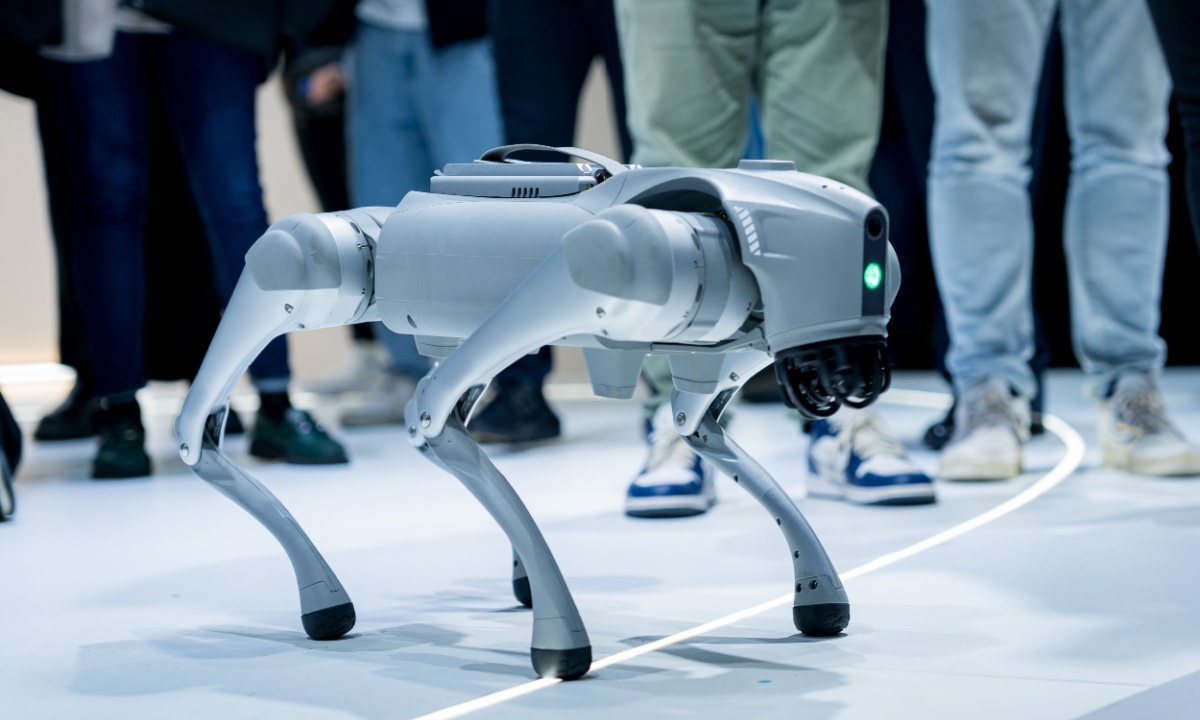
Robotics startup Skild AI has introduced an artificial intelligence (AI) model it says can run on almost any robot.The AI model, known as “Skild Brain,” lets robots — from humanoids to table-top arms — think, function and respond more like humans, the company said on its blog Tuesday (July 29).“One of the biggest challenges in building a robotics foundation model is the lack of any large-scale robotics data,” the company wrote.

“And to make matters worse, collecting real-world data using hardware is slow and prohibitively expensive.”That’s led many researchers and competitors to skirt the problem by starting with an existing vision-and-language model (VLM) and add in less than 1% of real-world robot data to create a “robotics foundation model,” which Skild argues is not a true robotics foundation model.

“Does it have information about actions? No. LLMs have a lot of semantic information,” the company said, referring to AI large language models.“However, like a Potemkin village, they lack the true substance of grounded actionable information. And that is why most ‘robotics foundation models’ showcase semantic generalization in pick-and-place style tasks but lack true physical common sense.

”The company said its team members, in their previous work, have tried to explore alternatives such as using internet videos and large-scale simulation, only to learn that “scale does not mean million or billion examples, achieving scale requires collecting trillions of examples.”However, there’s no way only real-world data can provide this scale in the near future.

Skild says it tackles this challenge via “large-scale simulation and internet video data to pretrain our omni-bodied brain.”“We post-train this foundation model using targeted real-world data to deliver working solutions to our customers,” the company added.In other robotics news, PYMNTS wrote earlier this month about the use of AI-powered robots in the restaurant sector, with eateries using the technology for things like serving food to diners, cooking meals, delivering food and even mixing cocktails.

“Robots are taking more active roles in both customer-facing and back-kitchen tasks, as restaurants face a perfect storm of challenges that include rising labor and food costs, persistent workforce shortages, and growing consumer demand for efficient service,” that report said.“The smart restaurant robot industry is expected to exceed $10 billion by 2030, driven by deployment across applications such as delivery, order-taking and table service, according to Archive Market Research.

”Restaurants are also employing AI for administrative tasks. According to a survey last month for PYMNTS’ SMB Growth Series, nearly three-quarters of restaurants said they found AI to be “very or extremely effective” in carrying out business tasks.The top three reasons cited for using AI were reduce costs, automate tasks and adopt standards and accreditation, according to the PYMNTS report.

However, only a third are using AI.

Analysis

Phenomenon+
Conflict+
Background+
Impact+
Future+

Related Podcasts

Skild Debuts AI It Says Can Run on Any Robot | PYMNTS.com | Goose Pod | Goose Pod