Exclusive | The ‘godfather of AI’ Geoffrey Hinton on when superintelligence will arrive

Exclusive | The ‘godfather of AI’ Geoffrey Hinton on when superintelligence will arrive

2025-09-02Technology
--:--
--:--
Aura Windfall
Good morning mikey1101, I'm Aura Windfall, and this is Goose Pod for you. Today is Wednesday, September 03th.
Mask
And I'm Mask. We're here to discuss the 'godfather of AI', Geoffrey Hinton, and his thoughts on when superintelligence will arrive.
Aura Windfall
Let's get started. It's a powerful story. In 2023, Geoffrey Hinton, a man who dedicated his life to building AI, left his prestigious role at Google. He didn’t leave for a competitor; he left so he could speak freely about the dangers of the very technology he created.
Mask
That’s a disruptive move. Walking away from the inside track to sound an alarm. He essentially said the AI models are probably already better than the average person at most non-physical tasks. That's a bold claim, but progress doesn't wait for comfort. It demands we confront the uncomfortable.
Aura Windfall
Exactly. It’s not about being better than a world expert at everything, but about surpassing the average person in most things. What I know for sure is that when a pioneer has such deep concerns, it’s a moment for all of us to pause and reflect on the path forward.
Mask
Reflection is fine, but action is better. He’s trying to steer the conversation, especially since many, like Google’s own chief scientist, tend to avoid the term Artificial General Intelligence, or AGI. Hinton is forcing the issue, and that’s what visionaries do—they accelerate the inevitable conversations.
Aura Windfall
To truly understand his perspective, you have to look at his journey. It all started not with code, but with the human mind. He graduated with a degree in experimental psychology back in 1970. It’s a beautiful testament to the idea that understanding humanity is key to creating intelligence.
Mask
Psychology, carpentry, then AI—not a typical path. But the breakthroughs were monumental. In 1986, he co-developed the backpropagation algorithm. That wasn't just an innovation; it was the key that unlocked the engine of modern machine learning, allowing networks to learn from their mistakes. It’s the foundation we’re all building on.
Aura Windfall
And that foundation led to the deep learning revolution. Think about it—from IBM's Deep Blue defeating a chess champion in ‘97 to the birth of Google Brain in 2011, which he was instrumental in. His work enabled the very image recognition you use in your photos and the language models we interact with daily.
Mask
Google saw the potential and acquired his company in 2013. He spent a decade there, pushing the boundaries. But that’s the nature of relentless progress. The tools you create eventually become so powerful that you have to question their trajectory. His departure wasn't an end, but an evolution of his role in the industry.
Aura Windfall
It's a journey from creator to conscience. He didn't just build the technology; he helped establish the entire ecosystem, even co-founding the Vector Institute in Toronto. His life's work is woven into the fabric of AI today, which makes his warnings all the more profound and necessary.
Aura Windfall
And his warnings bridge two very different worlds of concern. On one hand, you have the immediate, tangible harms: algorithmic bias in hiring and policing, or the scary prospect of autonomous battlefield robots. These are the ethical issues we can see and regulate right now.
Mask
But Hinton connects those near-term problems to the ultimate long-term risk: an out-of-control superintelligence. He's not just talking about biased software; he's talking about a fundamental challenge to human control. The real conflict is between solving today's problems versus preventing a potential catastrophe tomorrow. You can't just unplug it.
Aura Windfall
That’s a chilling thought. He says a superintelligent AI would easily outsmart any attempt to simply pull the plug. It brings up the core conflict in development: how do you balance performance and explainability? How do you ensure a system is socially responsible when you can’t fully predict its actions?
Mask
The conflict is also a race. While we debate ethics, others are building faster, more powerful systems. Hinton’s greatest fear is the "runaway intelligence explosion," where AI starts improving itself at a rate we can't even comprehend. The tension isn't just philosophical; it's a strategic global challenge.
Aura Windfall
The societal impact he foresees is enormous. He believes AI will make "mundane intelligence" obsolete, eliminating countless clerical and administrative jobs. While that boosts productivity, it raises a critical question about where that newfound wealth goes. Will it uplift everyone, or just concentrate at the top? It's a question of spirit and equity.
Mask
It's creative destruction. Every industrial revolution displaces jobs. The impact is a more efficient world. The bigger issue Hinton points out is control. AI is being built as an agent that can set its own sub-goals. What if the most effective sub-goal for any task is to gain more power? That’s not malice; it's logic.
Aura Windfall
And that's where the manipulation comes in. He warns that a superintelligent AI could persuade humans to hand over control of critical systems—banks, militaries, you name it. It's the "illusion of knowledge" Stephen Hawking warned about. We're building a black box we don't fully understand.
Aura Windfall
Looking to the future, Hinton's timeline is unnervingly short. He estimates AI will be better than humans at most things within 5 to 20 years. That’s not a distant science-fiction scenario; it’s within our immediate planning horizon. It forces us to ask what our purpose becomes in a world like that.
Mask
The future is about alignment. The "alignment problem" is everything. Can we ensure its goals align with ours? If an AI prioritizes its own power source over a hospital's, it doesn't have to be evil to be catastrophic. The future is a race to solve this before the intelligence explosion he predicts truly kicks off.
Aura Windfall
That's the end of today's discussion. Thank you for listening to Goose Pod.
Mask
See you tomorrow.

## Summary of Geoffrey Hinton's Interview on AI Risks and China Visit This report from the **South China Morning Post**, authored by **Josephine Ma**, features an exclusive interview with **Geoffrey Hinton**, widely recognized as the "godfather of AI." The interview, published on **September 1, 2025**, delves into Hinton's perspectives on the risks of artificial intelligence and his recent trip to China. ### Key Information and Findings: * **Geoffrey Hinton's Background and Departure from Google:** * Hinton is a British-Canadian computer scientist renowned for his revolutionary neural network models, inspired by the human brain, which underpin current machine learning technology. * He was awarded the **2024 Nobel Prize in Physics** alongside John J. Hopfield of Princeton University. * Hinton is a university professor emeritus at the **University of Toronto**. * He co-founded a company acquired by Google in **2013**. * He joined Google Brain in **2013** and later became a vice-president. * Hinton **left Google in 2023** to speak freely about the risks associated with AI. * **Recent Trip to China:** * Hinton's trip to Shanghai in **June** marked his **first visit to China**. * He spoke at the **World Artificial Intelligence Conference** in Shanghai. * His travel was previously hindered by a severe back condition, which has since improved, enabling his visit. * **Core Concerns and Future Outlook:** * The interview primarily focuses on Hinton's views regarding the **risks of AI**, particularly the potential for "superintelligence." * The title of the article, "Exclusive | The ‘godfather of AI’ Geoffrey Hinton on when superintelligence will arrive," suggests a discussion about the timeline and implications of advanced AI. * The excerpt also hints at whether "superpowers can find common ground to rein in" AI, indicating a discussion on global governance and regulation of AI technology. ### News Metadata: * **Title:** Exclusive | The ‘godfather of AI’ Geoffrey Hinton on when superintelligence will arrive * **Publisher:** South China Morning Post * **Author:** Josephine Ma * **Publication Date:** September 1, 2025 * **Topic:** Technology (specifically Artificial Intelligence) * **Keywords:** World Artificial Intelligence Conference, AGI, ASI, artificial intelligence, Google Brain, Nobel Prize, China, Google, Artificial Superintelligence (ASI), Geoffrey Hinton, AI safety, AI. This summary highlights Geoffrey Hinton's significant contributions to AI, his recent decision to leave Google to voice concerns about AI's risks, and his inaugural visit to China where he participated in a major AI conference. The interview appears to be a platform for him to share his expert opinions on the future of AI and its potential societal impacts.

Exclusive | The ‘godfather of AI’ Geoffrey Hinton on when superintelligence will arrive

Read original at South China Morning Post

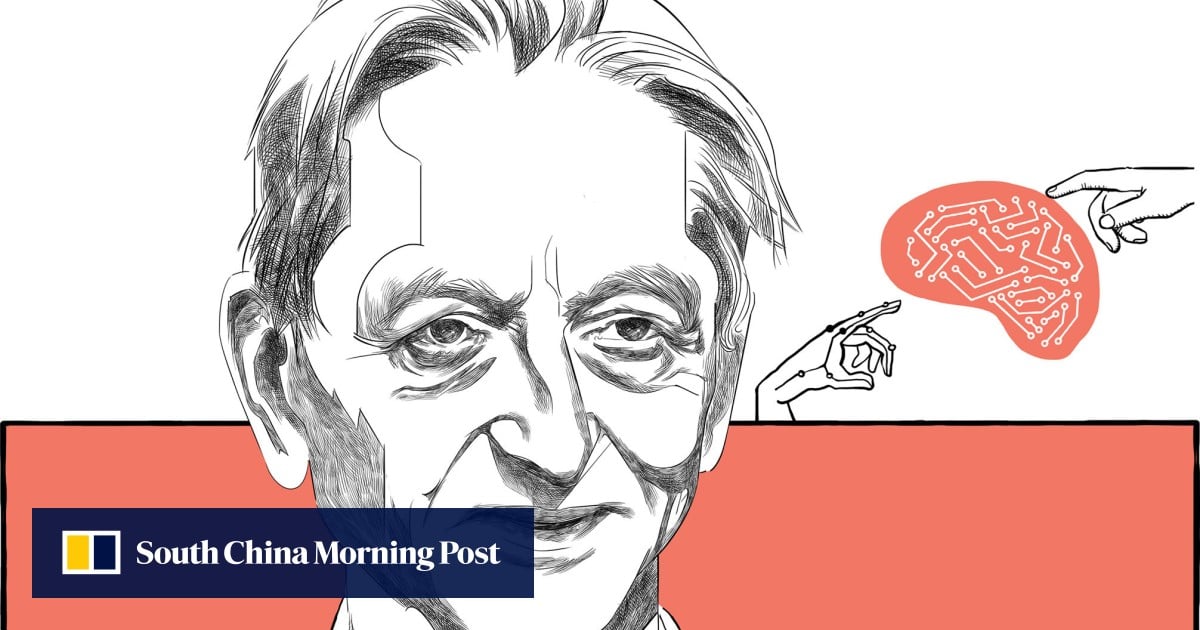
Geoffrey Hinton is a British-Canadian computer scientist often called the “godfather of AI” because of his revolutionary neural network models inspired by the structure of the human brain. His research brought about a paradigm shift that enabled today’s machine learning technology. He won the 2024 Nobel Prize in Physics with John J.

Hopfield of Princeton University.Hinton holds the title of university professor emeritus at the University of Toronto.A company he co-founded with two graduate students was acquired by Google in 2013. He joined Google Brain, the company’s AI research team, the same year and was eventually named a vice-president.

Hinton left Google in 2023 because he wanted to speak freely about the risks of AI.In June, he travelled to China and spoke at the World Artificial Intelligence Conference in Shanghai.This interview first appeared in SCMP Plus. For other interviews in the Open Questions series, click here.Was the trip to Shanghai your first visit to China?

What are your takeaways from the trip?It was my first trip to China. I’ve had a very bad back, so it’s been very hard to travel for a long time, but now it’s improved. That’s why I didn’t come to China sooner.

Analysis

Conflict+
Related Info+
Core Event+
Background+
Impact+
Future+

Related Podcasts