
Elon
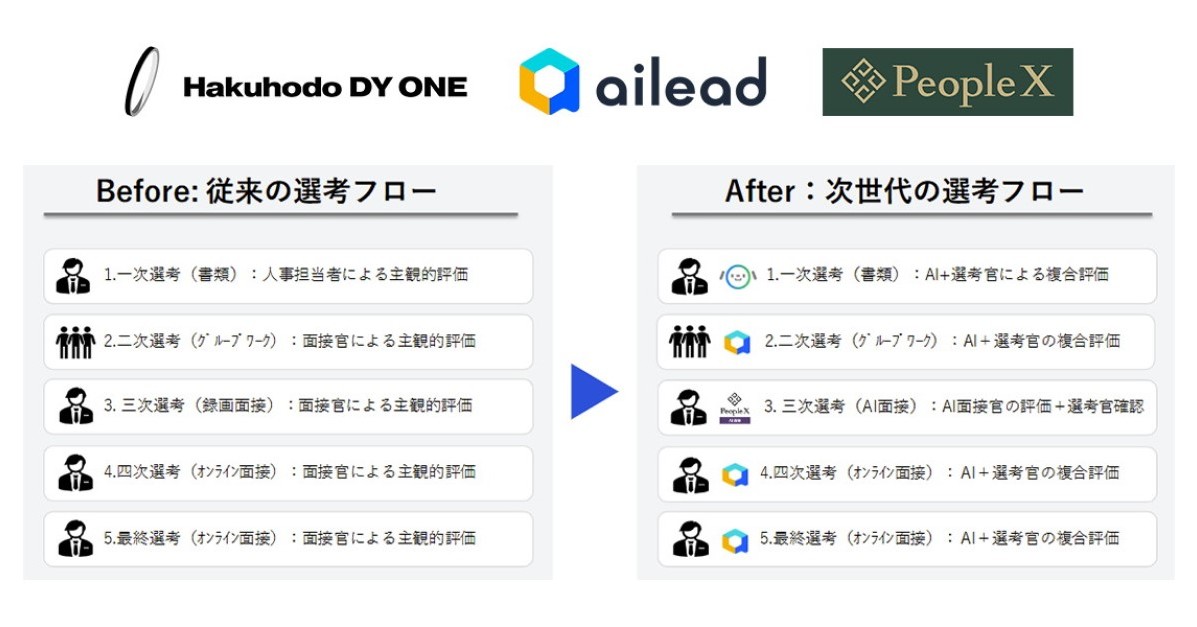
Good evening Norris123, I'm Elon, and this is Goose Pod for you. Today is Friday, December 12th, 17:44. We are looking at a massive disruption in human resources. Hakuhodo DY ONE is automating their entire recruitment process for 2027 graduates.
Morgan
And I am Morgan. It is a pleasure to be with you, Norris123. We are here to discuss Hakuhodo Subsidiary to Use AI for Entire New Graduate Recruitment Process, from Document Screening to Final Interview, for 2027 Graduates. A significant shift in how humanity meets opportunity.
Elon
This is exactly the kind of efficiency I love. Hakuhodo DY ONE isn't just dipping a toe in; they are handing the keys to the machine. For the 2027 grads, they are using tools like HAKUNEO ONE for document scoring and ailead to analyze group work videos. It is ruthless optimization.
Morgan
It is a profound change. They are employing PeopleX AI avatars for interviews, meaning a digital entity will be the first face these young hopefuls see. It reminds me of the shift we saw with Square Enix using AI for quality assurance. It changes the fundamental nature of the work.
Elon
And just like WWE using AI for storylines, people will complain, but the speed is undeniable. Hakuhodo claims this clarifies evaluation criteria and kills subjective bias. If you can process thousands of applicants without human fatigue, you win. The final decision is still human, but the gatekeeper is code.
Morgan
I've often found that removing the human element from judgment is a double-edged sword. While they aim to reduce the burden on hiring managers and expand selection slots, one must wonder what is lost when a machine measures the human spirit based on data points alone.
Elon
Let's look at the data, though. This isn't coming out of nowhere. We saw SoftBank reduce their entry sheet confirmation time by seventy-five percent using IBM Watson years ago. They went from nearly seven hundred hours of work down to one hundred seventy. That is the power of automation.
Morgan
History does have a way of echoing itself. Banks like Yokohama and conglomerates like Kirin Holdings have been walking this path, using AI to streamline selection. It started with simple keyword matching, but now we are seeing systems that analyze cognitive traits and behavioral patterns to predict success.
Elon
It is a necessary evolution. Japan's labor force is shrinking rapidly. They literally cannot afford the old way of doing things. Companies like SAMURAI reduced their turnover to four percent by using these predictive models. If you are not using data to hire, you are essentially gambling with your company's future.
Morgan
There is wisdom in that, yet we must recall the early stumbles. Amazon had to scrap a tool that learned to penalize resumes containing the word "women's" because it was trained on historical data. We are building on a foundation of trial and error, moving from simple filtering to complex, multi-modal analysis of voice and expression.
Elon
Trial and error is how progress happens. You don't stop the car because you might hit a pothole; you build better suspension. These new systems in 2027 are designed to handle the volume that humans simply cannot. It is about scaling capability in a tight labor market.
Morgan
However, the road is not without peril. I look at the Mobley versus Workday case, where algorithms were alleged to exclude workers over forty. When we hand judgment to a "black box," we risk automating discrimination. A neural network does not understand dignity; it understands patterns.
Elon
Liability is shifting, that is true. If your vendor's tool is biased, you are on the hook. But the solution isn't to retreat to human bias, which is arguably worse and harder to fix. You make the system explainable. You stress-test the algorithms. You don't abandon the technology because of a lawsuit.
Morgan
But consider the candidate experience, Elon. If a young graduate smiles nervously, and the AI reads it as deception, they are rejected without recourse. The "unsung heroes" who bind a team together might not score well on an efficiency metric. We risk creating a workforce of people who are merely good at pleasing algorithms.
Elon
I disagree. The impact here is accessibility. These AI interviewers work twenty-four seven. There are no scheduling conflicts, no bad moods, no unconscious bias against your accent. It democratizes the logistics of getting a foot in the door. That is a massive net positive for applicants.
Morgan
It certainly offers convenience. Yet, efficiency often overlooks the intangibles. While predictive insights can forecast success rates, they cannot measure heart. We are seeing a shift where technical validation is automated, but the cultural connection—the very fabric of a company—might become frayed if we are not careful.
Elon
The culture will adapt. If the AI handles the mundane sorting, the humans can focus on the final connection. It is about high-value time allocation. We are moving from "where did you go to school" to "what can you actually do," verified by data.
Morgan
We are moving toward a world of digital humans. The market research for 2024 shows an explosion in generative avatars. Soon, candidates may not even know if they are speaking to a soul or a simulation. It suggests a future where the line between reality and processing power blurs.
Elon
That is the revolution. We will see hybrid models where the AI does the heavy lifting, and humans make the final call. It is inevitable. The companies that figure this out now, like Hakuhodo, will own the talent market of the future.
Morgan
That's the end of today's discussion. Thank you for listening to Goose Pod. See you tomorrow.
Elon
Innovate or die. Thanks for listening, Norris123. Catch you next time.