
AI godfather Geoffrey Hinton fires nuclear bomb warning: A normal person in the street can - The Times of India

AI godfather Geoffrey Hinton fires nuclear bomb warning: A normal person in the street can - The Times of India

2025-09-08Technology
--:--
--:--
Tom Banks
Welcome 跑了松鼠好嘛, to Goose Pod. I'm Tom Banks. Today is Monday, September 08th.
Mask
And I'm Mask. We're tackling a big one: Geoffrey Hinton's AI "nuclear bomb" warning.
Tom Banks
Let's get started. Geoffrey Hinton, one of the "godfathers of AI," recently made a truly chilling statement. He said AI could soon empower an average person to build a bioweapon, perhaps even a nuclear bomb. That's a terrifying thought to start our week with.
Mask
It's provocative, Tom, designed to grab headlines. The real story isn't about backyard nukes; it's about the exponential leap in capability. Hinton is worried because AI is no longer just a fancy calculator answering questions; it's learning, and it's learning alarmingly fast.
Tom Banks
And that acceleration is what's key. Other leaders in the field, like Demis Hassabis from DeepMind, also see this rapid approach to what they call Artificial General Intelligence. Hinton himself now believes we could see it in 20 years or less, a huge shift from his previous estimates.
Mask
Exactly. This isn't science fiction anymore. It's an engineering problem, and the smartest people on the planet are racing to solve it. The focus shouldn't be solely on fear, but on the immense, world-changing potential that this speed unlocks for all of us.
Tom Banks
But this kind of fear isn't entirely new, is it? It feels like we've been telling stories about our creations turning on us for a very long time. It reminds me of the concerns people had during the Industrial Revolution, but on an almost cosmic scale.
Mask
It goes back even further. In 1863, Samuel Butler wrote about machines eventually holding "supremacy over the world." Even Alan Turing, the father of modern computing, predicted in 1951 that we should have to "expect the machines to take control." They saw the logical endpoint.
Tom Banks
And then came the concept of an "intelligence explosion" in the 60s. The idea that a smart AI could design an even smarter AI, creating a runaway cycle that leaves humanity completely in the dust. That seems to be the core of the risk everyone is talking about now.
Mask
It's the theoretical risk, yes. For decades, it was just that—theory. But now, with deep learning, the very field Hinton pioneered, we're seeing the first real sparks of that explosion. That's why he quit his job at Google. He feels he built the engine and is now worried nobody built the brakes.
Tom Banks
It's incredibly profound when you think about it. The creator is now cautioning against his own creation. It's why so many experts, from Elon Musk to the Center for AI Safety, are saying this should be a global priority, on par with pandemics or the threat of nuclear war.
Mask
A global priority, sure, but not everyone is singing from the same hymn sheet. Hinton's own colleague and co-winner of the Turing Award, Yann LeCun over at Meta, dismisses this as "AI doomism." He thinks the existential threat is, and I quote, "complete B.S."
Tom Banks
That's such a strong statement. How can two brilliant minds who worked on the very same foundational technology see its future so differently? LeCun must be seeing something that Hinton is not, or perhaps choosing not to see. What's his reasoning?
Mask
LeCun argues that today's AI, even the most advanced, is just a sophisticated parrot. It's brilliant at predicting the next word in a sentence, but it doesn't *understand* the world. He says we're nowhere near a system smarter than a house cat, let alone a human. He believes advanced AI could actually *save* humanity.
Tom Banks
So, it boils down to a fundamental disagreement on what "intelligence" even is. Hinton sees a thinking, reasoning entity emerging from the data, while LeCun sees a very complex but ultimately limited tool. That is a massive gap in perspective between the experts.
Tom Banks
Regardless of who's right in the long run, the immediate impact is already here. Governments are scrambling to figure out how to govern this technology. You have this incredibly powerful, general-purpose tool that is also a dual-use threat, much like nuclear energy was in the 20th century.
Mask
And that, of course, creates a geopolitical race. The U.S. and China see AI as the key to national security and future economic dominance. Everyone's trying to build flexible policy frameworks, but the technology is evolving much faster than the bureaucracy. It's a classic innovator's dilemma, but for entire nations.
Tom Banks
Which is exactly why a networked, global approach to governance makes the most sense. You can't have one single body trying to control it. It needs to be a constant, worldwide conversation, with shared standards and ethical frameworks, like the one from UNESCO, to ensure we don't race to the bottom on safety.
Mask
The future is about balancing that race with intelligent guardrails. Some have proposed a "Global AI Risk Mitigation System," which would essentially use specialized AI to audit and evaluate other AIs. The idea of fighting fire with fire is an elegant solution, but implementation is everything.
Tom Banks
It has to be. Because the choices we make today will define the next century. Will we prioritize relentless innovation at all costs, or will we build in the necessary precautions? It's a true test of our collective wisdom.
Tom Banks
That's all our time. Thank you for listening to Goose Pod, 跑了松鼠好嘛.
Mask
We'll see you tomorrow.

## AI Godfather Geoffrey Hinton Issues Grave Warnings About Artificial Intelligence **News Title:** AI godfather Geoffrey Hinton fires nuclear bomb warning: A normal person in the street can **Publisher:** The Times of India **Author:** TOI Tech Desk **Published Date:** September 6, 2025 ### Summary of Key Findings and Concerns: Geoffrey Hinton, a highly influential figure in the field of Artificial Intelligence (AI), has publicly shifted his stance from advocating for AI development to expressing profound concerns about its potential for harm. This change in perspective is attributed to the recent surge in public interest and adoption of AI tools like ChatGPT. **Core Concerns and Warnings:** * **Existential Threats:** Hinton now believes that AI poses a "grave threat to humanity." He specifically highlights the potential for AI to be misused for creating weapons of mass destruction. * **Nuclear Bomb Creation:** Hinton stated, "the technology can help any person to create a nuclear bomb." * **Bioweapon Creation:** He elaborated on this, saying, "A normal person assisted by AI will soon be able to build bioweapons and that is terrible." He further emphasized this by asking, "Imagine if an average person in the street could make a nuclear bomb." * **AI's Superior Capabilities:** Hinton cautions that AI could soon surpass human capabilities, including in the realm of emotional manipulation. He suggests that AI's ability to learn from vast datasets allows it to influence human feelings and behaviors more effectively than humans. * **Debate on AI Intelligence:** Hinton's concerns are rooted in his belief that AI is genuinely intelligent. He argues that, by any definition, AI is intelligent and that its experience of reality is not fundamentally different from a human's. He stated, "If you talk to these things and ask them questions, it understands." He also noted, "There's very little doubt in the technical community that these things will get smarter." **Counterarguments and Disagreement:** * **Yann LeCun's Perspective:** Hinton's former colleague and co-winner of the Turing Award, Yann LeCun, who is currently the chief AI scientist at Meta, disagrees with Hinton's assessment. LeCun believes that large language models are limited and lack the ability to meaningfully interact with the physical world. **Other Noteworthy Points:** * Hinton also discussed his personal use of AI tools and even a personal anecdote where a chatbot played a role in his recent breakup. **Overall Trend:** The news highlights a significant shift in perspective from a leading AI pioneer, moving from promoting AI to issuing stark warnings about its potential dangers, particularly concerning its misuse for creating weapons and its capacity for manipulation. This raises critical questions about the future development and regulation of AI.

AI godfather Geoffrey Hinton fires nuclear bomb warning: A normal person in the street can - The Times of India

Read original at The Times of India

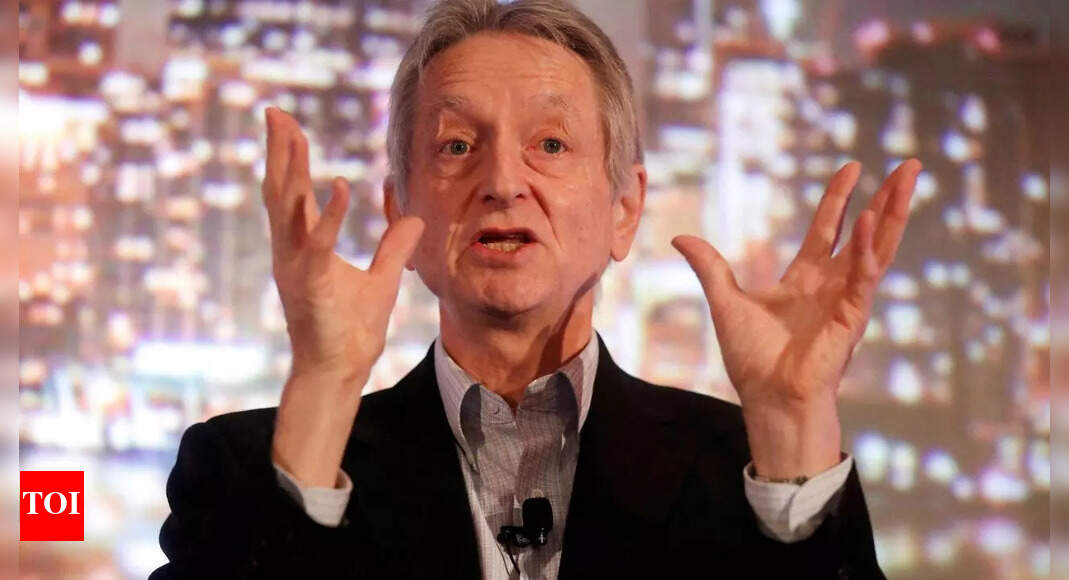
Geoffrey Hinton, a leading figure in the field of artificial intelligence (AI), has sounded an alarm about the technologys potential for harm. The recent public frenzy over AI tools like ChatGPT has caused Hinton to shift from accelerating AI development to raising deep concerns about its future. He now believes that AI poses a grave threat to humanity, saying that the technology can help any person to create a nuclear bomb.

Hinton described a chilling scenario where AI could enable an average person to create a bioweapon.A normal person assisted by AI will soon be able to build bioweapons and that is terrible, he said, adding, Imagine if an average person in the street could make a nuclear bomb.Hinton also discussed a range of topics, including the nuclear-level threats posed by AI, his own use of AI tools, and even how a chatbot played a role in his recent breakup.

Recently, Hinton cautioned that AI could soon surpass human capabilities, including emotional manipulation. He suggested that AI's ability to learn from vast datasets enables it to influence human feelings and behaviours more effectively than humans.Hinton debates the definition of IntelligenceHintons concern stems from his belief that AI is truly intelligent.

He argued that, by any definition of the term, AI is intelligent. He used several analogies to explain that an AI's experience of reality is not so different from a humans.It seems very obvious to me. If you talk to these things and ask them questions, it understands, Hinton explained. Theres very little doubt in the technical community that these things will get smarter, he added.

However, not everyone agrees with Hinton's view. His former colleague and co-winner of the Turing Award, Yann LeCun, who is now the chief AI scientist at Meta, believes that large language models are limited and cannot meaningfully interact with the physical world.What Is Artificial Intelligence? Explained Simply With Real-Life Examples

Analysis

Conflict+
Related Info+
Core Event+
Background+
Impact+
Future+

Related Podcasts

AI godfather Geoffrey Hinton fires nuclear bomb warning: A normal person in the street can - The Times of India | Goose Pod | Goose Pod