
US team develops nuclear propulsion concept to shorten Mars trip

US team develops nuclear propulsion concept to shorten Mars trip

2025-09-16Science
--:--
--:--
Aura Windfall
Good morning 老王, I'm Aura Windfall, and this is Goose Pod for you. Today is Tuesday, September 16th. What I know for sure is that today, we're exploring a topic that touches the very spirit of human curiosity.
Trump
And I'm Trump. We're here to discuss something tremendous: a US team developing a nuclear propulsion concept to shorten the trip to Mars. It's going to be unbelievable, folks. The best. We're making space travel great again.
Aura Windfall
Let's get started. At the heart of today's topic is a truly innovative concept from Ohio State University called the centrifugal nuclear thermal rocket, or CNTR. They're not just improving old designs; they're reimagining the engine itself using liquid uranium.
Trump
Liquid uranium! It's genius. Absolute genius. For years, we've been stuck with these slow, inefficient chemical rockets. A total disaster. This new idea, it's a winner. It's the kind of thinking we need to be number one, and believe me, we will be.
Aura Windfall
The truth of this innovation is what it means for the astronauts. A potential trip to Mars could be shortened to just six months one-way. This dramatically reduces their exposure to the dangers of deep space, like cosmic radiation. It’s a profound step for human well-being.
Trump
It's about winning the race! Six months! We'll get there so fast, everyone else will be left in the dust. It’s not just about safety, which is very important, the most important, but it’s about showing the world what American ingenuity can do. It's going to be beautiful.
Aura Windfall
Let’s talk about the performance metrics, because they are quite staggering. A typical chemical engine has a specific impulse—a measure of efficiency—of about 450 seconds. Older nuclear designs from the sixties hit 900. This CNTR is projected to reach 1800 seconds.
Trump
The numbers are huge! The biggest numbers. I don't get bogged down in the details, you don't have to, but what it means is that it's twice as good as the old nuclear, four times as good as the chemical junk. We're getting the best deal with this engine.
Aura Windfall
Beyond Mars, this power could unlock the rest of the solar system, enabling faster missions to the outer planets. But for this to become a reality, it needs consistent support. A clear, long-term policy is essential for these technologies to mature properly.
Trump
Policy is fine, but you need a strong leader to push it through. Lots of talk, no action, that's the problem. We need to tell the scientists, 'We have your back, you have the funding, now go out and build the greatest rocket engine ever seen!' It's simple.
Aura Windfall
That drive is certainly what fuels these breakthroughs. It’s this marriage of bold vision and brilliant engineering that truly pushes us toward the future, ensuring that we don’t just dream of the stars, but that we can actually reach them safely and swiftly.
Trump
It’s the future, and we’re building it now. This isn’t some fantasy. The people at Ohio State, they’re patriots. They’re building a fantastic piece of technology that will keep America at the forefront of space, and I’m telling you, it’s going to be a huge success.
Aura Windfall
What I find so fascinating is that this journey didn't begin yesterday. The seeds of nuclear propulsion were planted back in 1961 with the NERVA program. NASA and the Atomic Energy Commission saw this potential, this incredible promise, for deep space missions.
Trump
They had it! They had it right there in the sixties and they gave it up. Can you believe it? A terrible deal. They had the lead and they fumbled it because they lacked vision. They didn't know how to win. It was very sad. So sad.
Aura Windfall
It was a different time, with different priorities and perceived needs. But now, aerospace engineers are re-embracing that original vision. Let’s talk about how it works. Instead of a chemical explosion, you have a small nuclear reactor, a tiny, powerful heart for the engine.
Trump
It's a great engine. The best engine. It uses a small piece of uranium, about the size of a marble, believe me, and the power is just unbelievable. It heats up hydrogen gas and shoots it out the back. Very simple. Very, very powerful. No smoke, no fire. Clean.
Aura Windfall
That’s a perfect way to put it. This process is more than twice as efficient as chemical rockets. It creates more thrust for every drop of propellant. This efficiency is what gives missions incredible new flexibility. We're no longer completely beholden to planetary alignments.
Trump
Exactly! We go when we want to go. We don't ask the planets for permission. We tell them when we're coming. It’s about taking control. With the old rockets, you miss your window, you have to wait years. With this, you can abort a mission and come home. Total control.
Aura Windfall
That mid-transit abort capability is a monumental leap for crew safety. And speaking of safety, a key point is that the reactor is only activated once the spacecraft is already in a safe orbit, far from Earth. The design spirit is fundamentally about safety and responsibility.
Trump
It's totally safe. The safest. Anyone who says otherwise is peddling fake news. We launch it cold. It's not nuclear until it's way up there in space. It's probably safer than the batteries in your phone, believe me. We have the best people on this.
Aura Windfall
And there are brilliant people working on this now, like the teams at BWX Technologies and X-energy, who are developing advanced, meltdown-proof fuels. They're building on the lessons of the past to create a system that is not only powerful, but also incredibly robust and reliable.
Trump
That's what we do. We learn and we build it better. We take the old ideas, which were good, very good, and we make them great. This new TRISO-X fuel, it can handle incredible heat. It's tough. It's American-made tough, and it won't fail. No failing.
Aura Windfall
It's this continuous innovation that truly defines the new space age. We're seeing a convergence of advanced materials, new manufacturing techniques, and a renewed national will. It’s a testament to the idea that when we commit to a goal, incredible things become possible.
Trump
It's about commitment. You have to be committed to being the best. For a long time, we weren't. We let other countries catch up. Those days are over. With technology like this, we're not just catching up; we're lapping everybody. It's a whole new ballgame now.
Aura Windfall
Of course, a journey this revolutionary is never without its challenges. What I know for sure is that great leaps require overcoming great obstacles. The Ohio State team is very open about the engineering hurdles they need to solve before this design is ready for flight.
Trump
Hurdles? We love hurdles. We fly right over them. These engineers, they're the best in the world, but they need a push. They'll figure it out. The challenges, like stable startup and shutdown, that's what they do. They solve problems. It's what makes our country great.
Aura Windfall
There's also the challenge of minimizing any loss of the liquid uranium fuel, which is a complex fluid dynamics problem. And beyond the technical, there's the entire regulatory landscape. Getting a new type of nuclear reactor certified is a marathon, not a sprint.
Trump
It's a marathon because of the swamp! The bureaucracy in Washington, it's terrible. The NRC hasn't certified a new advanced reactor in 50 years. Can you believe it? They create problems. We need to cut the red tape and let our great companies build things again.
Aura Windfall
This brings up the classic debate between prioritizing performance versus affordability. The CNTR design focuses on maximum performance, which is incredible, but it exists in a world where cost is always a factor. Finding that perfect balance is a delicate dance.
Trump
You have to have the best. You can't be second-best. People who talk about affordability are thinking small. You make it the best, and then you build a lot of them. That's how it becomes affordable. You win first, then you figure out the rest. Don't lead from behind.
Aura Windfall
But perhaps the single biggest conflict isn't on a design schematic or in a committee room. It's the universe itself. The single greatest challenge for any Mars mission is the constant, invisible threat of deep space radiation. It's the ultimate adversary on this journey.
Trump
Radiation is a problem, a big one. But we'll solve it. We'll build the greatest shields, the best you've ever seen. We have the technology. It's another hurdle, and we're going to clear it. When you have the will to win, you find a way to beat everything, even radiation.
Aura Windfall
So, let's step back and look at the larger picture. If we overcome these challenges, what is the true impact of this technology? How does it fundamentally change our future in space? It feels like we're on the cusp of a whole new chapter for humanity.
Trump
The impact is simple: we will own space. It's the ultimate high ground. We'll have, as some people are saying, freight trains to the Moon. Can you imagine? A new economy. It's going to create so many jobs, it'll make your head spin. It’s going to be tremendous.
Aura Windfall
I love that phrase, "freight trains to the Moon." It speaks to building a real, sustainable infrastructure. And for national security, the U.S. Space Force talks about "maneuvering without regret," which this technology enables. It's about having agility and freedom of movement in the cislunar domain.
Trump
'Maneuvering without regret.' It's fantastic. I've been saying that for years, in a way. You have to be strong, you can't have regrets. You move fast, you win, and you don't look back. This technology lets our military and our commercial partners do exactly that. No hesitation.
Aura Windfall
This really transforms the economics of space. When you can move heavier payloads faster and more efficiently, it opens up possibilities for space industrialization, resource utilization, and even tourism on a scale we've only dreamed of. It builds high-speed routes between Earth's orbits.
Trump
It's a game-changer. A total game-changer. The old way, with chemical rockets, is like taking a horse and buggy. This is the supersonic jet. It makes everything else obsolete. We're going to build a trillion-dollar economy in space, and it's going to be led by America.
Aura Windfall
What I know for sure is that this isn't just about faster ships; it's about a faster future. It accelerates the timeline for humanity becoming a multi-planetary species. It's a strategic capability that changes our relationship with the cosmos, making it more accessible and immediate.
Aura Windfall
And this isn't just a theoretical discussion. There are real, tangible plans moving forward. The future is being built right now. A key project to watch is the DRACO program, a partnership between DARPA and NASA. It's the next concrete step.
Trump
DRACO is a fantastic program. Very important. But they're planning a test flight by 2027. We should be doing it by 2026, maybe even late 2025. We have to move faster than the competition. We can't be complacent. We need to accelerate these things. It's a race.
Aura Windfall
The goal of DRACO is to conduct a full in-space demonstration of a nuclear thermal rocket in Earth orbit. This test will be the moment of truth, proving that the technology works in the actual environment where it will be used. It’s a critical milestone.
Trump
It's a huge milestone. And we have to win it. Other countries, they're watching, they're trying to do what we're doing. But they don't have our people, our innovators. This is about showing the world that America is, and will always be, the leader in space exploration. America First.
Aura Windfall
So, what we know for sure today is that a bold new concept, the Centrifugal Nuclear Thermal Rocket, is paving the way for a future where humanity can travel the solar system faster and safer than ever before. It's a testament to the power of human ingenuity.
Trump
The bottom line is this: it's faster, it's safer, and it's better. We're going to build it, and it's going to be a tremendous success. That's the end of today's discussion. Thank you for listening to Goose Pod. See you tomorrow.

## Ohio State Engineers Design Revolutionary Liquid Uranium Nuclear Rocket Concept for Mars Trip This news report from **Interesting Engineering**, authored by **Mrigakshi Dixit**, details the development of a novel nuclear thermal propulsion system by engineers at **The Ohio State University**. The concept, named the **Centrifugal Nuclear Thermal Rocket (CNTR)**, aims to significantly enhance rocket performance and reduce risks for deep-space missions, particularly for future human expeditions to Mars. The report was updated on **September 12, 2025, 06:53 AM EST**. ### Key Findings and Conclusions: * **Innovative Fuel Design:** The CNTR system distinguishes itself by utilizing **liquid uranium** to directly heat rocket propellant, unlike conventional designs that rely on solid fuel elements. * **Doubled Efficiency:** This liquid uranium approach is projected to make the engine **twice as efficient** as current conventional nuclear designs. * **Performance Prioritization:** The CNTR's primary focus is on **performance enhancement**, aiming to double engine efficiency rather than solely on cost reduction, which is a common goal in other nuclear propulsion developments. * **Reduced Travel Times:** The CNTR has the potential to drastically shorten travel times to distant destinations. It is projected to enable viable human missions to Mars with **round-trip times shortened to 420 days**. A PhD student leading prototype construction, Spencer Christian, envisions a safe **one-way trip to Mars in just six months**. * **Expanded Mission Capabilities:** Beyond Mars, the powerful thrust generated by the CNTR could facilitate quicker scientific rendezvous missions to the **outer planets and Kuiper Belt objects** via direct injection orbits. It could also support new **one-way robotic missions to distant outer planets** like Saturn, Uranus, and Neptune. * **Propellant Flexibility:** The CNTR could utilize various propellants, including **ammonia, methane, propane, or hydrazine**, opening possibilities for using in-space resources from asteroids and Kuiper Belt objects for a self-sustaining presence in space. ### Key Statistics and Metrics: * **Specific Impulse:** The CNTR is projected to achieve a high specific impulse of **1800 seconds**. * **Context:** This is significantly higher than the approximately **450 seconds** for chemical engines and **900 seconds** for 1960s-era nuclear designs. Specific impulse is a measure of how efficiently a rocket engine uses propellant; a higher number means more thrust for the same amount of fuel. * **Mars Round-Trip Time:** Projected to be **420 days**. * **Mars One-Way Trip Time:** Envisioned to be as short as **six months**. ### Significant Trends or Changes: * **Growing Interest in Nuclear Thermal Propulsion:** Space agencies like NASA are increasingly developing nuclear thermal propulsion (NTP) technologies to reach distant regions of the solar system and to facilitate human return missions to the Moon and beyond. * **Addressing Limitations of Chemical Engines:** Standard chemical engines have limitations in thrust and fuel consumption, making them impractical for long-distance missions. The CNTR offers a solution to overcome these limitations. * **Prioritizing Astronaut Health:** Reducing travel time in space is crucial for mitigating health risks associated with prolonged exposure for astronauts. ### Notable Risks or Concerns (Engineering Challenges): * **Technical Hurdles:** The CNTR concept currently faces significant engineering challenges that need to be resolved before the design is ready. * **Operational Stability:** Ensuring **stable startup, operation, and shutdown** of the liquid uranium core is a key challenge. * **Fuel Management:** Minimizing the **loss of uranium fuel** is critical for efficiency and safety. * **Failure Management:** Developing strategies to **manage potential engine failures** is paramount. ### Important Recommendations: * **Consistent Priority for Space Nuclear Propulsion:** Dean Wang emphasizes the need to maintain space nuclear propulsion as a **consistent priority** to allow the technology time to mature. ### Financial Data: * The Ohio State team's efforts are supported by a **grant provided by NASA**, highlighting the national importance of this advanced propulsion technology. ### Timeline: * The team hopes to have the design ready within **five years**. This development represents a significant step forward in the pursuit of faster, more efficient, and safer deep-space exploration, with the CNTR concept holding substantial promise for the future of human and robotic missions.

US team develops nuclear propulsion concept to shorten Mars trip

Read original at Interesting Engineering

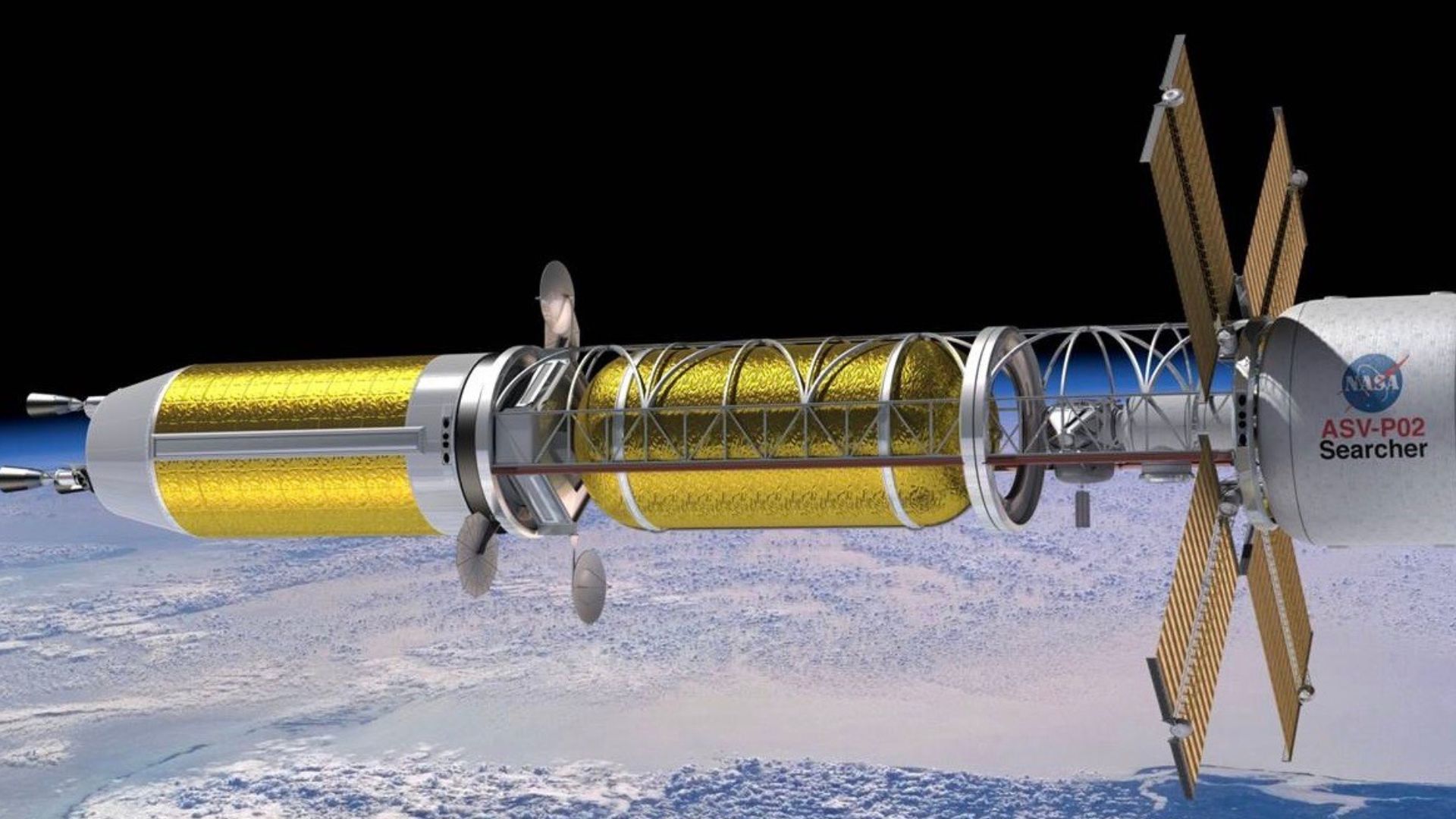
Ohio State engineers design liquid uranium nuclear rocket concept for Mars tripThe team says this technology could boost a rocket’s performance as well as reduce engine risks. Updated: Sep 12, 2025 06:53 AM ESTIllustration of a spacecraft enabled by nuclear thermal propulsion. NASA The Ohio State University is developing a new nuclear thermal propulsion system called the centrifugal nuclear thermal rocket (CNTR).

Rather than solid fuel elements, this new design uses liquid uranium to heat the rocket propellant directly. The result is an engine that could be twice as efficient as conventional nuclear designs. In a statement released on September 11, Dean Wang of Ohio State said the CNTR system stands out from other nuclear propulsion developments.

While many focus on making the technology more affordable, the CNTR prioritizes performance by doubling an engine’s efficiency. Shortening the Mars trip In the new space race, space agencies like NASA are developing nuclear thermal propulsion to reach the solar system’s most distant regions. Interest in nuclear thermal propulsion is growing as space agencies look to send humans back to the Moon and beyond.

The limitations of standard chemical engines—low thrust and high fuel consumption—make them impractical for long-distance missions. As a result, missions to the outer solar system can take many years, as seen with the New Horizons probe’s nine-year journey to Pluto. For future human missions to distant destinations, it is integral to find a way to reduce travel time, increase cargo capacity, or both.

This is vital because prolonged time in space increases health risks for astronauts. Therefore, developing more efficient propulsion systems is required to make deep-space travel safer and more feasible. The CNTR’s potential looks promising. As per the study paper, it is projected to have a high specific impulse of 1800 seconds, compared to approximately 450 seconds for chemical engines and 900 seconds for 1960s-era nuclear designs.

The CNTR could enable viable human missions to Mars with round-trip times shortened to 420 days. Spencer Christian, a PhD student leading prototype construction, envisions a safe one-way trip to Mars in just six months. “Depending on how well it works, the prototype CNTR engine is pushing us towards the future,” said Christian in the press release.

Beyond Mars, this powerful thrust could facilitate quicker scientific rendezvous missions to the outer planets and Kuiper Belt objects via direct injection orbits. Engineering challenges In addition to being faster, nuclear thermal propulsion gives rockets more flexibility in flight paths than chemical engines can reach distant targets.

Moreover, the CNTR could also use various propellants, such as ammonia, methane, propane, or hydrazine. This ability could pave the way for utilizing in-space resources from asteroids and Kuiper Belt objects, developing a self-sustaining presence in space. These advanced capabilities of nuclear thermal propulsion could also support new one-way robotic missions to distant outer planets like Saturn, Uranus, and Neptune.

At present, the CNTR concept faces major engineering challenges. According to Wang, the team needs to solve technical hurdles before the design is ready. These challenges include ensuring stable startup, operation, and shutdown, as well as minimizing the loss of uranium fuel and managing potential engine failures.

The team hopes to have the design ready within five years. RECOMMENDED ARTICLES “We need to keep space nuclear propulsion as a consistent priority in the future, so that technology can have time to mature,” said Wang. The Ohio State team’s efforts are supported by a grant provided by NASA, which showcases the national importance of this advanced propulsion technology in shaping the future of space exploration.

ABOUT THE AUTHORMrigakshi Dixit Mrigakshi is a science journalist who enjoys writing about space exploration, biology, and technological innovations. Her work has been featured in well-known publications including Nature India, Supercluster, The Weather Channel and Astronomy magazine. If you have pitches in mind, please do not hesitate to email her.

RELATED ARTICLESJOBS

Analysis

Conflict+
Related Info+
Background+
Impact+
Future+

Related Podcasts