What happened
Between Fascination and Discomfort: The New Generation of Humanoid Robots
Report Provider: Rat für Formgebung Stiftung
Author: Armin Scharf
7 Min LesezeitTo what extent should robots be anthropomorphised? At what point does their resemblance to humans become uncomfortable or even repugnant? These are not new questions, nor have they been definitively answered. However, given the current hype surrounding humanoid robots, they are more relevant now than they have been for years.
by Armin ScharfIs this what the uncanny valley looks like? With its extremely human-like anatomy, the Protoclone is set to raise the bar for humanoid robots. It is already available for pre-order | YouTube Video: © CloneRoboticsIn February, an intriguing video did the rounds. It shows a human-like figure hanging motionless from the ceiling, which suddenly starts to twitch, writhe and convulse – a fascinating yet unsettling sight.
The video was released by Clone Robotics, a Polish start-up company, to introduce its Protoclone V1.Beneath the white, elastic film – or should we say ‘skin’? – lies a system of 1,000 artificial muscles, known as myofibres, which are hydraulically activated, i.e. using water pressure. This distinguishes the concept from most other humanoid robots, which typically rely on electric motors.
It is also unique in that these muscles are attached to a skeletal system that replicates human anatomy, with all 206 of its elements. The robot features a torso, pelvis and spine, as well as delicate ‘finger bones’ in its slender hands. Four depth cameras behind the head visor, along with inertia and pressure sensors, report real-time data to microcontrollers in the spine.
These microcontrollers then control the high-pressure pump and valves. The aim is to achieve a high degree of mobility and muscle strength using minimal energy. The Clone Alpha, which is already available to pre-order, will eventually be able to walk upright, although it remains to be seen whether it will move as smoothly as the animations on the website suggest.
Unfortunately, Clone Robotics did not reply to repeated requests for information.‘The robot features a torso, pelvis and spine, as well as delicate ‘finger bones’ in its slender hands… ‘Protoclone: Bipedal Musculoskeletal – A Synthetic Human with Artificial Muscles | Screenshot from YouTube: © CloneRoboticsThe Leap into the Uncanny ValleyIf we are to take the scenario presented by Clone Robotics seriously, it raises urgent questions that go far beyond the technology itself.
Fundamentally, the issue is what makes a robot seem human. This has been a concern for engineers, designers and philosophers ever since Japanese roboticist Masahiro Mori coined the term ‘Uncanny Valley’ in 1970. According to his theory, the more human-like a robot becomes, the greater the public’s acceptance of it – until a critical point is reached at which its near-human resemblance becomes unsettling.
However, Wulf Loh of the International Centre for Ethics in the Sciences at the University of Tübingen IZEW (german: Internationalen Zentrum für Ethik in den Wissenschaften der Universität Tübingen) suggests that ‘this effect may turn back into acceptance once robots become truly human-like’. In his words: ‘Does Data from Star Trek still reside in the Uncanny Valley, or has he already overcome it?
’When asked about the Protoclone, Dr Werner Kraus, head of the Department of Automation and Robotics at the Fraunhofer Institute IPA, remarked: ‘In terms of design, we are indeed still in the uncanny valley. In my view, the robot provokes more fear than sympathy.’ He is also concerned about what people expect from such robots: ‘With a robot that looks so human, we tend to expect it to be able to do everything humans can, but from a technical standpoint, we are still far from achieving that.
’One of the biggest challenges at present is creating reliable and dexterous hands, as well as the ability to cope with unpredictable situations and unfamiliar objects. Thanks to its biomimetic design, the Protoclone demonstrates lifelike movements in videos released by the start-up. This is made possible by its complex articulated joints, which offer a wide range of motion.
According to the development team, the shoulder has four joints offering 20 degrees of freedom, while the hand has 26. This could potentially make the robot more agile than a human.‘The more human-like a robot becomes, the greater the public’s acceptance of it – until a critical point is reached at which its near-human resemblance becomes unsettling.
’The Clone Torso 2 features an actuated lumbar spine and all the corresponding abdominal muscles. A white, transparent skin encloses 910 muscle fibres that enable 164 degrees of freedom and is equipped with 182 sensors for feedback control | Screenshot from YouTube: © CloneRoboticsWhy Humanoids Are So FascinatingThe ultimate goal is to develop robots that can operate autonomously in human environments and perform repetitive tasks without requiring those environments to be modified.
However, despite the current hype, the reality is different. ‘Humanoids are still far from being practical beyond prototypical testing,’ says Kraus. ‘They currently perform well in controlled test environments, but often fail in dynamic, unstructured scenarios.’ The list of challenges is long: ‘These include improving fine motor skills, particularly in the hands and grippers, recognising and understanding complex surroundings, and enabling natural interaction with people.
’Even at the recent Automatica trade fair, the impact of the environment was evident: the 4NE-1 humanoid robots by Neura Robotics remained inactive as they could not handle the acoustic conditions at the event. For now, the dream of a universal robot that can do it all remains just that.Humanoid robots are set to become the next big thing in robotics, and the ‘4NE-1’ by Neura Robotics is a promising example of this emerging technology | © Neura RoboticsChina: The New Hotspot for HumanoidsWhile Western companies have not even reached the beta stage, China has become the epicentre of humanoid robotics.
“There are over 100 companies focused on humanoid development. The pace is intense,” reports Kraus, who recently travelled to East Asia. The approach taken there is fundamentally different: ‘Iterate quickly, fail fast, and restart immediately. That’s the Chinese strategy.” He visited firms that developed functioning humanoid prototypes within two years and recently put them through half-marathon test runs.
Since 2023, humanoid robots have been at the top of China’s development agenda, partly as a means of maintaining economic output in the face of demographic decline.The British company Engineered Arts presents Ameca. Thanks to the integration of generative AI, it is possible to communicate with the robot in natural language | © Engineered ArtsDesign: Between Function and AcceptanceThe design of humanoid robots faces a central dilemma, namely whether they should look as human as possible or remain clearly recognisable as machines.
Kraus advocates a functional approach: ‘We’ve found the principle of “form follows function” to be helpful in making the robot’s capabilities apparent to users quickly. The design should strike a balance between functionality and aesthetics. An attractive, yet not overly human-like, appearance can help to avoid confusion or even fear.
” Design conveys a message: a humanoid robot implies familiarity and partnership, but it also carries the risk of creating misplaced expectations. Loh summarises this tightrope act as follows: ‘On the one hand, it’s about joyful interaction between humans and machines. On the other hand, the machine must always be recognisable as such.
’The Ethics of Synthetic HumansAccording to Loh, synthetic humans raise significant ethical concerns. “Anthropomorphisation and zoomorphisation create emotional bonds,” he explains. “The design elements needed to elicit empathy from humans are often very subtle.” Eyes, for instance, can convey deeply emotional signals.
“The danger,” he continues, “is that robots might replace human relationships or be assigned social responsibilities, such as childcare.”This places a responsibility on those involved in their development. ‘Designers must be aware of their ethical responsibilities.’ Loh advocates the inclusion of ‘disruptive’ elements – cues that remind users they are interacting with a machine.
‘Designers must be aware of their ethical responsibilities’– Wulf Loh from IZEW Where Humanoids Will Be Used First‘In economic terms, the most interesting applications at the moment are for commercial use,‘ says Kraus. A recent study by his team identified the greatest value as being their versatility – their ability to be deployed flexibly, like a floating workforce, without the need for major reconfiguration.
For now, domestic applications remain more of an attractive fantasy, especially in terms of cost. In healthcare, the barriers are even higher, with safety being a major concern. Humanoids will not be used in care settings as long as there’s a risk of them falling uncontrollably.This is why the start-up Devanthro is taking a different approach with its robotic assistants for the elderly and mobility-impaired.
Their Robody machines move on wheels, not legs. “30% of our target customers live in flats. Of those living in houses, half only use one floor,” says Rafael Hostettler from Devanthro. Wheels are also safer: “No one wants a robot falling on someone during a malfunction.” Several pilot phases have already been completed by the Robodys, which are expected to be market-ready by early 2027 with remote control functionality.
“It’s especially valuable in care or home contexts when there’s a real person on the other end,” Hostettler explains. This person is displayed on the robot’s head screen and controls the Robody using VR tools. The system is designed to be so intuitive that even family members who are not on site can assist.
85% of test participants have reportedly been very satisfied.The Robody does not aim to be as humanoid as possible, but rather functional and reliable. It is controlled via virtual reality (VR) instruments, and the display on the helmet shows the face of the person controlling it remotely | © Devanthro‘The way in which humans and robots live and work together will depend on our willingness to redefine the boundaries between the natural and the artificial’The Future of Human–Robot CoexistenceLoh anticipates a fundamental transformation akin to the Industrial Revolution, but with one key difference: work may lose its societal and personal value as robots take over many roles.
This change requires more than just technical excellence. It requires new social norms, legal frameworks and ethical standards. The way in which humans and robots live and work together will depend on our willingness to redefine the boundaries between the natural and the artificial.The future of robotics will be shaped not only in laboratories, but also by how we as a society choose to develop and engage with this technology.
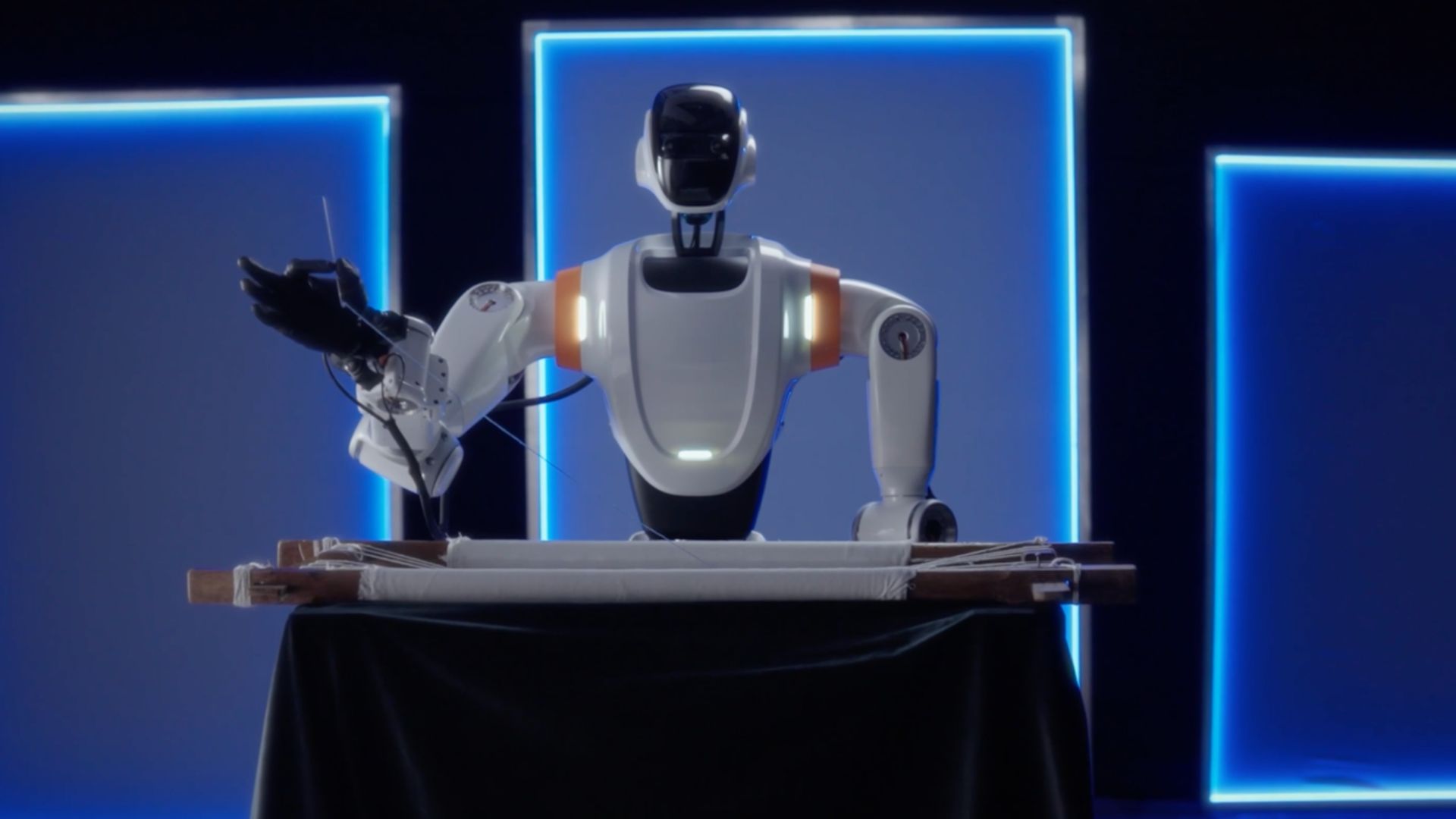
Torso by Clone – Bimanual Android with Artificial Muscles | YouTube Video: @CloneRobotics
Source coverage
Between Fascination and Discomfort: The New Generation of Humanoid Robots
Report Provider: Rat für Formgebung Stiftung
Deeper analysis
Full source content
7 Min LesezeitTo what extent should robots be anthropomorphised? At what point does their resemblance to humans become uncomfortable or even repugnant? These are not new questions, nor have they been definitively answered. However, given the current hype surrounding humanoid robots, they are more relevant now than they have been for years.
by Armin ScharfIs this what the uncanny valley looks like? With its extremely human-like anatomy, the Protoclone is set to raise the bar for humanoid robots. It is already available for pre-order | YouTube Video: © CloneRoboticsIn February, an intriguing video did the rounds. It shows a human-like figure hanging motionless from the ceiling, which suddenly starts to twitch, writhe and convulse – a fascinating yet unsettling sight.
The video was released by Clone Robotics, a Polish start-up company, to introduce its Protoclone V1.Beneath the white, elastic film – or should we say ‘skin’? – lies a system of 1,000 artificial muscles, known as myofibres, which are hydraulically activated, i.e. using water pressure. This distinguishes the concept from most other humanoid robots, which typically rely on electric motors.
It is also unique in that these muscles are attached to a skeletal system that replicates human anatomy, with all 206 of its elements. The robot features a torso, pelvis and spine, as well as delicate ‘finger bones’ in its slender hands. Four depth cameras behind the head visor, along with inertia and pressure sensors, report real-time data to microcontrollers in the spine.
These microcontrollers then control the high-pressure pump and valves. The aim is to achieve a high degree of mobility and muscle strength using minimal energy. The Clone Alpha, which is already available to pre-order, will eventually be able to walk upright, although it remains to be seen whether it will move as smoothly as the animations on the website suggest.
Unfortunately, Clone Robotics did not reply to repeated requests for information.‘The robot features a torso, pelvis and spine, as well as delicate ‘finger bones’ in its slender hands… ‘Protoclone: Bipedal Musculoskeletal – A Synthetic Human with Artificial Muscles | Screenshot from YouTube: © CloneRoboticsThe Leap into the Uncanny ValleyIf we are to take the scenario presented by Clone Robotics seriously, it raises urgent questions that go far beyond the technology itself.
Fundamentally, the issue is what makes a robot seem human. This has been a concern for engineers, designers and philosophers ever since Japanese roboticist Masahiro Mori coined the term ‘Uncanny Valley’ in 1970. According to his theory, the more human-like a robot becomes, the greater the public’s acceptance of it – until a critical point is reached at which its near-human resemblance becomes unsettling.
However, Wulf Loh of the International Centre for Ethics in the Sciences at the University of Tübingen IZEW (german: Internationalen Zentrum für Ethik in den Wissenschaften der Universität Tübingen) suggests that ‘this effect may turn back into acceptance once robots become truly human-like’. In his words: ‘Does Data from Star Trek still reside in the Uncanny Valley, or has he already overcome it?
’When asked about the Protoclone, Dr Werner Kraus, head of the Department of Automation and Robotics at the Fraunhofer Institute IPA, remarked: ‘In terms of design, we are indeed still in the uncanny valley. In my view, the robot provokes more fear than sympathy.’ He is also concerned about what people expect from such robots: ‘With a robot that looks so human, we tend to expect it to be able to do everything humans can, but from a technical standpoint, we are still far from achieving that.
’One of the biggest challenges at present is creating reliable and dexterous hands, as well as the ability to cope with unpredictable situations and unfamiliar objects. Thanks to its biomimetic design, the Protoclone demonstrates lifelike movements in videos released by the start-up. This is made possible by its complex articulated joints, which offer a wide range of motion.
According to the development team, the shoulder has four joints offering 20 degrees of freedom, while the hand has 26. This could potentially make the robot more agile than a human.‘The more human-like a robot becomes, the greater the public’s acceptance of it – until a critical point is reached at which its near-human resemblance becomes unsettling.
’The Clone Torso 2 features an actuated lumbar spine and all the corresponding abdominal muscles. A white, transparent skin encloses 910 muscle fibres that enable 164 degrees of freedom and is equipped with 182 sensors for feedback control | Screenshot from YouTube: © CloneRoboticsWhy Humanoids Are So FascinatingThe ultimate goal is to develop robots that can operate autonomously in human environments and perform repetitive tasks without requiring those environments to be modified.
However, despite the current hype, the reality is different. ‘Humanoids are still far from being practical beyond prototypical testing,’ says Kraus. ‘They currently perform well in controlled test environments, but often fail in dynamic, unstructured scenarios.’ The list of challenges is long: ‘These include improving fine motor skills, particularly in the hands and grippers, recognising and understanding complex surroundings, and enabling natural interaction with people.
’Even at the recent Automatica trade fair, the impact of the environment was evident: the 4NE-1 humanoid robots by Neura Robotics remained inactive as they could not handle the acoustic conditions at the event. For now, the dream of a universal robot that can do it all remains just that.Humanoid robots are set to become the next big thing in robotics, and the ‘4NE-1’ by Neura Robotics is a promising example of this emerging technology | © Neura RoboticsChina: The New Hotspot for HumanoidsWhile Western companies have not even reached the beta stage, China has become the epicentre of humanoid robotics.
“There are over 100 companies focused on humanoid development. The pace is intense,” reports Kraus, who recently travelled to East Asia. The approach taken there is fundamentally different: ‘Iterate quickly, fail fast, and restart immediately. That’s the Chinese strategy.” He visited firms that developed functioning humanoid prototypes within two years and recently put them through half-marathon test runs.
Since 2023, humanoid robots have been at the top of China’s development agenda, partly as a means of maintaining economic output in the face of demographic decline.The British company Engineered Arts presents Ameca. Thanks to the integration of generative AI, it is possible to communicate with the robot in natural language | © Engineered ArtsDesign: Between Function and AcceptanceThe design of humanoid robots faces a central dilemma, namely whether they should look as human as possible or remain clearly recognisable as machines.
Kraus advocates a functional approach: ‘We’ve found the principle of “form follows function” to be helpful in making the robot’s capabilities apparent to users quickly. The design should strike a balance between functionality and aesthetics. An attractive, yet not overly human-like, appearance can help to avoid confusion or even fear.
” Design conveys a message: a humanoid robot implies familiarity and partnership, but it also carries the risk of creating misplaced expectations. Loh summarises this tightrope act as follows: ‘On the one hand, it’s about joyful interaction between humans and machines. On the other hand, the machine must always be recognisable as such.
’The Ethics of Synthetic HumansAccording to Loh, synthetic humans raise significant ethical concerns. “Anthropomorphisation and zoomorphisation create emotional bonds,” he explains. “The design elements needed to elicit empathy from humans are often very subtle.” Eyes, for instance, can convey deeply emotional signals.
“The danger,” he continues, “is that robots might replace human relationships or be assigned social responsibilities, such as childcare.”This places a responsibility on those involved in their development. ‘Designers must be aware of their ethical responsibilities.’ Loh advocates the inclusion of ‘disruptive’ elements – cues that remind users they are interacting with a machine.
‘Designers must be aware of their ethical responsibilities’– Wulf Loh from IZEW Where Humanoids Will Be Used First‘In economic terms, the most interesting applications at the moment are for commercial use,‘ says Kraus. A recent study by his team identified the greatest value as being their versatility – their ability to be deployed flexibly, like a floating workforce, without the need for major reconfiguration.
For now, domestic applications remain more of an attractive fantasy, especially in terms of cost. In healthcare, the barriers are even higher, with safety being a major concern. Humanoids will not be used in care settings as long as there’s a risk of them falling uncontrollably.This is why the start-up Devanthro is taking a different approach with its robotic assistants for the elderly and mobility-impaired.
Their Robody machines move on wheels, not legs. “30% of our target customers live in flats. Of those living in houses, half only use one floor,” says Rafael Hostettler from Devanthro. Wheels are also safer: “No one wants a robot falling on someone during a malfunction.” Several pilot phases have already been completed by the Robodys, which are expected to be market-ready by early 2027 with remote control functionality.
“It’s especially valuable in care or home contexts when there’s a real person on the other end,” Hostettler explains. This person is displayed on the robot’s head screen and controls the Robody using VR tools. The system is designed to be so intuitive that even family members who are not on site can assist.
85% of test participants have reportedly been very satisfied.The Robody does not aim to be as humanoid as possible, but rather functional and reliable. It is controlled via virtual reality (VR) instruments, and the display on the helmet shows the face of the person controlling it remotely | © Devanthro‘The way in which humans and robots live and work together will depend on our willingness to redefine the boundaries between the natural and the artificial’The Future of Human–Robot CoexistenceLoh anticipates a fundamental transformation akin to the Industrial Revolution, but with one key difference: work may lose its societal and personal value as robots take over many roles.
This change requires more than just technical excellence. It requires new social norms, legal frameworks and ethical standards. The way in which humans and robots live and work together will depend on our willingness to redefine the boundaries between the natural and the artificial.The future of robotics will be shaped not only in laboratories, but also by how we as a society choose to develop and engage with this technology.
Torso by Clone – Bimanual Android with Artificial Muscles | YouTube Video: @CloneRobotics
How this page is built
Goose Pod turns cited reporting into a public episode summary first, then pairs that summary with audio playback so listeners can check the source material before they decide how deeply to engage.
The goal is to make this page useful as a news landing page first, while still giving listeners transcript access, related episodes, and direct links back to the original publishers.