What happened
美国特朗普政府以打击毒品走私和恐怖组织“太阳集团”为名,在委内瑞拉附近集结军事力量,并采取致命攻击。此举引发国际争议,被指违反国际法,可能旨在改变委内瑞拉政经格局,以符合美国利益。马杜罗政府则称这是帝国主义掠夺石油的借口。
United States President Donald Trump declared on Saturday that Venezuelan airspace had been “closed”, without offering any further details, spiking tensions between Washington and Caracas amid months of military build-up in the Caribbean.Venezuela has accused the US of a “colonialist threat” in Latin America, as millions of people in the country remain on edge.
President Nicolas Maduro had earlier warned that Washington was fabricating claims as a pretext to justify military intervention in Venezuela.Venezuela has been conducting regular drills over the past few weeks and has announced a large-scale mobilisation in preparation for any possible attack.The Trump administration has deployed massive naval assets in the Southern Caribbean since launching a series of strikes on alleged drug boats in early September.
Washington has not provided any proof that the targeted boats were involved in drug trafficking. At least 83 people have been killed in those attacks.Ramping up pressure on Maduro last week, Washington designated what is known among Venezuelans as the Cartel de los Soles, or Cartel of the Suns in English, as a “foreign terrorist organization”.
The Trump administration says it is targeting Venezuela as part of a push to combat drug trafficking. However, political analysts and human rights observers warn Washington against laying the groundwork to unlawfully remove Maduro from power.So, will Trump strike Venezuela after announcing the closure of Venezuelan airspace?
Can the US military action be legally justified? And what is driving Trump’s hostile policy against Maduro?Will the US go to war against Venezuela?Since returning to power in January, Trump has ramped up rhetoric against Maduro, blaming Caracas for drug trafficking and the flow of immigrants from Venezuela.
Within a few weeks into his second term, Trump nixed Venezuelan oil concessions granted by his predecessor, Joe Biden, imposed 25 percent tariffs on countries buying oil from Venezuela, and doubled the reward for the arrest of Maduro to $50m, designating him a “global terrorist leader”.In recent weeks, Trump confirmed that he has authorised the CIA to carry out secret operations in Venezuela, as his administration deployed the world’s largest aircraft carrier, USS Gerald R Ford, other warships, thousands of troops, and F-35 stealth jets to the Caribbean.
Last Thursday, Trump said land strikes inside the country could come imminently.Amid heightened military tensions, Trump reportedly spoke with Maduro last week, as per reporting by The New York Times and The Wall Street Journal, before sanctions against Cartel de los Soles came into effect.On November 25, Trump, on board Air Force One, was asked by reporters if he planned on speaking with Maduro.
“I might talk to him. We’ll see. But we’re discussing that with the different staffs. We might talk,” Trump told reporters.When asked why Trump wants to talk to a leader of the designated “foreign terrorist organization”, he took the moral high ground.“If we can save lives, we can do things the easy way, that’s fine.
And if we have to do it the hard way, that’s fine, too,” he replied.Can the US military action be legally justified?Critics of the Trump administration have argued that the administration’s military actions violate the US Constitution in addition to international laws. Rights observers and legal scholars have said the deadly boat strikes amount to “extrajudicial killing” and violation of human rights.
A report in The Washington Post says that Defense Secretary Pete Hegseth ordered the military to kill all the passengers on board a boat suspected of carrying drugs.Hegseth has rejected allegations, calling the report “fake news”. The “fabricated and inflammatory” report, he said, was aimed at “discrediting our incredible warriors fighting to protect the homeland”.
The defence secretary has said the strikes in the Caribbean are “lawful”.Meanwhile, the US Congress on Saturday ordered an inquiry into the incident. “At this point, I would call them extrajudicial killings,” Republican Senator Rand Paul told Fox News Sunday in October.Bruce Fein, a US constitutional expert, concurred with Paul.
“Trump is acting extra-constitutionally and committing murder,” said Fein, who served as associate deputy attorney general under Republican President Ronald Reagan.“Only Congress can authorise the offensive use of the military,” said Fein, adding that Trump’s executive orders in this matter do not have a legal standing.
“The victims are engaged in warfare against the United States, except in Trump’s fantasyland – a page from George Orwell’s 1984.”By designating the Cartel de los Soles, which now Washington equates with the Venezuelan state, as a “foreign terrorist organization”, the Trump administration is posing that this is no longer a war between two nations that requires congressional declaration, but a counterterrorism operation against a non-state actor.
Cartel de los Soles emerged in the 1990s when Venezuelan generals and senior officers were investigated for drug trafficking and related crimes. In Venezuela, it is not a cartel, but rather a common reference to military officers and officials involved in corruption and other illegal activities.Maduro delivers a speech while holding the Venezuelan independence hero Simon Bolivar’s ‘Sword of Peru’ during a military ceremony in Caracas on November 25, 2025 [Federico Parra/AFP]How has the Venezuelan president responded?
Caracas has denounced Trump’s announcement that effectively closed the airspace above and surrounding Venezuela.The Ministry of Foreign Affairs said in a statement that Trump’s statement sought “to affect the sovereignty of [Venezuelan] airspace, constituting yet another extravagant, illegal and unjustified aggression against the Venezuelan people”.
Meanwhile, Maduro, whose win in July’s election was not recognised by Washington, has called for peace, rejecting war, and advocated for harmony as he continues to appear frequently on state television broadcasts. In a mix of Spanish and English, Maduro declared, “No war … Yes peace, forever.”On November 15, Maduro invoked singer John Lennon’s peace anthem “Imagine” during a rally of supporters.
“Do everything for peace, as John Lennon used to say. Imagine all the people,” he said.Two days later, condemning the use of force or military threats, Maduro said, “Dialogue, call, yes. Peace, yes. War, no. Never, never war.”But as tensions continue to escalate, Maduro last week pledged to defend the country against any “imperialist threat”.
He addressed a crowd at the Fuerte Tiuna military academy, in full martial dress, waving a sword that belonged to Simon Bolivar, Venezuela’s national hero.Trump leans in to hear a question as he speaks with reporters on board Air Force One, November 25, 2025 [Alex Brandon/AP Photo]What’s driving Trump’s hostile policy against Maduro?
Foreign policy analysts argue that Trump’s aggressive policies towards the Venezuelan government are rooted in Caracas’s oil holdings, the world’s largest proven reserves, and to establish US supremacy in the Western Hemisphere.Salvador Santino Regilme, a political scientist who leads the international relations programme at Leiden University, said Washington wants Venezuela to align firmly with US strategic preferences instead of China, Russia, or Iran.
Venezuela was seen as a reliable Cold War ally of the US during the 1970s. But when the founder of the governing United Socialist Party and former president, Hugo Chavez, was elected in 1998, relations with Washington began to sour.After a failed coup attempt in 2002, Chavez ended cooperation with the US drug enforcement agencies and expelled US military advisers.
He also pushed out US oil majors ExxonMobil and ConocoPhillips after nationalising the oil sector, further straining the ties. Chevron, another US oil giant, still operates in Venezuela.Chavez was critical of the US involvement in Latin America and cultivated ties with regional left-leaning countries such as Cuba and Bolivia under former socialist President Evo Morales.
He also forged closer economic ties with Russia and China.After Maduro took over from Chavez in 2013, relations worsened. During his first term, Trump backed Maduro’s political rivals, recognising opposition figure Juan Guaido as interim president in 2019.The US’s so-called “war on drugs” here functions as a political technology that strips alleged traffickers and small-boat crews of their humanity, argued Regilme, “so that lethal force and regime change look like law enforcement rather than war”.
Trump’s administration also frames Maduro’s state as a criminal syndicate “to delegitimise not just the regime but the entire political-economic model that resists this kind of restructuring”, said Regilme.Adolfo Franco, a lawyer and Republican strategist, told Al Jazeera that while Trump has not explicitly laid out the next steps, he clearly wants regime change in Venezuela.
“For President Trump, everything is on the table. The desire here, from my experience in government, is forcing Maduro to exit, either peacefully, which I think might be a tall order,” Franco said.“The negotiation part is difficult because of the massive amount of forces and signals we have sent in the region that we’re serious about some affirmative change in Venezuela,” he added.
“I can’t imagine it being business as usual with Maduro running the Venezuelan government. That is not on the table.”Two homeless people share a dose of fentanyl in an alley in Los Angeles, August 18, 2022. Use of fentanyl, a powerful opioid, has exploded in the US [Jae C Hong/AP Photo]Is Venezuela the main source of drugs going to the US, as Trump claims?
The Trump administration has pushed the narrative of linking Venezuela to “narco-terrorist” networks. But the fentanyl crisis that claims the most American lives has hardly any connection to Caracas.US Drug Enforcement Administration (DEA) and Department of State data consistently identify Mexico, specifically the Sinaloa and Jalisco New Generation cartels, as the manufacturing hub for synthetic opioids, utilising precursors imported from China.
Venezuela does not even serve as a significant transit corridor for the drug that overwhelmingly enters the US through legal ports of entry, along the southwest land border rather than via the Caribbean maritime routes currently being targeted by the US Navy.For cocaine, while Venezuela appears to be a transit hub, it is neither the primary producer nor the dominant trafficking actor.
Colombia remains the world’s leading cultivator of the drug. Most of the cocaine that passes through Venezuela goes to Europe.In March 2020, the US estimated between 200 and 250 tonnes of cocaine were trafficked through Venezuela each year, representing 13 percent of the estimated global production.
The US allies in Europe have also pushed back against the Trump administration’s strikes in the Caribbean.At a Group of Seven foreign ministers’ meeting in Canada’s Niagara region, French Foreign Minister Jean-Noel Barrot said the strikes “violate international law” and were concerning France’s territories in the wider region.
US State Secretary Marco Rubio was present at the meeting. Before departing, he told reporters that drugs are also shipped via Venezuela to Europe, so the US should be thanked for killing the alleged smugglers.“I don’t think that the European Union gets to determine what international law is,” Rubio said.
“They certainly don’t get to determine how the United States defends its national security.”Colombia has been vocal against the US actions as a conflict would impact the country, which shares a 2,219km-long (1,378-mile) border with Venezuela. Bogota already hosts millions of Venezuelan refugees who have fled the country due to a debilitating economic and political crisis.
Left-wing Colombian President Gustavo Petro, who refused to recognise Maduro’s re-election in January, has effectively severed security cooperation with the US over the strikes on boats.Petro has described Trump as a “barbarian” who “wants to frighten us” in interviews in the US media. He has called the US military build-up in the Caribbean “undoubtedly an aggression against Latin America”.
Brazil’s President Lula da Silva has taken a more diplomatic but equally firm stance, telling reporters in Johannesburg, South Africa, “no president of another country should make assumptions about what Venezuela … will be like”.Russian Foreign Minister Sergey Lavrov condemned the US strikes as “unacceptable” in televised remarks, adding, “This is how, in general, lawless countries act, as well as those who consider themselves above the law.
”Chinese President Xi Jinping, in a late November letter to Maduro, reaffirmed the two nations as “intimate friends, dear brothers, and good partners”, saying “China resolutely opposes the meddling of external forces in Venezuela’s internal affairs under any pretext”.Trump dances onstage as the Village People perform during a rally the day before he is scheduled to be inaugurated for a second term, in Washington, DC, January 19, 2025 [Brian Snyder/Reuters]Are Venezuela’s actions dividing Trump’s MAGA base?
Trump returned to power this year, rising on a pledge to avoid “forever wars”, a message that appeared to resonate deeply with his Make America Great Again (MAGA) campaign.Many in his camp are sceptical of extended military engagements abroad, viewing them as costly distractions from domestic priorities and a drain on US resources.
That fear was central to the debate when the US bombed Iran earlier this year amid tensions between Tehran and Israel.Marjorie Taylor Greene, one of the most vocal faces of MAGA, had a public falling-out with Trump over his administration’s focus on foreign conflicts at the expense of the pressing economic issues, including the cost-of-living crisis, facing Americans.
She has since decided to step down from Congress.However, some MAGA-aligned voices have backed pressuring Venezuela’s government by sanctions or low-scale operations amid public opinion against any military intervention in the country.Rubio, who is also the national security adviser, has pushed for a tough policy against Venezuela – an agenda that serves his support base in Florida, home to a significant population of Cuban and Venezuelan immigrants.
Confronting an “authoritarian socialist narco-regime” plays well domestically for Trump as well, said Regilme, the foreign policy expert, adding that it ties “together anticommunism, border security, and the promise to be tough on crime”.For Trump, Regilme argued, a kinetic strike on Venezuela is both a bargaining tool and a real option.
“That’s precisely what makes it so dangerous,” he said. “Trump has little appetite for large-scale occupations, but he has repeatedly embraced highly visible uses of force that send a clear message to domestic audiences and foreign elites while limiting US casualties.”
Source coverage
This situation, as I understand it from the Al Jazeera English article published on November 30, 2025 (though the timeline spans events up to that point), has become extremely tense. It appears that President Trump, in his [second term], is on the verge of military action against Venezuela, and I'm carefully...
The Escalation: Trump has dramatically escalated tensions by declaring Venezuelan airspace "closed." He's significantly beefing up military presence in the Caribbean. We're talking about the USS Gerald R. Ford, other warships, thousands of troops, and F-35 fighter jets. These are significant deployments, and it’s...
Deeper analysis
Full source content
United States President Donald Trump declared on Saturday that Venezuelan airspace had been “closed”, without offering any further details, spiking tensions between Washington and Caracas amid months of military build-up in the Caribbean.Venezuela has accused the US of a “colonialist threat” in Latin America, as millions of people in the country remain on edge.
President Nicolas Maduro had earlier warned that Washington was fabricating claims as a pretext to justify military intervention in Venezuela.Venezuela has been conducting regular drills over the past few weeks and has announced a large-scale mobilisation in preparation for any possible attack.The Trump administration has deployed massive naval assets in the Southern Caribbean since launching a series of strikes on alleged drug boats in early September.
Washington has not provided any proof that the targeted boats were involved in drug trafficking. At least 83 people have been killed in those attacks.Ramping up pressure on Maduro last week, Washington designated what is known among Venezuelans as the Cartel de los Soles, or Cartel of the Suns in English, as a “foreign terrorist organization”.
The Trump administration says it is targeting Venezuela as part of a push to combat drug trafficking. However, political analysts and human rights observers warn Washington against laying the groundwork to unlawfully remove Maduro from power.So, will Trump strike Venezuela after announcing the closure of Venezuelan airspace?
Can the US military action be legally justified? And what is driving Trump’s hostile policy against Maduro?Will the US go to war against Venezuela?Since returning to power in January, Trump has ramped up rhetoric against Maduro, blaming Caracas for drug trafficking and the flow of immigrants from Venezuela.
Within a few weeks into his second term, Trump nixed Venezuelan oil concessions granted by his predecessor, Joe Biden, imposed 25 percent tariffs on countries buying oil from Venezuela, and doubled the reward for the arrest of Maduro to $50m, designating him a “global terrorist leader”.In recent weeks, Trump confirmed that he has authorised the CIA to carry out secret operations in Venezuela, as his administration deployed the world’s largest aircraft carrier, USS Gerald R Ford, other warships, thousands of troops, and F-35 stealth jets to the Caribbean.
Last Thursday, Trump said land strikes inside the country could come imminently.Amid heightened military tensions, Trump reportedly spoke with Maduro last week, as per reporting by The New York Times and The Wall Street Journal, before sanctions against Cartel de los Soles came into effect.On November 25, Trump, on board Air Force One, was asked by reporters if he planned on speaking with Maduro.
“I might talk to him. We’ll see. But we’re discussing that with the different staffs. We might talk,” Trump told reporters.When asked why Trump wants to talk to a leader of the designated “foreign terrorist organization”, he took the moral high ground.“If we can save lives, we can do things the easy way, that’s fine.
And if we have to do it the hard way, that’s fine, too,” he replied.Can the US military action be legally justified?Critics of the Trump administration have argued that the administration’s military actions violate the US Constitution in addition to international laws. Rights observers and legal scholars have said the deadly boat strikes amount to “extrajudicial killing” and violation of human rights.
A report in The Washington Post says that Defense Secretary Pete Hegseth ordered the military to kill all the passengers on board a boat suspected of carrying drugs.Hegseth has rejected allegations, calling the report “fake news”. The “fabricated and inflammatory” report, he said, was aimed at “discrediting our incredible warriors fighting to protect the homeland”.
The defence secretary has said the strikes in the Caribbean are “lawful”.Meanwhile, the US Congress on Saturday ordered an inquiry into the incident. “At this point, I would call them extrajudicial killings,” Republican Senator Rand Paul told Fox News Sunday in October.Bruce Fein, a US constitutional expert, concurred with Paul.
“Trump is acting extra-constitutionally and committing murder,” said Fein, who served as associate deputy attorney general under Republican President Ronald Reagan.“Only Congress can authorise the offensive use of the military,” said Fein, adding that Trump’s executive orders in this matter do not have a legal standing.
“The victims are engaged in warfare against the United States, except in Trump’s fantasyland – a page from George Orwell’s 1984.”By designating the Cartel de los Soles, which now Washington equates with the Venezuelan state, as a “foreign terrorist organization”, the Trump administration is posing that this is no longer a war between two nations that requires congressional declaration, but a counterterrorism operation against a non-state actor.
Cartel de los Soles emerged in the 1990s when Venezuelan generals and senior officers were investigated for drug trafficking and related crimes. In Venezuela, it is not a cartel, but rather a common reference to military officers and officials involved in corruption and other illegal activities.Maduro delivers a speech while holding the Venezuelan independence hero Simon Bolivar’s ‘Sword of Peru’ during a military ceremony in Caracas on November 25, 2025 [Federico Parra/AFP]How has the Venezuelan president responded?
Caracas has denounced Trump’s announcement that effectively closed the airspace above and surrounding Venezuela.The Ministry of Foreign Affairs said in a statement that Trump’s statement sought “to affect the sovereignty of [Venezuelan] airspace, constituting yet another extravagant, illegal and unjustified aggression against the Venezuelan people”.
Meanwhile, Maduro, whose win in July’s election was not recognised by Washington, has called for peace, rejecting war, and advocated for harmony as he continues to appear frequently on state television broadcasts. In a mix of Spanish and English, Maduro declared, “No war … Yes peace, forever.”On November 15, Maduro invoked singer John Lennon’s peace anthem “Imagine” during a rally of supporters.
“Do everything for peace, as John Lennon used to say. Imagine all the people,” he said.Two days later, condemning the use of force or military threats, Maduro said, “Dialogue, call, yes. Peace, yes. War, no. Never, never war.”But as tensions continue to escalate, Maduro last week pledged to defend the country against any “imperialist threat”.
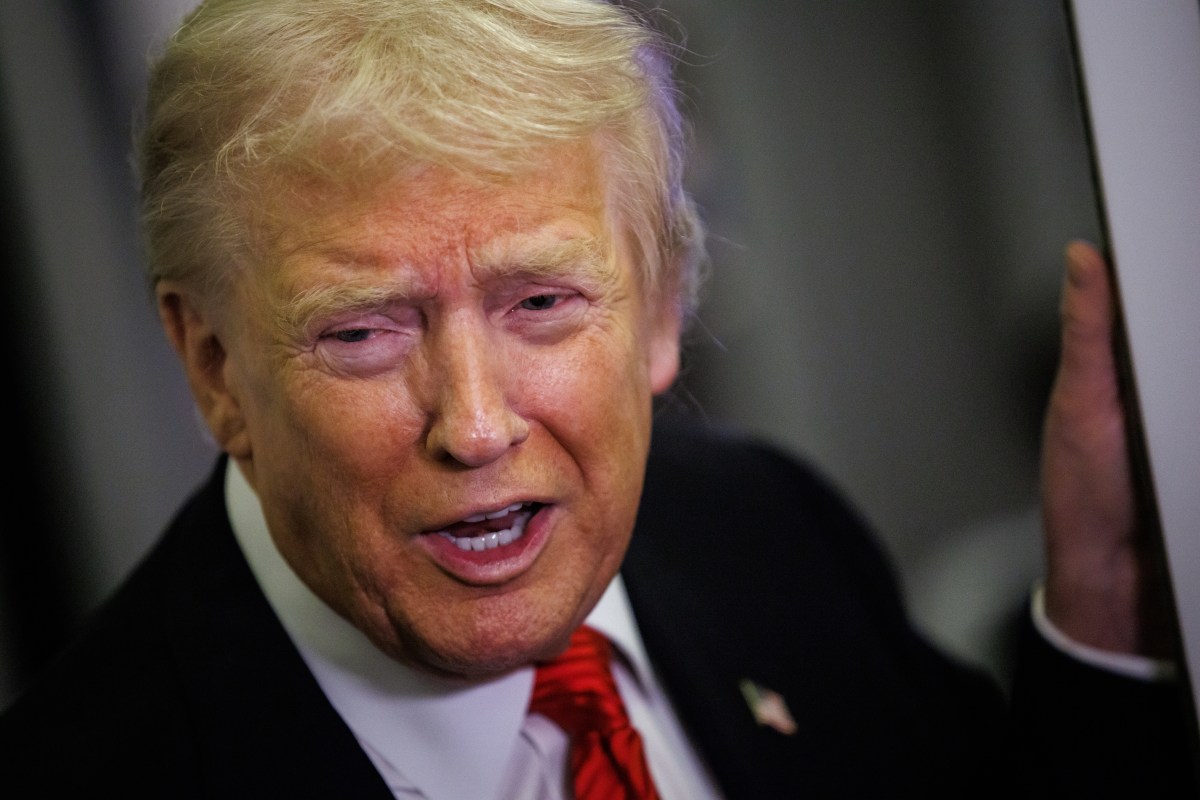
He addressed a crowd at the Fuerte Tiuna military academy, in full martial dress, waving a sword that belonged to Simon Bolivar, Venezuela’s national hero.Trump leans in to hear a question as he speaks with reporters on board Air Force One, November 25, 2025 [Alex Brandon/AP Photo]What’s driving Trump’s hostile policy against Maduro?
Foreign policy analysts argue that Trump’s aggressive policies towards the Venezuelan government are rooted in Caracas’s oil holdings, the world’s largest proven reserves, and to establish US supremacy in the Western Hemisphere.Salvador Santino Regilme, a political scientist who leads the international relations programme at Leiden University, said Washington wants Venezuela to align firmly with US strategic preferences instead of China, Russia, or Iran.
Venezuela was seen as a reliable Cold War ally of the US during the 1970s. But when the founder of the governing United Socialist Party and former president, Hugo Chavez, was elected in 1998, relations with Washington began to sour.After a failed coup attempt in 2002, Chavez ended cooperation with the US drug enforcement agencies and expelled US military advisers.
He also pushed out US oil majors ExxonMobil and ConocoPhillips after nationalising the oil sector, further straining the ties. Chevron, another US oil giant, still operates in Venezuela.Chavez was critical of the US involvement in Latin America and cultivated ties with regional left-leaning countries such as Cuba and Bolivia under former socialist President Evo Morales.
He also forged closer economic ties with Russia and China.After Maduro took over from Chavez in 2013, relations worsened. During his first term, Trump backed Maduro’s political rivals, recognising opposition figure Juan Guaido as interim president in 2019.The US’s so-called “war on drugs” here functions as a political technology that strips alleged traffickers and small-boat crews of their humanity, argued Regilme, “so that lethal force and regime change look like law enforcement rather than war”.
Trump’s administration also frames Maduro’s state as a criminal syndicate “to delegitimise not just the regime but the entire political-economic model that resists this kind of restructuring”, said Regilme.Adolfo Franco, a lawyer and Republican strategist, told Al Jazeera that while Trump has not explicitly laid out the next steps, he clearly wants regime change in Venezuela.
“For President Trump, everything is on the table. The desire here, from my experience in government, is forcing Maduro to exit, either peacefully, which I think might be a tall order,” Franco said.“The negotiation part is difficult because of the massive amount of forces and signals we have sent in the region that we’re serious about some affirmative change in Venezuela,” he added.
“I can’t imagine it being business as usual with Maduro running the Venezuelan government. That is not on the table.”Two homeless people share a dose of fentanyl in an alley in Los Angeles, August 18, 2022. Use of fentanyl, a powerful opioid, has exploded in the US [Jae C Hong/AP Photo]Is Venezuela the main source of drugs going to the US, as Trump claims?
The Trump administration has pushed the narrative of linking Venezuela to “narco-terrorist” networks. But the fentanyl crisis that claims the most American lives has hardly any connection to Caracas.US Drug Enforcement Administration (DEA) and Department of State data consistently identify Mexico, specifically the Sinaloa and Jalisco New Generation cartels, as the manufacturing hub for synthetic opioids, utilising precursors imported from China.
Venezuela does not even serve as a significant transit corridor for the drug that overwhelmingly enters the US through legal ports of entry, along the southwest land border rather than via the Caribbean maritime routes currently being targeted by the US Navy.For cocaine, while Venezuela appears to be a transit hub, it is neither the primary producer nor the dominant trafficking actor.
Colombia remains the world’s leading cultivator of the drug. Most of the cocaine that passes through Venezuela goes to Europe.In March 2020, the US estimated between 200 and 250 tonnes of cocaine were trafficked through Venezuela each year, representing 13 percent of the estimated global production.
The US allies in Europe have also pushed back against the Trump administration’s strikes in the Caribbean.At a Group of Seven foreign ministers’ meeting in Canada’s Niagara region, French Foreign Minister Jean-Noel Barrot said the strikes “violate international law” and were concerning France’s territories in the wider region.
US State Secretary Marco Rubio was present at the meeting. Before departing, he told reporters that drugs are also shipped via Venezuela to Europe, so the US should be thanked for killing the alleged smugglers.“I don’t think that the European Union gets to determine what international law is,” Rubio said.
“They certainly don’t get to determine how the United States defends its national security.”Colombia has been vocal against the US actions as a conflict would impact the country, which shares a 2,219km-long (1,378-mile) border with Venezuela. Bogota already hosts millions of Venezuelan refugees who have fled the country due to a debilitating economic and political crisis.
Left-wing Colombian President Gustavo Petro, who refused to recognise Maduro’s re-election in January, has effectively severed security cooperation with the US over the strikes on boats.Petro has described Trump as a “barbarian” who “wants to frighten us” in interviews in the US media. He has called the US military build-up in the Caribbean “undoubtedly an aggression against Latin America”.
Brazil’s President Lula da Silva has taken a more diplomatic but equally firm stance, telling reporters in Johannesburg, South Africa, “no president of another country should make assumptions about what Venezuela … will be like”.Russian Foreign Minister Sergey Lavrov condemned the US strikes as “unacceptable” in televised remarks, adding, “This is how, in general, lawless countries act, as well as those who consider themselves above the law.
”Chinese President Xi Jinping, in a late November letter to Maduro, reaffirmed the two nations as “intimate friends, dear brothers, and good partners”, saying “China resolutely opposes the meddling of external forces in Venezuela’s internal affairs under any pretext”.Trump dances onstage as the Village People perform during a rally the day before he is scheduled to be inaugurated for a second term, in Washington, DC, January 19, 2025 [Brian Snyder/Reuters]Are Venezuela’s actions dividing Trump’s MAGA base?
Trump returned to power this year, rising on a pledge to avoid “forever wars”, a message that appeared to resonate deeply with his Make America Great Again (MAGA) campaign.Many in his camp are sceptical of extended military engagements abroad, viewing them as costly distractions from domestic priorities and a drain on US resources.
That fear was central to the debate when the US bombed Iran earlier this year amid tensions between Tehran and Israel.Marjorie Taylor Greene, one of the most vocal faces of MAGA, had a public falling-out with Trump over his administration’s focus on foreign conflicts at the expense of the pressing economic issues, including the cost-of-living crisis, facing Americans.
She has since decided to step down from Congress.However, some MAGA-aligned voices have backed pressuring Venezuela’s government by sanctions or low-scale operations amid public opinion against any military intervention in the country.Rubio, who is also the national security adviser, has pushed for a tough policy against Venezuela – an agenda that serves his support base in Florida, home to a significant population of Cuban and Venezuelan immigrants.
Confronting an “authoritarian socialist narco-regime” plays well domestically for Trump as well, said Regilme, the foreign policy expert, adding that it ties “together anticommunism, border security, and the promise to be tough on crime”.For Trump, Regilme argued, a kinetic strike on Venezuela is both a bargaining tool and a real option.
“That’s precisely what makes it so dangerous,” he said. “Trump has little appetite for large-scale occupations, but he has repeatedly embraced highly visible uses of force that send a clear message to domestic audiences and foreign elites while limiting US casualties.”
How this page is built
Goose Pod turns cited reporting into a public episode summary first, then pairs that summary with audio playback so listeners can check the source material before they decide how deeply to engage.
The goal is to make this page useful as a news landing page first, while still giving listeners transcript access, related episodes, and direct links back to the original publishers.