
What happened
Publisher: NBC News
Author: Natalie Kainz
Date: October 28, 2025 (Published online)
Oct. 28, 2025, 5:00 AM EDTOn a March afternoon in Mason County, Kentucky, Dr. Timothy Grosser and his son Andy sat across the table from three men who came with an offer: $10 million for the 250-acre farm where they’d lived and worked for nearly four decades. That’s 35 times what Grosser bought his land for in 1988 and significantly more than what others in the area had sold their land for recently.
But there was a catch — it wasn’t clear who was funding the offer. One of the men said he represented a “Fortune 100 company” that wanted the property for an industrial development, but he refused to say what kind, which company or even his own name. Instead, he pulled out a non-disclosure agreement.
Grosser said the contract would prevent him from discussing the project’s details with any third parties in exchange for limited information about its purpose, timeline and size. It didn’t disclose the company’s name, which could be discussed only after the company publicly announced its participation in the project.
“We refused to sign it,” Grosser said. “I’m not selling my farm for any amount of money.”Dr. Timothy Grosser on his farm in Mason County on Oct. 20.Michael Swensen for NBC NewsFive months after Grosser turned them down, local officials said at a public meeting that Mason County was being scouted as a location for a new data center development.
Grosser experienced firsthand what has become a common but controversial aspect of the multibillion-dollar data center boom, fueled by artificial intelligence services. Major tech companies launching the huge projects across the country are asking land sellers and public officials to sign NDAs to limit discussions about details of the projects in exchange for morsels of information and the potential of economic lifelines for their communities.
It often leaves neighbors searching for answers about the futures of their communities.The construction of such hyperscale data centers — giant facilities that house servers and computing resources — is booming nationwide. President Donald Trump’s AI action plan and related executive orders have recently facilitated their speedy approval, in part by loosening environmental regulations from clean air and water laws.
Hundreds of projects were announced last year, touted by developers and many local officials as economic boosts to local economies. Those in the data center industry argue the NDAs serve a particular purpose: ensuring that their competitors aren’t able to access information about their strategies and planned projects before they’re announced.
And NDAs are common in many types of economic development deals aside from data centers.But as the facilities have spread into suburbs and farmland, they’ve drawn pushback from dozens of communities concerned by how they could upend daily life. Data centers often draw enormous amounts of water and electricity, causing residents to complain about rising power bills and water shortages.
In Virginia’s Loudoun County, the world’s densest hub of data centers, locals have complained of a “constant whir” from cooling fans and backup generators. And in Tennessee’s South Memphis, the methane gas turbines that power an xAI data center give off air pollutants contributing to smog and formaldehyde.
xAI has vowed to stay below pollutant limits in the area.The confidentiality behind some of the projects has only added to the level of concern from some residents. When he isn't hunting deer, harvesting hay or tending to beef cattle on his land, Grosser works as a family medicine doctor in downtown Maysville.
Michael Swensen for NBC NewsAn NBC News review of over 30 data center proposals across 14 states found that in a majority of cases, local officials signed NDAs and worked with what appeared to be shell companies that can conceal visibility into the project developers. Five elected officials in different counties said the agreements barred them from sharing information with their constituents.
“That violates a very fundamental norm of democracy, which is that they are answerable first to the voters and to their constituents, not to some secret corporation that they’re cutting deals with in the back room,” said Pat Garofalo, the director of state and local policy at the American Economic Liberties Project, a nonprofit organization focused on economic equality.
Amazon, Microsoft, xAI, Google, Meta and Vantage Data Centers — six of the largest tech companies racing to build data centers across the country — all declined to or didn’t respond to questions about the use of NDAs in data center projects.An information vacuumIn Mason County, 20 residents, including Grosser, were offered deals to sell their land — thousands of acres in total — for significantly above market value, according to Tyler McHugh, director of the county’s industrial development authority, which is administering the deals.
Eighteen of them signed property purchase contracts with the unknown company, agreeing to sell if the project proceeds. The Huddleston family, whose relatives have lived on the same property for more than 150 years, said they signed a property purchase contract with the county’s industrial development authority for $60,000 per acre.
When they learned from their neighbors that the land would be used for a data center, they asked McHugh for a legal release to absolve them of the contract and the confidentiality clause associated with it.“The neighbors didn’t want to be sold out, and my mom and I agree with them,” Delsia Huddleston Bare said.
“If it’s artificial intelligence, I don’t want it anywhere near me at all.”Huddleston said she was concerned about noise, pollution and groundwater contamination that could come with the project. McHugh said he wishes he could be more transparent about what’s happening but worries controversy could scare away opportunity.
“If I could go get on a megaphone downtown and say everything I know about this project, I would,” McHugh said. “You know what’s going to happen if I do that? Then everybody in the county is going to put it on Facebook, they’re going to put it out there, and then it just becomes a huge mess. Companies don’t want to deal with that.
” But dozens of residents say the lack of transparency is unacceptable. “We are Mason County, KY” — a 1,500-member Facebook group — said it has collected more than 500 signatures from locals in the county of 16,900 people who believe the project poses a threat to their quality of life because of its potential to pollute the area with noise and contaminants.
McHugh said the developer hopes to amend the county’s zoning laws to make way for the project. “It’s just destroying trust in the government,” said Max Moran, the resident who started the Facebook group. “People just feel let down and kind of betrayed, because if you can’t ask what’s going on, then how can you trust anything they say?
”Max Moran poses for a portrait on his grandmother’s farm in Germantown, Ky., on Oct. 20.Michael Swensen for NBC NewsMcHugh revealed in a budgetary meeting that Mason County was part of a “global selection process” and that the project would include single-story data center buildings and office space.
That has fueled frustration for residents, including Jennifer Setty-Botkin, who lives across the road from a landowner who agreed to sell his property for the project. She filed a public records request for impact studies, contracts and meeting minutes related to it. Her request and a request from NBC News were rejected, appealed and ultimately denied.
Kentucky’s public records act exempts from disclosure records that “pertain to a prospective location of a business or industry where no previous public disclosure” documenting the business’s interest in the location has been made. Eric Bonds, a sociology and anthropology professor at the University of Mary Washington, said that’s the whole point.
Bonds led a research study that found 25 of 31 localities in Virginia with proposed or existing data centers have NDAs in place. “They can pose quality-of-life kinds of impacts for neighbors who live next door, and when the public isn’t fully informed, that can inhibit debate,” Bonds said.Secrecy can backfireLocal battles over data center development are playing out across the United States.
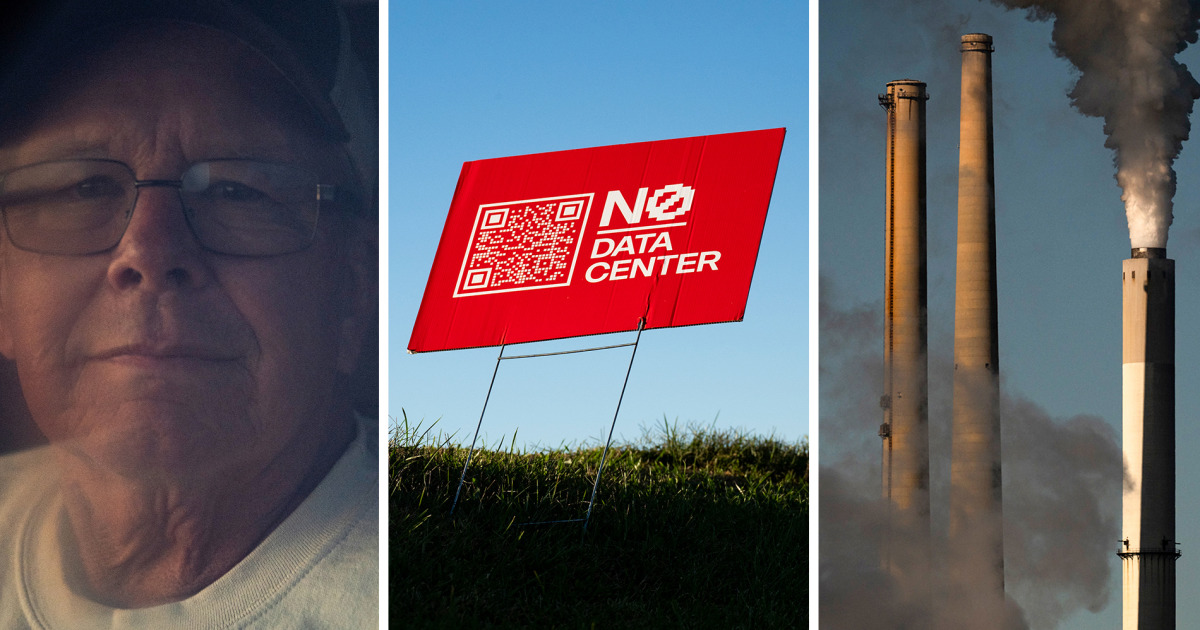
In Saint Charles, Missouri, secrecy fueled a grassroots revolt. Thousands of residents led a movement to strike down “Project Cumulus,” a 440-acre data center proposal.A yard sign opposing the data center along Tuckahoe Road near the proposed site in Mason County on Oct. 20.Michael Swensen for NBC NewsThe larger tech company backing the project remained undeclared, having used NDAs and registered the proposal through a smaller company, Spark Innovations LLC, which locals believed was a shell company.
Saint Charles Mayor Dan Borgmeyer, bound by an NDA, said that he pleaded with developers for months to let him share details but that they refused, citing concerns about competition.The backers of Project Cumulus eventually withdrew. In August, Saint Charles became the first city in the country to enact a yearlong ban on data center construction.
Similar bans have been approved and proposed in dozens of counties and townships across the country, including St. Louis, Oldham County in Kentucky and Jerome Township in Ohio.In Arizona, the secrecy of data center developers backfired. Pima County officials were bound by an NDA over “Project Blue,” a $3.
6 billion proposal put forth by Amazon Web Services, according to a one-page county memo NBC News obtained through a public records request. The project, which would have been built just outside Tucson, was revealed through a leak to the local outlet Arizona Luminaria.Dr. Matt Heinz, a member of the Pima County Board of Supervisors, said he didn’t even realize he was covered by the agreement until,he said, a developer’s spokesperson called to accuse him of violating it by having spoken to a local newspaper.
Dr. Matt Heinz, a Pima County, Ariz., supervisor.Dr. Matt Heinz, Pima County Supervisor, District 2 via Facebook“I just have a lot of trouble with the general idea that I, as an elected official representing 200,000-plus people in Pima County, can be held to the parameters of a non-disclosure agreement with a for-profit, private entity,” Heinz said.
“That seems like there could be just a natural conflict with what I have to do in service to my constituents.”Because Pima County officials were bound by the NDA, Tucson city leaders, whose city utilities would have been responsible for supplying the water and power, said they were left in the dark until late in the process.
“The lack of community engagement from the jump led to a lot of distrust,” City Council member Nikki Lee said. “I’ve never seen Tucson as united in opposition to one thing as they were to this project.”In response to the proposal and the lack of information, residents built their own dashboard to try to quantify Project Blue’s data and water consumption.
“We calculated that Project Blue would use more energy than every home in Tucson combined,” said Ed Hendel, whose company Sky Island AI created the dashboard.After public outcry, the Tucson City Council struck down the project. The Pima County Board of Supervisors also voted to dissolve NDAs 90 days before any county body vote.
Keeping quiet to stay competitiveThe data center industry is a fast-moving and fiercely competitive space, where companies view secrecy as essential to protect trade secrets and stay ahead of rivals. Some local officials, caught between company demands and public accountability, said they felt pressured to sign NDAs to keep their communities in the running.
Mason County Attorney John Estill, who signed an NDA for the project proposal, said the county’s leadership would rather not be bound by an NDA but maintained that it’s the only way for elected officials to stay informed about the company’s plans. “Either you want your government to be courting businesses and looking for development in your communities or you don’t.
And if you want them to be courting businesses and looking for growth in your local economies, then unfortunately, NDAs are part of the landscape,” Estill said.But many residents don’t see it that way. A copy of the contract from the company asking to purchase Grosser’s land in Mason County on Oct.
20.Michael Swensen for NBC News “We don’t have to give up our way of life and bow down to the data center in order to attract other business and industry,” Mason County Schools Superintendent Rick Ross said. “Saying we must cede hundreds of acres of farmland without regard for those who will be stuck looking at and hearing this thing is just a weak scare tactic.
“According to records obtained by NBC News, data center NDAs can extend years beyond the initial proposal dates. Many of them also include clauses requiring local jurisdictions to limit disclosure of records as much as legally possible under Freedom of Information Act laws and notify the companies first so they have a “reasonable opportunity to prevent disclosure.
”Bonds believes the statistics from his study in Virginia, which found that 80% of the 31 data center deals in the state had used NDAs, are most likely a low estimate of the number of confidentiality agreements used in the state’s data center projects. “There are potential definitions that might be used to avoid disclosure of the NDA,” he said, such as those that wouldn’t categorize them as public records that need to be kept on file or disclosed via public records requests.
An NDA for a data center signed with city officials in North Mankato, Minn., completed on July 28, 2023.Obtained by NBC NewsThat kind of secrecy can leave residents in the dark until data centers are already deep into the approval process. In Minnesota, the group Minnesota Center for Environmental Advocacy sued the towns of Hermantown, Farmington, North Mankato and Rosemount, where, it says, developers used NDAs to hide project details from the public, arguing that state environmental laws require a more rigorous review process.
“In Farmington, they were six months into the planning process before residents even knew it was a data center,” said Kathryn Hoffman, the group’s CEO. “This is obviously a troubling trend.”Andy Grosser on his family's farm in Mason County on Oct. 20.Michael Swensen for NBC NewsEven when cities produce environmental review documents, Hoffman said, they often avoid using the words “data center” altogether.
Instead, they can run the projects through a process designed for smaller developments, like a strip mall or an office park, she said, referring to emails the group obtained through public records requests. Those reviews give wide-ranging estimates but rarely analyze what such impacts would mean for local aquifers, power bills or infrastructure.
What’s next for Mason County?Mason County officials say the proposed data center could be an economic lifeline. According to the county’s most recent comprehensive plan, its population and workforce have declined over the past five years. Total jobs are down more than 5% since 2018. McHugh said the data center could reverse that trend by bringing roughly 400 high-paying jobs to the region.
“This is not the time for Mason County to be overly picky or critical about anyone who’s showing interest in coming to our area,” McHugh said.But many residents question whose interests are being served by the confidentiality surrounding the project.“They could have come in and said we have a prime location and we have the resources for a data center,” said Janet Garrison, who lives two farms away from the scouted site.
“Why don’t we get together and have a big community discussion about the pros and cons?”The data center would require building new power lines to re-route electricity from Spurlock Station, pictured along Mary Ingles Highway near Maysville, Ky., on Oct. 20.Michael Swensen for NBC NewsKentucky residents are already feeling squeezed.
This month, two of the state’s major power companies have requested rate hikes that aren’t explicitly related to the data center proposals. Customers could pay up to an additional $9 every month if they are approved.Records from the East Kentucky Power Cooperative from July reveal that a new customer is requesting transmission upgrades so the area can accommodate a “2.
2 gigawatt data center load” by 2031. Jennifer Setty-Botkin, another homeowner in the area, shares that frustration. She moved to Mason County for its rolling hills, farms and open spaces, and she worries the project could upend the quiet lifestyle that drew her there.“We love the community, but if this goes through and we have constant 24/7 noise and other issues like power surges, we’re going to want to move,” she said.
“But then the problem is: who’s going to buy our house if we’re having those issues?”Grosser knows the developers don’t need his land to build the project. McHugh confirmed that they can easily construct around him. But that doesn’t ease his anxiety about what could follow: higher electric bills, declining land values and pollution.
“It’ll knock out the woods I’m sitting right next to,” Grosser said from his porch, speaking over the hum of crickets. “I’ve got too many memories, too much sweat and blood there.”Timothy and Andy Grosser on their family’s farm in Mason County on Oct. 20.Michael Swensen for NBC NewsNatalie KainzNatalie Kainz is a PA at Top Story with Tom Llamas.
Source coverage
Publisher: NBC News
Author: Natalie Kainz
Deeper analysis
Full source content
Oct. 28, 2025, 5:00 AM EDTOn a March afternoon in Mason County, Kentucky, Dr. Timothy Grosser and his son Andy sat across the table from three men who came with an offer: $10 million for the 250-acre farm where they’d lived and worked for nearly four decades. That’s 35 times what Grosser bought his land for in 1988 and significantly more than what others in the area had sold their land for recently.
But there was a catch — it wasn’t clear who was funding the offer. One of the men said he represented a “Fortune 100 company” that wanted the property for an industrial development, but he refused to say what kind, which company or even his own name. Instead, he pulled out a non-disclosure agreement.
Grosser said the contract would prevent him from discussing the project’s details with any third parties in exchange for limited information about its purpose, timeline and size. It didn’t disclose the company’s name, which could be discussed only after the company publicly announced its participation in the project.
“We refused to sign it,” Grosser said. “I’m not selling my farm for any amount of money.”Dr. Timothy Grosser on his farm in Mason County on Oct. 20.Michael Swensen for NBC NewsFive months after Grosser turned them down, local officials said at a public meeting that Mason County was being scouted as a location for a new data center development.
Grosser experienced firsthand what has become a common but controversial aspect of the multibillion-dollar data center boom, fueled by artificial intelligence services. Major tech companies launching the huge projects across the country are asking land sellers and public officials to sign NDAs to limit discussions about details of the projects in exchange for morsels of information and the potential of economic lifelines for their communities.
It often leaves neighbors searching for answers about the futures of their communities.The construction of such hyperscale data centers — giant facilities that house servers and computing resources — is booming nationwide. President Donald Trump’s AI action plan and related executive orders have recently facilitated their speedy approval, in part by loosening environmental regulations from clean air and water laws.
Hundreds of projects were announced last year, touted by developers and many local officials as economic boosts to local economies. Those in the data center industry argue the NDAs serve a particular purpose: ensuring that their competitors aren’t able to access information about their strategies and planned projects before they’re announced.
And NDAs are common in many types of economic development deals aside from data centers.But as the facilities have spread into suburbs and farmland, they’ve drawn pushback from dozens of communities concerned by how they could upend daily life. Data centers often draw enormous amounts of water and electricity, causing residents to complain about rising power bills and water shortages.
In Virginia’s Loudoun County, the world’s densest hub of data centers, locals have complained of a “constant whir” from cooling fans and backup generators. And in Tennessee’s South Memphis, the methane gas turbines that power an xAI data center give off air pollutants contributing to smog and formaldehyde.
xAI has vowed to stay below pollutant limits in the area.The confidentiality behind some of the projects has only added to the level of concern from some residents. When he isn't hunting deer, harvesting hay or tending to beef cattle on his land, Grosser works as a family medicine doctor in downtown Maysville.
Michael Swensen for NBC NewsAn NBC News review of over 30 data center proposals across 14 states found that in a majority of cases, local officials signed NDAs and worked with what appeared to be shell companies that can conceal visibility into the project developers. Five elected officials in different counties said the agreements barred them from sharing information with their constituents.
“That violates a very fundamental norm of democracy, which is that they are answerable first to the voters and to their constituents, not to some secret corporation that they’re cutting deals with in the back room,” said Pat Garofalo, the director of state and local policy at the American Economic Liberties Project, a nonprofit organization focused on economic equality.
Amazon, Microsoft, xAI, Google, Meta and Vantage Data Centers — six of the largest tech companies racing to build data centers across the country — all declined to or didn’t respond to questions about the use of NDAs in data center projects.An information vacuumIn Mason County, 20 residents, including Grosser, were offered deals to sell their land — thousands of acres in total — for significantly above market value, according to Tyler McHugh, director of the county’s industrial development authority, which is administering the deals.
Eighteen of them signed property purchase contracts with the unknown company, agreeing to sell if the project proceeds. The Huddleston family, whose relatives have lived on the same property for more than 150 years, said they signed a property purchase contract with the county’s industrial development authority for $60,000 per acre.
When they learned from their neighbors that the land would be used for a data center, they asked McHugh for a legal release to absolve them of the contract and the confidentiality clause associated with it.“The neighbors didn’t want to be sold out, and my mom and I agree with them,” Delsia Huddleston Bare said.
“If it’s artificial intelligence, I don’t want it anywhere near me at all.”Huddleston said she was concerned about noise, pollution and groundwater contamination that could come with the project. McHugh said he wishes he could be more transparent about what’s happening but worries controversy could scare away opportunity.
“If I could go get on a megaphone downtown and say everything I know about this project, I would,” McHugh said. “You know what’s going to happen if I do that? Then everybody in the county is going to put it on Facebook, they’re going to put it out there, and then it just becomes a huge mess. Companies don’t want to deal with that.
” But dozens of residents say the lack of transparency is unacceptable. “We are Mason County, KY” — a 1,500-member Facebook group — said it has collected more than 500 signatures from locals in the county of 16,900 people who believe the project poses a threat to their quality of life because of its potential to pollute the area with noise and contaminants.
McHugh said the developer hopes to amend the county’s zoning laws to make way for the project. “It’s just destroying trust in the government,” said Max Moran, the resident who started the Facebook group. “People just feel let down and kind of betrayed, because if you can’t ask what’s going on, then how can you trust anything they say?
”Max Moran poses for a portrait on his grandmother’s farm in Germantown, Ky., on Oct. 20.Michael Swensen for NBC NewsMcHugh revealed in a budgetary meeting that Mason County was part of a “global selection process” and that the project would include single-story data center buildings and office space.
That has fueled frustration for residents, including Jennifer Setty-Botkin, who lives across the road from a landowner who agreed to sell his property for the project. She filed a public records request for impact studies, contracts and meeting minutes related to it. Her request and a request from NBC News were rejected, appealed and ultimately denied.
Kentucky’s public records act exempts from disclosure records that “pertain to a prospective location of a business or industry where no previous public disclosure” documenting the business’s interest in the location has been made. Eric Bonds, a sociology and anthropology professor at the University of Mary Washington, said that’s the whole point.
Bonds led a research study that found 25 of 31 localities in Virginia with proposed or existing data centers have NDAs in place. “They can pose quality-of-life kinds of impacts for neighbors who live next door, and when the public isn’t fully informed, that can inhibit debate,” Bonds said.Secrecy can backfireLocal battles over data center development are playing out across the United States.
In Saint Charles, Missouri, secrecy fueled a grassroots revolt. Thousands of residents led a movement to strike down “Project Cumulus,” a 440-acre data center proposal.A yard sign opposing the data center along Tuckahoe Road near the proposed site in Mason County on Oct. 20.Michael Swensen for NBC NewsThe larger tech company backing the project remained undeclared, having used NDAs and registered the proposal through a smaller company, Spark Innovations LLC, which locals believed was a shell company.
Saint Charles Mayor Dan Borgmeyer, bound by an NDA, said that he pleaded with developers for months to let him share details but that they refused, citing concerns about competition.The backers of Project Cumulus eventually withdrew. In August, Saint Charles became the first city in the country to enact a yearlong ban on data center construction.
Similar bans have been approved and proposed in dozens of counties and townships across the country, including St. Louis, Oldham County in Kentucky and Jerome Township in Ohio.In Arizona, the secrecy of data center developers backfired. Pima County officials were bound by an NDA over “Project Blue,” a $3.
6 billion proposal put forth by Amazon Web Services, according to a one-page county memo NBC News obtained through a public records request. The project, which would have been built just outside Tucson, was revealed through a leak to the local outlet Arizona Luminaria.Dr. Matt Heinz, a member of the Pima County Board of Supervisors, said he didn’t even realize he was covered by the agreement until,he said, a developer’s spokesperson called to accuse him of violating it by having spoken to a local newspaper.
Dr. Matt Heinz, a Pima County, Ariz., supervisor.Dr. Matt Heinz, Pima County Supervisor, District 2 via Facebook“I just have a lot of trouble with the general idea that I, as an elected official representing 200,000-plus people in Pima County, can be held to the parameters of a non-disclosure agreement with a for-profit, private entity,” Heinz said.
“That seems like there could be just a natural conflict with what I have to do in service to my constituents.”Because Pima County officials were bound by the NDA, Tucson city leaders, whose city utilities would have been responsible for supplying the water and power, said they were left in the dark until late in the process.
“The lack of community engagement from the jump led to a lot of distrust,” City Council member Nikki Lee said. “I’ve never seen Tucson as united in opposition to one thing as they were to this project.”In response to the proposal and the lack of information, residents built their own dashboard to try to quantify Project Blue’s data and water consumption.
“We calculated that Project Blue would use more energy than every home in Tucson combined,” said Ed Hendel, whose company Sky Island AI created the dashboard.After public outcry, the Tucson City Council struck down the project. The Pima County Board of Supervisors also voted to dissolve NDAs 90 days before any county body vote.
Keeping quiet to stay competitiveThe data center industry is a fast-moving and fiercely competitive space, where companies view secrecy as essential to protect trade secrets and stay ahead of rivals. Some local officials, caught between company demands and public accountability, said they felt pressured to sign NDAs to keep their communities in the running.
Mason County Attorney John Estill, who signed an NDA for the project proposal, said the county’s leadership would rather not be bound by an NDA but maintained that it’s the only way for elected officials to stay informed about the company’s plans. “Either you want your government to be courting businesses and looking for development in your communities or you don’t.
And if you want them to be courting businesses and looking for growth in your local economies, then unfortunately, NDAs are part of the landscape,” Estill said.But many residents don’t see it that way. A copy of the contract from the company asking to purchase Grosser’s land in Mason County on Oct.
20.Michael Swensen for NBC News “We don’t have to give up our way of life and bow down to the data center in order to attract other business and industry,” Mason County Schools Superintendent Rick Ross said. “Saying we must cede hundreds of acres of farmland without regard for those who will be stuck looking at and hearing this thing is just a weak scare tactic.
“According to records obtained by NBC News, data center NDAs can extend years beyond the initial proposal dates. Many of them also include clauses requiring local jurisdictions to limit disclosure of records as much as legally possible under Freedom of Information Act laws and notify the companies first so they have a “reasonable opportunity to prevent disclosure.
”Bonds believes the statistics from his study in Virginia, which found that 80% of the 31 data center deals in the state had used NDAs, are most likely a low estimate of the number of confidentiality agreements used in the state’s data center projects. “There are potential definitions that might be used to avoid disclosure of the NDA,” he said, such as those that wouldn’t categorize them as public records that need to be kept on file or disclosed via public records requests.
An NDA for a data center signed with city officials in North Mankato, Minn., completed on July 28, 2023.Obtained by NBC NewsThat kind of secrecy can leave residents in the dark until data centers are already deep into the approval process. In Minnesota, the group Minnesota Center for Environmental Advocacy sued the towns of Hermantown, Farmington, North Mankato and Rosemount, where, it says, developers used NDAs to hide project details from the public, arguing that state environmental laws require a more rigorous review process.
“In Farmington, they were six months into the planning process before residents even knew it was a data center,” said Kathryn Hoffman, the group’s CEO. “This is obviously a troubling trend.”Andy Grosser on his family's farm in Mason County on Oct. 20.Michael Swensen for NBC NewsEven when cities produce environmental review documents, Hoffman said, they often avoid using the words “data center” altogether.
Instead, they can run the projects through a process designed for smaller developments, like a strip mall or an office park, she said, referring to emails the group obtained through public records requests. Those reviews give wide-ranging estimates but rarely analyze what such impacts would mean for local aquifers, power bills or infrastructure.
What’s next for Mason County?Mason County officials say the proposed data center could be an economic lifeline. According to the county’s most recent comprehensive plan, its population and workforce have declined over the past five years. Total jobs are down more than 5% since 2018. McHugh said the data center could reverse that trend by bringing roughly 400 high-paying jobs to the region.
“This is not the time for Mason County to be overly picky or critical about anyone who’s showing interest in coming to our area,” McHugh said.But many residents question whose interests are being served by the confidentiality surrounding the project.“They could have come in and said we have a prime location and we have the resources for a data center,” said Janet Garrison, who lives two farms away from the scouted site.
“Why don’t we get together and have a big community discussion about the pros and cons?”The data center would require building new power lines to re-route electricity from Spurlock Station, pictured along Mary Ingles Highway near Maysville, Ky., on Oct. 20.Michael Swensen for NBC NewsKentucky residents are already feeling squeezed.
This month, two of the state’s major power companies have requested rate hikes that aren’t explicitly related to the data center proposals. Customers could pay up to an additional $9 every month if they are approved.Records from the East Kentucky Power Cooperative from July reveal that a new customer is requesting transmission upgrades so the area can accommodate a “2.
2 gigawatt data center load” by 2031. Jennifer Setty-Botkin, another homeowner in the area, shares that frustration. She moved to Mason County for its rolling hills, farms and open spaces, and she worries the project could upend the quiet lifestyle that drew her there.“We love the community, but if this goes through and we have constant 24/7 noise and other issues like power surges, we’re going to want to move,” she said.
“But then the problem is: who’s going to buy our house if we’re having those issues?”Grosser knows the developers don’t need his land to build the project. McHugh confirmed that they can easily construct around him. But that doesn’t ease his anxiety about what could follow: higher electric bills, declining land values and pollution.
“It’ll knock out the woods I’m sitting right next to,” Grosser said from his porch, speaking over the hum of crickets. “I’ve got too many memories, too much sweat and blood there.”Timothy and Andy Grosser on their family’s farm in Mason County on Oct. 20.Michael Swensen for NBC NewsNatalie KainzNatalie Kainz is a PA at Top Story with Tom Llamas.
How this page is built
Goose Pod turns cited reporting into a public episode summary first, then pairs that summary with audio playback so listeners can check the source material before they decide how deeply to engage.
The goal is to make this page useful as a news landing page first, while still giving listeners transcript access, related episodes, and direct links back to the original publishers.