
What happened
Report Provider: ScienceDaily
Publication Date: August 13, 2025
Article URL: https://www.sciencedaily.com/releases/2025/08/250812234535.htm
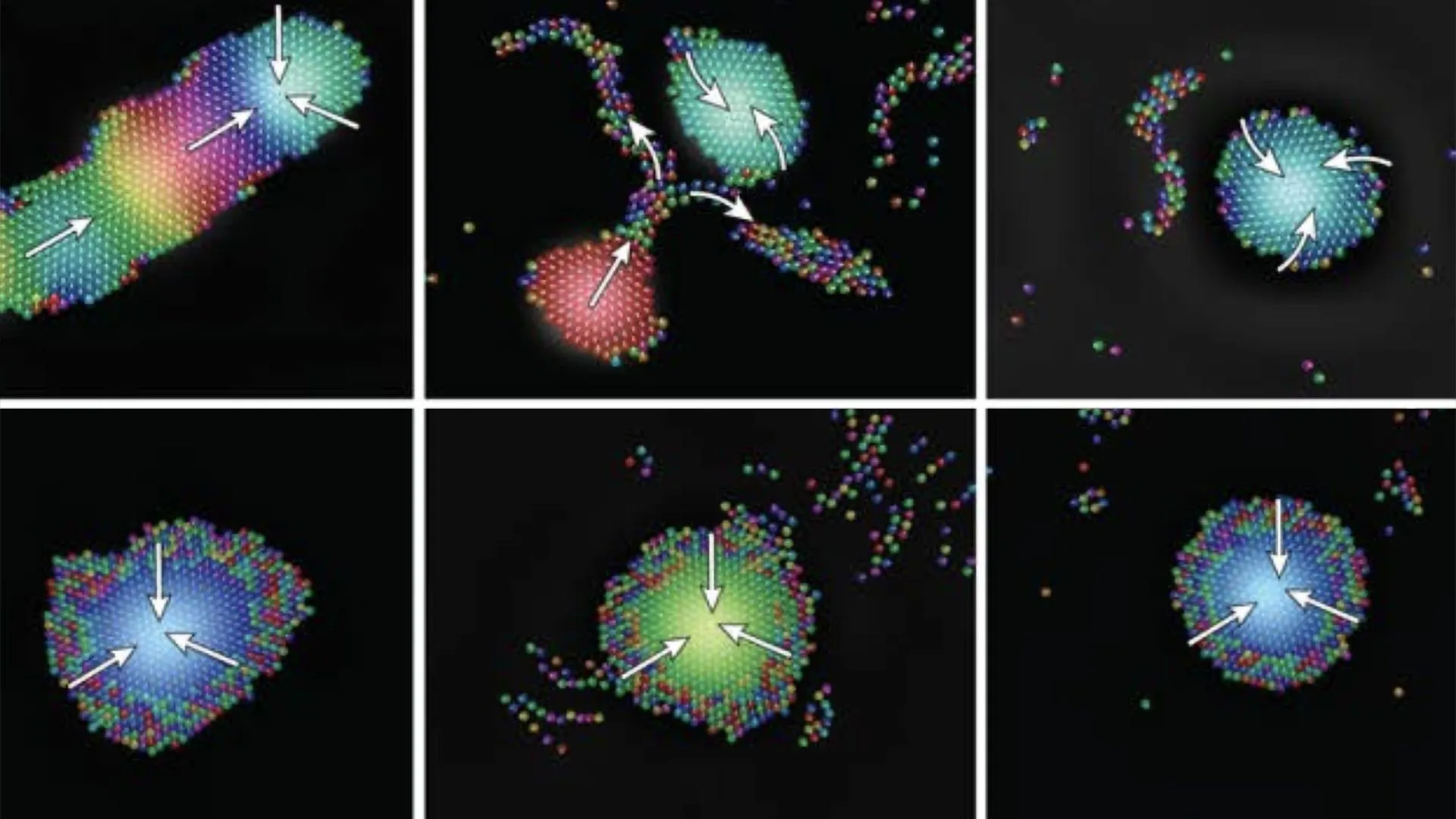
Animals like bats, whales and insects have long used acoustic signals for communication and navigation. Now, an international team of scientists have taken a page from nature's playbook to model micro-sized robots that use sound waves to coordinate into large swarms that exhibit intelligent-like behavior.
The robot groups could one day carry out complex tasks like exploring disaster zones, cleaning up pollution, or performing medical treatments from inside the body, according to team lead Igor Aronson, Huck Chair Professor of Biomedical Engineering, Chemistry, and Mathematics at Penn State."Picture swarms of bees or midges," Aronson said.
"They move, that creates sound, and the sound keeps them cohesive, many individuals acting as one."The researchers published their work on August 12 in the journal Physical Review X.Since the miniature, sound-broadcasting swarms of micromachines are self-organizing, they can navigate tight spaces and even re-form themselves if deformed.
The swarms' collective -- or emergent -- intelligence could one day be harnessed to carry out tasks like cleaning up pollution in contaminated environments, Aronson explained.Beyond the environment, the robot swarms could potentially work inside the body, delivering drugs directly to a problem area, for example.
Their collective sensing also helps in detecting changes in surroundings, and their ability to "self-heal" means they can keep functioning as a collective unit even after breaking apart, which could be especially useful for threat detection and sensor applications, Aronson said."This represents a significant leap toward creating smarter, more resilient and, ultimately, more useful microrobots with minimal complexity that could tackle some of our world's toughest problems," he said.
"The insights from this research are crucial for designing the next generation of microrobots, capable of performing complex tasks and responding to external cues in challenging environments."For the study, the team developed a computer model to track the movements of tiny robots, each equipped with an acoustic emitter and a detector.
They found that acoustic communication allowed the individual robotic agents to work together seamlessly, adapting their shape and behavior to their environment, much like a school of fish or a flock of birds.While the robots in the paper were computational agents within a theoretical -- or agent-based -- model, rather than physical devices that were manufactured, the simulations observed the emergence of collective intelligence that would likely appear in any experimental study with the same design, Aronson said."
We never expected our models to show such a high level of cohesion and intelligence from such simple robots," Aronson said. "These are very simple electronic circuits. Each robot can move along in some direction, has a motor, a tiny microphone, speaker and an oscillator. That's it, but nonetheless it's capable of collective intelligence.
It synchronizes its own oscillator to the frequency of the swarm's acoustic field and migrates toward the strongest signal."The discovery marks a new milestone for a budding field called active matter, the study of the collective behavior of self-propelled microscopic biological and synthetic agents, from swarms of bacteria or living cells to microrobots.
It shows for the first time that sound waves can function as a means of controlling the micro-sized robots, Aronson explained. Up until now, active matter particles have been controlled predominantly through chemical signaling."Acoustic waves work much better for communication than chemical signaling," Aronson said.
"Sound waves propagate faster and farther almost without loss of energy -- and the design is much simpler. The robots effectively 'hear' and 'find' each other, leading to collective self-organization. Each element is very simple. The collective intelligence and functionality arise from minimal ingredients and simple acoustic communication."
The other authors on the paper are Alexander Ziepke, Ivan Maryshev and Erwin Frey of the Ludwig Maximilian University of Munich. The John Templeton Foundation funded the research.
Source coverage
Report Provider: ScienceDaily
Publication Date: August 13, 2025
Deeper analysis
Full source content
Animals like bats, whales and insects have long used acoustic signals for communication and navigation. Now, an international team of scientists have taken a page from nature's playbook to model micro-sized robots that use sound waves to coordinate into large swarms that exhibit intelligent-like behavior.
The robot groups could one day carry out complex tasks like exploring disaster zones, cleaning up pollution, or performing medical treatments from inside the body, according to team lead Igor Aronson, Huck Chair Professor of Biomedical Engineering, Chemistry, and Mathematics at Penn State."Picture swarms of bees or midges," Aronson said.
"They move, that creates sound, and the sound keeps them cohesive, many individuals acting as one."The researchers published their work on August 12 in the journal Physical Review X.Since the miniature, sound-broadcasting swarms of micromachines are self-organizing, they can navigate tight spaces and even re-form themselves if deformed.
The swarms' collective -- or emergent -- intelligence could one day be harnessed to carry out tasks like cleaning up pollution in contaminated environments, Aronson explained.Beyond the environment, the robot swarms could potentially work inside the body, delivering drugs directly to a problem area, for example.
Their collective sensing also helps in detecting changes in surroundings, and their ability to "self-heal" means they can keep functioning as a collective unit even after breaking apart, which could be especially useful for threat detection and sensor applications, Aronson said."This represents a significant leap toward creating smarter, more resilient and, ultimately, more useful microrobots with minimal complexity that could tackle some of our world's toughest problems," he said.
"The insights from this research are crucial for designing the next generation of microrobots, capable of performing complex tasks and responding to external cues in challenging environments."For the study, the team developed a computer model to track the movements of tiny robots, each equipped with an acoustic emitter and a detector.
They found that acoustic communication allowed the individual robotic agents to work together seamlessly, adapting their shape and behavior to their environment, much like a school of fish or a flock of birds.While the robots in the paper were computational agents within a theoretical -- or agent-based -- model, rather than physical devices that were manufactured, the simulations observed the emergence of collective intelligence that would likely appear in any experimental study with the same design, Aronson said."
We never expected our models to show such a high level of cohesion and intelligence from such simple robots," Aronson said. "These are very simple electronic circuits. Each robot can move along in some direction, has a motor, a tiny microphone, speaker and an oscillator. That's it, but nonetheless it's capable of collective intelligence.
It synchronizes its own oscillator to the frequency of the swarm's acoustic field and migrates toward the strongest signal."The discovery marks a new milestone for a budding field called active matter, the study of the collective behavior of self-propelled microscopic biological and synthetic agents, from swarms of bacteria or living cells to microrobots.
It shows for the first time that sound waves can function as a means of controlling the micro-sized robots, Aronson explained. Up until now, active matter particles have been controlled predominantly through chemical signaling."Acoustic waves work much better for communication than chemical signaling," Aronson said.
"Sound waves propagate faster and farther almost without loss of energy -- and the design is much simpler. The robots effectively 'hear' and 'find' each other, leading to collective self-organization. Each element is very simple. The collective intelligence and functionality arise from minimal ingredients and simple acoustic communication."
The other authors on the paper are Alexander Ziepke, Ivan Maryshev and Erwin Frey of the Ludwig Maximilian University of Munich. The John Templeton Foundation funded the research.
How this page is built
Goose Pod turns cited reporting into a public episode summary first, then pairs that summary with audio playback so listeners can check the source material before they decide how deeply to engage.
The goal is to make this page useful as a news landing page first, while still giving listeners transcript access, related episodes, and direct links back to the original publishers.