
What happened
Report Provider: Space.com (Article originally published at The Conversation)
Author: Andrej Prša (Professor of Astrophysics and Planetary Science at Villanova University)
Publication Date: August 4, 2025, 15:00:00
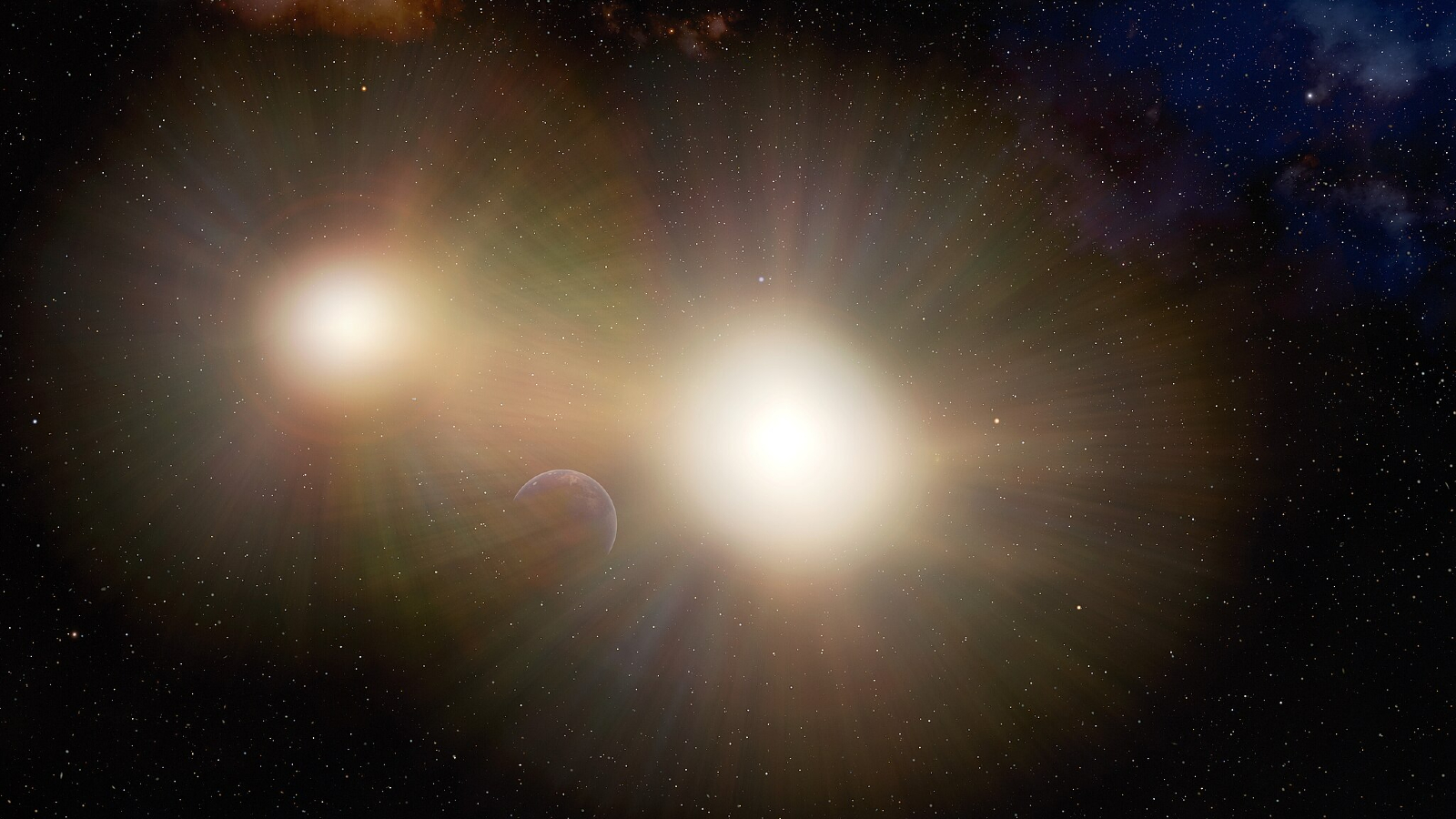
A binary star system has two stars revolving around one center of mass.(Image credit: International Gemini Observatory/NOIRLab/NSF/AURA/J. da Silva (Spaceengine))This article was originally published at The Conversation. The publication contributed the article to Space.com's Expert Voices: Op-Ed & Insights.
Stars are the fundamental building blocks of our universe. Most stars host planets, like our Sun hosts our solar system, and if you look more broadly, groups of stars make up huge structures such as clusters and galaxies. So before astrophysicists can attempt to understand these large-scale structures, we first need to understand basic properties of stars, such as their mass, radius and temperature.
But measuring these basic properties has proved exceedingly difficult. This is because stars are quite literally at astronomical distances. If our Sun were a basketball on the East Coast of the U.S., then the closest star, Proxima, would be an orange in Hawaii. Even the world’s largest telescopes cannot resolve an orange in Hawaii.
Measuring radii and masses of stars appears to be out of scientists’ reach.Enter binary stars. Binaries are systems of two stars revolving around a mutual center of mass. Their motion is governed by Kepler’s harmonic law, which connects three important quantities: the sizes of each orbit, the time it takes for them to orbit, called the orbital period, and the total mass of the system.
I’m an astronomer, and my research team has been working on advancing our theoretical understanding and modeling approaches to binary stars and multiple stellar systems. For the past two decades we’ve also been pioneering the use of artificial intelligence in interpreting observations of these cornerstone celestial objects.
Measuring stellar massesAstronomers can measure orbital size and period of a binary system easily enough from observations, so with those two pieces they can calculate the total mass of the system. Kepler’s harmonic law acts as a scale to weigh celestial bodies.Think of a playground seesaw. If the two kids weigh about the same, they’ll have to sit at about the same distance from the midpoint.
If, however, one child is bigger, he or she will have to sit closer, and the smaller kid farther from the midpoint.Breaking space news, the latest updates on rocket launches, skywatching events and more!It’s the same with stars: The more massive the star in a binary pair, the closer to the center it is and the slower it revolves about the center.
When astronomers measure the speeds at which the stars move, they can also tell how large the stars’ orbits are, and as a result, what they must weigh.A close binary star system happens when several planets orbit the brighter star out of the pair. (Image credit: Robin Dienel, courtesy of the Carnegie Institution for Science)Measuring stellar radiiKepler’s harmonic law, unfortunately, tells astronomers nothing about the radii of stars.
For those, astronomers rely on another serendipitous feature of Mother Nature.Binary star orbits are oriented randomly. Sometimes, it happens that a telescope’s line of sight aligns with the plane a binary star system orbits on. This fortuitous alignment means the stars eclipse one another as they revolve about the center.
The shapes of these eclipses allow astronomers to find out the stars’ radii using straightforward geometry. These systems are called eclipsing binary stars.More than half of all Sun-like stars are found in binaries, and eclipsing binaries account for about 1% to 2% of all stars. That may sound low, but the universe is vast, so there are lots and lots of eclipsing systems out there – hundreds of millions in our galaxy alone.
By observing eclipsing binaries, astronomers can measure not only the masses and radii of stars but also how hot and how bright they are.An illustration showing a binary star pair in the Auriga constellation. The two stars are roughly the same mass and diameter and around every 47 hours one of the stars partially eclipses the other as seen from Earth.
(Image credit: Pablo Carlos Budassi)Complex problems require complex computingEven with eclipsing binaries, measuring the properties of stars is no easy task. Stars are deformed as they rotate and pull on each other in a binary system. They interact, they irradiate one another, they can have spots and magnetic fields, and they can be tilted this way or that.
To study them, astronomers use complex models that have many knobs and switches. As an input, the models take parameters – for example, a star’s shape and size, its orbital properties, or how much light it emits – to predict how an observer would see such an eclipsing binary system.Computer models take time.
Computing model predictions typically takes a few minutes. To be sure that we can trust them, we need to try lots of parameter combinations – typically tens of millions.This many combinations requires hundreds of millions of minutes of compute time, just to determine basic properties of stars. That amounts to over 200 years of computer time.
Computers linked in a cluster can compute faster, but even using a computer cluster, it takes three or more weeks to “solve,” or determine all the parameters for, a single binary. This challenge explains why there are only about 300 stars for which astronomers have accurate measurements of their fundamental parameters.
The models used to solve these systems have already been heavily optimized and can’t go much faster than they already do. So, researchers need an entirely new approach to reducing computing time.Using deep learningOne solution my research team has explored involves deep-learning neural networks. The basic idea is simple: We wanted to replace a computationally expensive physical model with a much faster AI-based model.
First, we computed a huge database of predictions about a hypothetical binary star – using the features that astronomers can readily observe – where we varied the hypothetical binary star’s properties. We are talking hundreds of millions of parameter combinations. Then, we compared these results to the actual observations to see which ones best match up.
AI and neural networks are ideally suited for this task.In a nutshell, neural networks are mappings. They map a certain known input to a given output. In our case, they map the properties of eclipsing binaries to the expected predictions. Neural networks emulate the model of a binary but without having to account for all the complexity of the physical model.
We train the neural network by showing it each prediction from our database, along with the set of properties used to generate it. Once fully trained, the neural network will be able to accurately predict what astronomers should observe from the given properties of a binary system.Compared to a few minutes of runtime for the physical model, a neural network uses artificial intelligence to get the same result within a tiny fraction of a second.
Two stars revolve around each other in a binary system. (Image credit: NASA/ESA Hubble Space Telescope WFPC2)Reaping the benefitsA tiny fraction of a second works out to about a millionfold runtime reduction. This brings the time down from weeks on a supercomputer to mere minutes on a single laptop.
It also means that we can analyze hundreds of thousands of binary systems in a couple of weeks on a computer cluster.This reduction means we can obtain fundamental properties – stellar masses, radii, temperatures and luminosities – for every eclipsing binary star ever observed within a month or two.
The big challenge remaining is to show that AI results really give the same results as the physical model.This task is the crux of my team’s new paper. In it we’ve shown that, indeed, the AI-driven model yields the same results as the physical model across over 99% of parameter combinations. This result means the AI’s performance is robust.
Our next step? Deploy the AI on all observed eclipsing binaries.Best of all? While we applied this methodology to binaries, the basic principle applies to any complex physical model out there. Similar AI models are already speeding up many real-world applications, from weather forecasting to stock market analysis.
This article is republished from The Conversation under a Creative Commons license. Read the original article.Join our Space Forums to keep talking space on the latest missions, night sky and more! And if you have a news tip, correction or comment, let us know at: [email protected] Prša is a professor of Astrophysics and Planetary Science at Villanova University
Source coverage
Report Provider: Space.com (Article originally published at The Conversation)
Author: Andrej Prša (Professor of Astrophysics and Planetary Science at Villanova University)
Deeper analysis
Full source content
A binary star system has two stars revolving around one center of mass.(Image credit: International Gemini Observatory/NOIRLab/NSF/AURA/J. da Silva (Spaceengine))This article was originally published at The Conversation. The publication contributed the article to Space.com's Expert Voices: Op-Ed & Insights.
Stars are the fundamental building blocks of our universe. Most stars host planets, like our Sun hosts our solar system, and if you look more broadly, groups of stars make up huge structures such as clusters and galaxies. So before astrophysicists can attempt to understand these large-scale structures, we first need to understand basic properties of stars, such as their mass, radius and temperature.
But measuring these basic properties has proved exceedingly difficult. This is because stars are quite literally at astronomical distances. If our Sun were a basketball on the East Coast of the U.S., then the closest star, Proxima, would be an orange in Hawaii. Even the world’s largest telescopes cannot resolve an orange in Hawaii.
Measuring radii and masses of stars appears to be out of scientists’ reach.Enter binary stars. Binaries are systems of two stars revolving around a mutual center of mass. Their motion is governed by Kepler’s harmonic law, which connects three important quantities: the sizes of each orbit, the time it takes for them to orbit, called the orbital period, and the total mass of the system.
I’m an astronomer, and my research team has been working on advancing our theoretical understanding and modeling approaches to binary stars and multiple stellar systems. For the past two decades we’ve also been pioneering the use of artificial intelligence in interpreting observations of these cornerstone celestial objects.
Measuring stellar massesAstronomers can measure orbital size and period of a binary system easily enough from observations, so with those two pieces they can calculate the total mass of the system. Kepler’s harmonic law acts as a scale to weigh celestial bodies.Think of a playground seesaw. If the two kids weigh about the same, they’ll have to sit at about the same distance from the midpoint.
If, however, one child is bigger, he or she will have to sit closer, and the smaller kid farther from the midpoint.Breaking space news, the latest updates on rocket launches, skywatching events and more!It’s the same with stars: The more massive the star in a binary pair, the closer to the center it is and the slower it revolves about the center.
When astronomers measure the speeds at which the stars move, they can also tell how large the stars’ orbits are, and as a result, what they must weigh.A close binary star system happens when several planets orbit the brighter star out of the pair. (Image credit: Robin Dienel, courtesy of the Carnegie Institution for Science)Measuring stellar radiiKepler’s harmonic law, unfortunately, tells astronomers nothing about the radii of stars.
For those, astronomers rely on another serendipitous feature of Mother Nature.Binary star orbits are oriented randomly. Sometimes, it happens that a telescope’s line of sight aligns with the plane a binary star system orbits on. This fortuitous alignment means the stars eclipse one another as they revolve about the center.
The shapes of these eclipses allow astronomers to find out the stars’ radii using straightforward geometry. These systems are called eclipsing binary stars.More than half of all Sun-like stars are found in binaries, and eclipsing binaries account for about 1% to 2% of all stars. That may sound low, but the universe is vast, so there are lots and lots of eclipsing systems out there – hundreds of millions in our galaxy alone.
By observing eclipsing binaries, astronomers can measure not only the masses and radii of stars but also how hot and how bright they are.An illustration showing a binary star pair in the Auriga constellation. The two stars are roughly the same mass and diameter and around every 47 hours one of the stars partially eclipses the other as seen from Earth.
(Image credit: Pablo Carlos Budassi)Complex problems require complex computingEven with eclipsing binaries, measuring the properties of stars is no easy task. Stars are deformed as they rotate and pull on each other in a binary system. They interact, they irradiate one another, they can have spots and magnetic fields, and they can be tilted this way or that.
To study them, astronomers use complex models that have many knobs and switches. As an input, the models take parameters – for example, a star’s shape and size, its orbital properties, or how much light it emits – to predict how an observer would see such an eclipsing binary system.Computer models take time.
Computing model predictions typically takes a few minutes. To be sure that we can trust them, we need to try lots of parameter combinations – typically tens of millions.This many combinations requires hundreds of millions of minutes of compute time, just to determine basic properties of stars. That amounts to over 200 years of computer time.
Computers linked in a cluster can compute faster, but even using a computer cluster, it takes three or more weeks to “solve,” or determine all the parameters for, a single binary. This challenge explains why there are only about 300 stars for which astronomers have accurate measurements of their fundamental parameters.
The models used to solve these systems have already been heavily optimized and can’t go much faster than they already do. So, researchers need an entirely new approach to reducing computing time.Using deep learningOne solution my research team has explored involves deep-learning neural networks. The basic idea is simple: We wanted to replace a computationally expensive physical model with a much faster AI-based model.
First, we computed a huge database of predictions about a hypothetical binary star – using the features that astronomers can readily observe – where we varied the hypothetical binary star’s properties. We are talking hundreds of millions of parameter combinations. Then, we compared these results to the actual observations to see which ones best match up.
AI and neural networks are ideally suited for this task.In a nutshell, neural networks are mappings. They map a certain known input to a given output. In our case, they map the properties of eclipsing binaries to the expected predictions. Neural networks emulate the model of a binary but without having to account for all the complexity of the physical model.
We train the neural network by showing it each prediction from our database, along with the set of properties used to generate it. Once fully trained, the neural network will be able to accurately predict what astronomers should observe from the given properties of a binary system.Compared to a few minutes of runtime for the physical model, a neural network uses artificial intelligence to get the same result within a tiny fraction of a second.
Two stars revolve around each other in a binary system. (Image credit: NASA/ESA Hubble Space Telescope WFPC2)Reaping the benefitsA tiny fraction of a second works out to about a millionfold runtime reduction. This brings the time down from weeks on a supercomputer to mere minutes on a single laptop.
It also means that we can analyze hundreds of thousands of binary systems in a couple of weeks on a computer cluster.This reduction means we can obtain fundamental properties – stellar masses, radii, temperatures and luminosities – for every eclipsing binary star ever observed within a month or two.
The big challenge remaining is to show that AI results really give the same results as the physical model.This task is the crux of my team’s new paper. In it we’ve shown that, indeed, the AI-driven model yields the same results as the physical model across over 99% of parameter combinations. This result means the AI’s performance is robust.
Our next step? Deploy the AI on all observed eclipsing binaries.Best of all? While we applied this methodology to binaries, the basic principle applies to any complex physical model out there. Similar AI models are already speeding up many real-world applications, from weather forecasting to stock market analysis.
This article is republished from The Conversation under a Creative Commons license. Read the original article.Join our Space Forums to keep talking space on the latest missions, night sky and more! And if you have a news tip, correction or comment, let us know at: [email protected] Prša is a professor of Astrophysics and Planetary Science at Villanova University
How this page is built
Goose Pod turns cited reporting into a public episode summary first, then pairs that summary with audio playback so listeners can check the source material before they decide how deeply to engage.
The goal is to make this page useful as a news landing page first, while still giving listeners transcript access, related episodes, and direct links back to the original publishers.