
What happened
Author: Andy Tomaswick
This article discusses the ongoing race among astrobiologists to detect evidence of extant life on Mars before potential human colonization contaminates the planet. A new paper by Christopher Temby and Jan Spacek of the Agnostic Life Finder (ALF) team proposes a method to definitively prove the existence of Martian...
Key Findings and Conclusions:
Mars still holds the promise of being one of the first places in the solar system humanity will colonize. However, if there was evolutionarily distinct, extant life on the planet, it might sway the heart of even the most ardent Mars colonization fans. So astrobiologists are in a race against time to try to determine whether or not such life exists, before the entire planet becomes an analogue of the Earth’s biosphere, if only unintentionally, and only a shadow of the ones that exists here.
A new paper from the Christopher Temby and Jan Spacek of the Agnostic Life Finder (ALF) team discusses one of the most promising ways to prove definitively that life exists on the Red Planet - finding polyelectrolyte polymers - in other words, DNA.DNA isn’t the only type of polyelectrolyte polymer in our own biosphere - RNA is another example.
But the reason that finding a polyelectrolyte is so important is because of their ability to convey information between generations. Mars could have an entirely separate way of passing down genetic information from anything we know of on Earth, but it would still likely look at least something like a polyelectrolyte polymer.
In a landmark paper in 2018, NASA staff laid out what is now known as the “Ladder of Life Detection”, where polyelectrolytes are discussed as a possible biosignature. However, there are also a few weaknesses the molecules exhibit that have to be overcome by any instrument planning to find them.ALF Presentation of its device at a NIAC conference.
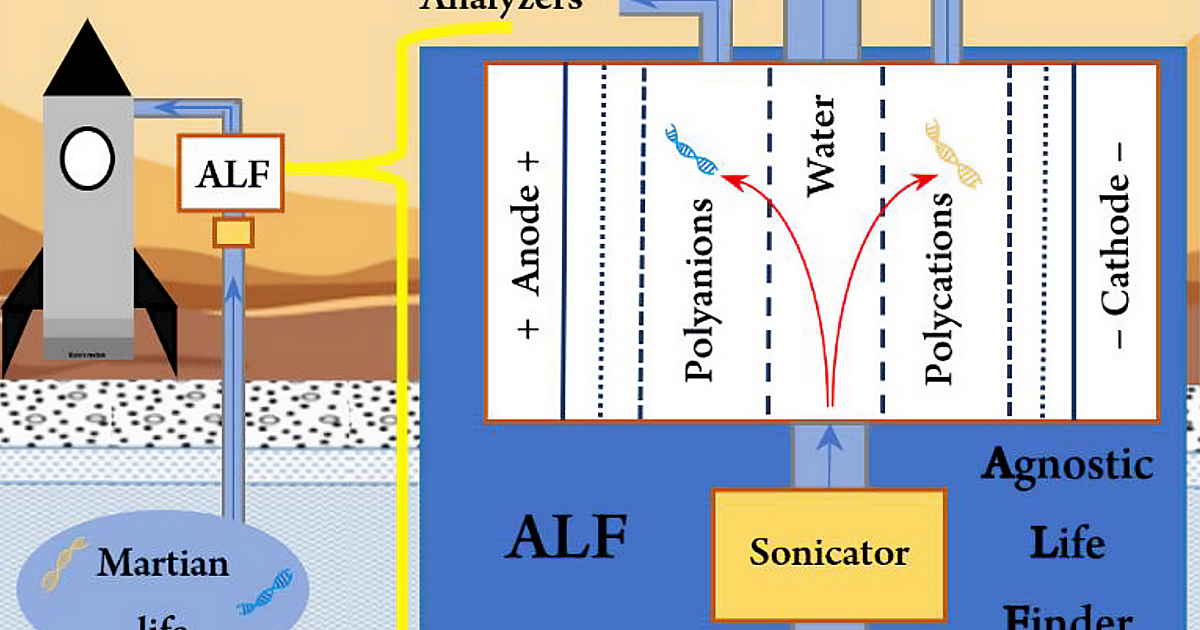
Credit - ALFA Mars YouTube ChannelThe first problem is that the polyelectrolytes could be so dilute that they wouldn’t reach the detection threshold of the instrument designed to find them, especially if the total amount of biomass is miniscule compared to that found on Earth. This problem is easily solved by concentrating the polyelectrodes using electrodialysis and a set of porous membranes.
In this system, first the sample is combined with water, and then that water is subjected to an electric field. Since polyelectrolytes are charged particles, they move in an electric field, as do natural salts such as potassium and magnesium (which is what typical dialysis is attempting to do for patients on Earth).
However, polyelectrolytes are physically much larger than the salt ions, so the ALF system has a series of nano-pore based filters that would allow the salts to keep moving farther, while holding the polyelectrolytes in a specific chamber. Subjecting a sample to the electric field for long enough would migrate all of the polyelectrolytes to one specific area on one side of the nanofilter, and allow a much high concentration that should be able to pass the detection threshold of the instrument, if enough of the molecules are actually in the sample.
The second problem mentioned by the Ladder of Life Detection paper is actually a strength according to the ALF researchers. Polyelectrodes don’t survive long when subjected to water - in the paper’s language “its survivability in liquid water is limited by hydrolysis”. Rather than seeing that as a problem that must be overcome, the ALF team thinks that simply means that if polyelectrodes are unequivocally detected there must be some extant life creating them, since older samples from life long ago would have been destroyed by the time the sampler came along.
Fraser tells the story of the search for life on Mars.As humanity continues to move towards Mars colonization, the window for finding and analyzing unique Martian life is continuing to close. We previously discussed how exactly the ALF would be implemented, and this sub-section of the instrument seems promising in finding this one particular sign of life.
But as with the instrument as a whole, it’s unclear whether budget cuts from NASA, which funded the original development of the ALF through a NIAC grant, will allow continuing support of the system or not. If it does, data on Martian DNA, or its equivalent, may someday be at scientists’ fingertips - hopefully before it's contaminated by any from Earth.
Learn More:C. Temby & J. Spacek - 21st-Century Astrobiology Missions Should Seek These High-Confidence Biosignatures in Mid-Latitude Martian IceM. Neveu et al. - The Ladder of Life DetectionUT - Mars Life Explorer Should Include An Agnostic Life FinderUT - Searching for Life on Mars in the Snow and Ice
Source coverage
Author: Andy Tomaswick
This article discusses the ongoing race among astrobiologists to detect evidence of extant life on Mars before potential human colonization contaminates the planet. A new paper by Christopher Temby and Jan Spacek of the Agnostic Life Finder (ALF) team proposes a method to definitively prove the existence of Martian...
Deeper analysis
Full source content
Mars still holds the promise of being one of the first places in the solar system humanity will colonize. However, if there was evolutionarily distinct, extant life on the planet, it might sway the heart of even the most ardent Mars colonization fans. So astrobiologists are in a race against time to try to determine whether or not such life exists, before the entire planet becomes an analogue of the Earth’s biosphere, if only unintentionally, and only a shadow of the ones that exists here.
A new paper from the Christopher Temby and Jan Spacek of the Agnostic Life Finder (ALF) team discusses one of the most promising ways to prove definitively that life exists on the Red Planet - finding polyelectrolyte polymers - in other words, DNA.DNA isn’t the only type of polyelectrolyte polymer in our own biosphere - RNA is another example.
But the reason that finding a polyelectrolyte is so important is because of their ability to convey information between generations. Mars could have an entirely separate way of passing down genetic information from anything we know of on Earth, but it would still likely look at least something like a polyelectrolyte polymer.
In a landmark paper in 2018, NASA staff laid out what is now known as the “Ladder of Life Detection”, where polyelectrolytes are discussed as a possible biosignature. However, there are also a few weaknesses the molecules exhibit that have to be overcome by any instrument planning to find them.ALF Presentation of its device at a NIAC conference.
Credit - ALFA Mars YouTube ChannelThe first problem is that the polyelectrolytes could be so dilute that they wouldn’t reach the detection threshold of the instrument designed to find them, especially if the total amount of biomass is miniscule compared to that found on Earth. This problem is easily solved by concentrating the polyelectrodes using electrodialysis and a set of porous membranes.
In this system, first the sample is combined with water, and then that water is subjected to an electric field. Since polyelectrolytes are charged particles, they move in an electric field, as do natural salts such as potassium and magnesium (which is what typical dialysis is attempting to do for patients on Earth).
However, polyelectrolytes are physically much larger than the salt ions, so the ALF system has a series of nano-pore based filters that would allow the salts to keep moving farther, while holding the polyelectrolytes in a specific chamber. Subjecting a sample to the electric field for long enough would migrate all of the polyelectrolytes to one specific area on one side of the nanofilter, and allow a much high concentration that should be able to pass the detection threshold of the instrument, if enough of the molecules are actually in the sample.
The second problem mentioned by the Ladder of Life Detection paper is actually a strength according to the ALF researchers. Polyelectrodes don’t survive long when subjected to water - in the paper’s language “its survivability in liquid water is limited by hydrolysis”. Rather than seeing that as a problem that must be overcome, the ALF team thinks that simply means that if polyelectrodes are unequivocally detected there must be some extant life creating them, since older samples from life long ago would have been destroyed by the time the sampler came along.
Fraser tells the story of the search for life on Mars.As humanity continues to move towards Mars colonization, the window for finding and analyzing unique Martian life is continuing to close. We previously discussed how exactly the ALF would be implemented, and this sub-section of the instrument seems promising in finding this one particular sign of life.
But as with the instrument as a whole, it’s unclear whether budget cuts from NASA, which funded the original development of the ALF through a NIAC grant, will allow continuing support of the system or not. If it does, data on Martian DNA, or its equivalent, may someday be at scientists’ fingertips - hopefully before it's contaminated by any from Earth.
Learn More:C. Temby & J. Spacek - 21st-Century Astrobiology Missions Should Seek These High-Confidence Biosignatures in Mid-Latitude Martian IceM. Neveu et al. - The Ladder of Life DetectionUT - Mars Life Explorer Should Include An Agnostic Life FinderUT - Searching for Life on Mars in the Snow and Ice
How this page is built
Goose Pod turns cited reporting into a public episode summary first, then pairs that summary with audio playback so listeners can check the source material before they decide how deeply to engage.
The goal is to make this page useful as a news landing page first, while still giving listeners transcript access, related episodes, and direct links back to the original publishers.